 Safekipedia
Developing country
Adapted from Wikipedia · Adventurer experience
A developing country is a country with a smaller industrial base and a lower Human Development Index (HDI) than richer countries. But people do not all agree on which countries are developing.
The World Bank groups countries by how much money people earn, called gross national income per capita. Some smaller places are called least developed countries, landlocked developing countries, or small island developing states.
Developing countries often have problems. They may not have enough clean drinking water, sanitation, or hygiene. Many people live with more air pollution and water pollution. There can also be less good infrastructure.
People in developing countries may have a harder time finding jobs, getting enough food, or escaping poverty. Healthcare can be hard to get, which can make life expectancies shorter. Climate change may also affect these places more.
Development aid is help from other countries and groups to make life better. The United Nations made the Sustainable Development Goals for 2030 to help solve many of these issues.
Terms used to classify countries
Countries can be grouped in different ways based on how developed they are. The World Bank, for example, sorts countries into four groups using their income. These groups are high-income countries, upper-middle income countries, lower-middle income countries, and low-income countries. Countries that are not high-income are often called "low and middle income countries."
Countries can also be grouped by how their economies are growing or by their location. Some are called "newly industrialized countries" because their economies are growing quickly. Others might be small island nations or landlocked countries, which can face special challenges. Some countries even choose to call themselves "developing" even if they are quite wealthy, because this label gives them certain benefits in international trade.
Measure and concept of development
Development can be measured by how strong a country's economy or people are. Developing countries are places that haven’t built many factories or big businesses compared to their number of people. Many people there don’t have a very high standard of living.
The United Nations created the Human Development Index (HDI) to help compare how well countries are doing. It looks at things like how much money people make, how long people live, and how many adults can read and write. This helps see how well people are doing in each country.
Associated theories
The term "developing countries" is linked to several ideas that researchers have studied over time.
- Modernization theory explains how societies change and become more modern.
- Dependency theory suggests that resources move from poorer countries to wealthier ones.
- Development theory is a group of theories about the best ways to create positive change in societies.
- Postdevelopment theory argues that the idea of development shows the power that wealthier countries have over others.
Criticisms of the term
Further information: Development aid
Some people say the term "developing country" can be unfair. They think it might make these countries look worse than others. It also assumes every country wants to grow the same way as some Western countries, but that is not always true. For example, places like Cuba and Bhutan choose not to follow that path.
Experts say it is hard to decide which countries are "developing." Some think separating countries into "developed" and "developing" is old-fashioned. They note that many countries today are in the middle—not very rich and not very poor. These experts say all countries follow the same natural laws but each has its own special features.
Some groups now use the term less economically developed country to talk about the poorest nations. This shows that living conditions can be very different even among these countries. In 2015, the World Bank said the old way of separating countries into "developed" and "developing" was no longer useful. Since then, the World Bank no longer uses these labels in its reports. Instead, it groups data by regions and income levels.
Related terms
The term "low and middle-income country" (LMIC) is often used to mean "developing country," but it only talks about the money in those countries. Least developed countries, landlocked developing countries, and small island developing states are all types of developing countries. Countries that are richer are usually called high-income countries or developed countries.
In healthcare, phrases like "resource poor setting" or "low-resource setting" are used to describe healthcare in developing countries. These places often have poor healthcare buildings, not enough money, few trained workers, old healthcare tools, and problems with getting supplies when they are needed. They may also face challenges because of where they are located, the weather, or cultural differences that affect how people understand health information.
Global South
Main article: Global South
The term "Global South" started being used more around 2004. It can also talk about poorer areas in wealthy countries. The Global South talks about these countries' shared histories of colonialism, neo-imperialism, and different economic and social changes that keep big differences in how people live, how long they live, and access to things they need.
Common characteristics
Many developing countries became independent and started their own governments in the second half of the 20th century. Most of them were once ruled by European powers. Today, many have democratic governments, but they still face challenges.
After independence, many developing countries needed help to build their economies. They often got money and support from other countries. But sometimes, this help was unfair. Weaker countries' resources and workers were used by richer nations. International groups like the United Nations work to help these countries with poverty, health, and education, especially in Africa, Latin America, and the Caribbean.
Common challenges
Global issues often discussed by developing countries include globalization, global health, and health needs. This is different from issues developed nations address, such as science and technology innovations.
Most developing countries share these traits:
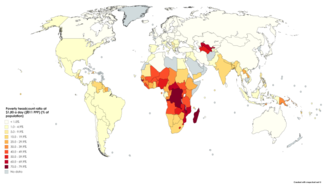
- High levels of poverty – measured by GNI per capita. If the GNI per capita is less than US$1,025, the country is a least developed country.
- Weak human resources (based on nutrition, health, education, and adult literacy).
- Economic weakness (based on unstable farming, unstable exports, and the impact of natural disasters). Developing countries also have a higher risk of money problems.
Urban slums
In 2012, about 33% of city people in developing countries, or about 863 million people, lived in slums. Slums form and grow for many reasons, such as people moving from farms to cities, economic stagnation, high unemployment, and poor planning.
In some cities, especially in Southern Asia and Sub-Saharan Africa, slums are home to many people. These are sometimes called "slum cities".
Healthcare and public health
Healthcare for everyone is different between developing countries and developed countries. People in developing countries usually have a lower life expectancy than people in developed countries. They also have less access to medical care and fewer resources for vaccines, even though vaccine equity is important to stop diseases like the COVID-19 pandemic.
Not enough food is more common in developing countries. Certain groups have even less food, including women, children under five, and older people. Not enough food can stop children from growing properly.
Water, sanitation, hygiene (WASH)
Access to water, sanitation, and hygiene (WASH) is very low in many developing countries. In 2015, the World Health Organization (WHO) said that 2.4 billion people did not have sanitation. Many of these people live in developing countries.
Sustainable Development Goal 6 calls for clean water and sanitation for all people. This is important for people in developing countries.
Energy
In 2009, 1.4 billion people lived without electricity. 2.7 billion used wood, charcoal, and dung for energy. Not having modern energy affects health and work.
Renewable energy can help developing countries. It can provide energy for work and homes. Kenya leads in solar power systems.
Climate change
The effects of climate change will happen everywhere and can cause extreme weather, droughts, floods, biodiversity loss, disease, and sea level rise. Developing countries are more at risk from these effects because of their weaker economies and limited resources.
Population growth
Over the last few decades, global population growth has been driven mostly by developing countries, which often have higher birth rates. The United Nations says that family planning can help slow population growth and reduce poverty.
Poor governance
Many developing countries have weak democracies or governments that are not free. After independence, leaders often had too much control.
Good democratic governments are hard to create when there is corruption and low trust in government. Political instability and political corruption are common problems.
Others
Other common challenges include: harmful chemicals in soil, air, and water, using too much energy, relying too much on natural resources, indebtedness, food insecurity, and unemployment. Many developing countries depend on selling natural resources to richer nations. When richer nations have economic problems, it can hurt their trading partners.
Opportunities
Developing countries can grow and improve by focusing on key areas. Helping people through education and health builds strong human capital. Fair trade policies help countries grow faster.
Support from other nations, called aid for trade, is important. This aid, part of the Sustainable Development Goal 8, helps countries improve trade, focus on opportunities, and reduce poverty. A global partnership, as outlined in Sustainable Development Goal 17, encourages investment and support. This partnership helps developing countries access new technologies and fair trade practices.
Country lists
Emerging and developing economies according to the International Monetary Fund
The following are considered emerging and developing economies according to the International Monetary Fund's World Economic Outlook Database, April 2023[update].
Countries not listed by IMF
High income countries by World Bank (developing only)
Upper middle income countries by World Bank
Lower middle income countries by World Bank
Low income countries by World Bank
Countries and regions that are graduated developed economies
In 1979, the International Monetary Fund changed its list of "industrial countries" to add some "more developed primary producing countries": Australia, Finland, Iceland, New Zealand, the Republic of Ireland and Spain. Before this, the list included only the G7 economies (Canada, France, Italy, Japan, the United Kingdom, the United States and West Germany) and some other European nations like Austria, Belgium, Denmark, Luxembourg, the Netherlands, Norway, Sweden and Switzerland. Later, Greece and Portugal became industrial countries, and the group was renamed "advanced economies" when the Four Asian Tigers and Israel joined in 1997. This list includes countries and regions that were once developing but are now considered advanced economies by the IMF.
Five economies do not have data about their development status before being listed as advanced economies:
Newly industrialized countries
Ten countries are called "newly industrialized country". These are countries whose economies are stronger than other developing countries but are not yet developed countries:
BRICS countries
Ten countries are part of the "emerging markets" and together form the BRICS organisation:
Society and culture
Media coverage
Western media often shows a simple view of developing countries. Many news reports talk mostly about poverty and other problems. This can make it seem like developing countries, sometimes called the "Global South," are behind compared to Western nations, called the "Global North."
Media also affects what people in developing countries learn. News often shows events in developed countries, so people in developing countries know less about others like them. This makes the flow of information uneven.
Images
Related articles


This article is a child-friendly adaptation of the Wikipedia article on Developing country, available under CC BY-SA 4.0.
Images from Wikimedia Commons. Tap any image to view credits and license.