Switzerland
Switzerland, officially the Swiss Confederation, is a landlocked country in the middle of Europe. It is where Central, Western, and Southern Europe meet. It shares borders with Germany to the north, France to the west, Austria and Liechtenstein to the east, and Italy to the south. The country has three main regions: the Swiss Alps, which cover most of the land, the Swiss Plateau, and the Jura Mountains. Most of its 9 million people live on the plateau. Many of the largest cities and business centres are there, including Zurich, Geneva, Basel, Bern, Lausanne, Winterthur, and Lucerne. (Other meanings of these names can be found on Switzerland (disambiguation) and Swiss Confederation (disambiguation).)
Switzerland is a federal republic made up of 26 cantons. Bern is the federal city and the home of the national government. The country has four main language and culture regions: German, French, Italian, and Romansh. Switzerland has a long tradition of speaking several languages and welcoming many cultures. Even so, Swiss people share a strong national identity. It is based on a shared history, values such as federalism and direct democracy, and Alpine symbols. Swiss nationhood is about more than language, ethnicity, or religion. For this reason, Switzerland is often called a Willensnation ("nation of volition") rather than a typical nation state.
The country began as the Old Swiss Confederacy. It was formed in the Late Middle Ages as a defensive and commercial alliance. The Federal Charter of 1291 is seen as its founding document. The confederation grew stronger, even though it faced outside threats and political and religious strife at home. In 1648, the Peace of Westphalia officially recognized Swiss independence from the Holy Roman Empire. The confederation was one of the first and few republics of the early modern period. It was also the only one, besides San Marino, to survive the Napoleonic Wars. In 1798, revolutionary France took over the country and imposed a centralist government called the Helvetic Republic. Napoleon ended this republic in 1803 and reinstated a confederation. After the Napoleonic Wars, Switzerland restored its pre-revolutionary system. However, by 1830, the country was growing divided and conflict between liberal and conservative groups. This led to a new constitution in 1848. It created the current federal system and protected ideas such as individual rights, sharing of power, and a two-part parliament.
Switzerland has followed a policy of armed neutrality since the 16th century. It has not fought in an international war since 1815. It joined the Council of Europe in 1964 and the United Nations (UN) in 2002. Switzerland is active in world affairs and often takes part in peace building and global governance. It is the birthplace of the Red Cross. It also hosts the headquarters or offices of many major international institutions, including the WTO, the WHO, the ILO, FIFA, the WEF, and the UN. Switzerland is a founding member of the European Free Trade Association (EFTA). It also takes part in the European single market and the Schengen Area. Switzerland is among the world's most developed countries. It has the highest nominal wealth per adult and the eighth-highest gross domestic product (GDP) per capita. It performs highly on several international measures, including economic competitiveness, democratic governance, and press freedom. Zurich, Geneva, and Basel rank among the highest for quality of life, although they also have some of the highest costs of living. The country is known for its long banking and financial sector, its advanced pharmaceutical and biotechnology industries, and its strong tradition of watchmaking, precision engineering, and technology. It is also famous for its chocolate and cheese production, its well-developed tourism industry, and its growing startup sector.
Main article: Name of Switzerland
The English name Switzerland combines Switzer, an old word for a Swiss person used from the 1500s to the 1800s, with the English ending -land, which means a region or country. The English word Swiss comes from the French Suisse. Switzer comes from the Alemannic Schwiizer, which first meant someone from Schwyz and its associated territory. Schwyz was one of the Waldstätte cantons that formed the core of the Old Swiss Confederacy. After the Swabian War of 1499, the Swiss began using this name for themselves, alongside Eidgenossen, meaning "comrades by oath," which had been used since the 1300s. The country codes CH and CHE come from the Latin Confoederatio Helvetica (Helvetic Confederation). The name Schwyz was first written down in 972 as Old High German Suittes. It may be related to a word meaning "to burn," because the land was cleared by burning forest. Later, the name spread to the whole country, which is known in Swiss German. The Latin name was neologised, which means it was newly created and used, and it was introduced gradually after the formation of the federal state in 1848. This recalled the Helvetic Republic. It appeared on coins from 1879, on the Federal Palace in 1902, and after 1948 in the official seal. It also gave the ISO banking code "CHF" for the Swiss franc, the Swiss stamps ("HELVETIA"), and the ".ch" internet domain. The name Helvetica comes from the Helvetii, a Gaulish tribe who lived on the Swiss Plateau before the Roman era. Later, it gave its name to a typeface developed in 1960. Helvetia appeared as a national personification of the Swiss confederacy in the 1600s, in a 1672 play by Johann Caspar Weissenbach.
History
Main article: History of Switzerland
Switzerland became the country we know today when the Swiss Federal Constitution was adopted in 1848. Long before that, Switzerland's early groups formed a defensive alliance in 1291. This was a loose confederation that lasted for hundreds of years. People have lived in the area for a very long time. The oldest signs of early humans in Switzerland are about 150,000 years old. The oldest known farming villages, found at Gächlingen, are about 7,300 years old. Early peoples included the Hallstatt and La Tène cultures. One well-known La Tène group was the Helvetii, who lived mainly on the Swiss Plateau. In 58 BC, the Helvetii wanted to move to find better opportunities. They were stopped by Julius Caesar's armies at the Battle of Bibracte, and they had to return to their lands. In 15 BC, Tiberius and his brother Drusus brought the Alps into the Roman Empire. The first and second centuries AD were a prosperous time on the Swiss Plateau. Towns such as Aventicum, Iulia Equestris and Augusta Raurica grew large. Later, raids by the Alamanni tribes damaged the Roman towns. By the end of the fourth century, Germanic tribes were able to settle on the Swiss Plateau. In the Early Middle Ages, the Kings of the Burgundians brought the French language to the western part of the area. The Alemanni settled in the valleys of the Alps. In the sixth century, the region became part of the Frankish Empire, after Clovis I won a victory over the Alemanni at Tolbiac. The Frankish Empire was later split by the Treaty of Verdun in 843. The lands were joined together again under the Holy Roman Empire around 1000 AD. By 1200, the Swiss Plateau was divided among the houses of Savoy, Zähringer, Habsburg, and Kyburg. Some mountain areas, including Uri, Schwyz, and Unterwalden, were given Imperial immediacy. This meant they were under the direct control of the empire.
The Old Swiss Confederacy was an alliance among the valley communities of the central Alps. It was led by nobles and patricians. The Federal Charter of 1291 is seen as its founding document. It was agreed upon by the rural communes of Uri, Schwyz, and Unterwalden. By 1353, the alliance had grown to eight states. These included Glarus, Zug, Lucerne, Zurich, and Bern. The confederates became strong and won several battles against the Habsburgs and Charles the Bold of Burgundy. In 1499, a Swiss victory in the Swabian War gave them de facto independence within the Holy Roman Empire. A setback came in 1515 at the Battle of Marignano. This ended what is called the "heroic" period of Swiss history. Religious disagreements followed when Zwingli's Reformation became popular in some cantons. In 1648, under the Peace of Westphalia, European countries recognised Switzerland's independence and its neutrality. Later, the Swiss peasant war of 1653 and disagreements between Catholic and Protestant cantons caused more trouble.
In 1798, the revolutionary French government invaded Switzerland. It set up a new unified constitution that largely removed the cantons' separate power. This new system, known as the Helvetic Republic, was not popular. In 1803, Napoleon invited Swiss politicians to a meeting in Paris. This led to the Act of Mediation, which gave back much of Switzerland's self-rule. It created a Confederation of 19 cantons. In 1815, the Congress of Vienna fully restored Swiss independence and recognised Switzerland's permanent neutrality. After that, Switzerland's borders changed only a little. After a period of unrest, a short civil war (the Sonderbundskrieg) broke out in 1847. It lasted less than a month. The war convinced most Swiss people that the country needed to be united. The country then created a constitution with a federal layout. Much of it was inspired by the United States Constitution. In 1850, the Swiss franc became the single currency. A 1874 change added the facultative referendum. In 1891, the constitution was updated with strong elements of direct democracy, which are still unique today. During World War I, Switzerland was not invaded. In 1920, Switzerland joined the League of Nations, which was based in Geneva. During World War II, Switzerland was never attacked. General Henri Guisan ordered a general mobilisation of the army. Switzerland stayed independent through a mix of strong defence, agreements with Germany, and good luck. Switzerland cared for many refugees, with help from the International Red Cross, which is based in Geneva. After the war, Switzerland contributed to the Marshall Plan to help Europe recover. Switzerland joined the Council of Europe in 1963. Women gained the right to vote at the federal level in 1971. The last canton, Appenzell Innerrhoden, approved it in 1990. In 2002, Switzerland became a full member of the United Nations. Switzerland has voted several times on its relationship with the European Union, and its membership application was withdrawn. In 2005, Swiss voters agreed to join the Schengen treaty.
Geography
Main article: Geography of Switzerland
Switzerland lies in west-central Europe, on both the north and south sides of the Swiss Alps. It covers 41,291 square kilometres (15,943 sq mi). The country has three main areas: the Alps in the south, the Swiss Plateau, and the Jura Mountains in the west. The Alps cover about 60% of the country, but most people live on the plateau. Big rivers such as the Rhine, Inn, Ticino and Rhône start in the Alps. Switzerland has more than 1,500 lakes, including Lake Geneva, Lake Constance and Lake Maggiore. Forty-eight mountains are 4,000 metres (13,000 ft) or higher. Monte Rosa is the highest, and the Matterhorn is the best known. The climate is mostly temperate, but it changes a lot. On mountaintops it is icy, like a glacier, while at Switzerland's southern tip it is close to a Mediterranean climate.
Global warming has changed Switzerland's climate. Heat waves and heavy rain have become more common. The national average temperature has risen by 2.9 °C since 1871–1900, which is more than twice the global average. The nine warmest years on record in Switzerland all came after 2010, and 2022 was the hottest. Switzerland's environment is sensitive to climate change. In 2014, the country ranked first among 132 nations in the Environmental Performance Index. It also promised to cut GHG emissions by 50% by 2030, compared to 1990 levels. However, Switzerland has far less biocapacity per person than the world average. Its ecological footprint is 4.6 times what its land can support.
Main articles: Geography of Switzerland § Environment, Environmental movement in Switzerland, and Health in Switzerland § Environmental issues related to health
Main article: Towns of Switzerland
About 85% of people live in cities and towns. Between 1930 and 2000, Switzerland changed from a mostly rural country to an urban one. The plateau has many people living close together, with about 400 people per square kilometre, and it has towns of many different sizes. The largest metropolitan areas are Zurich, Geneva–Lausanne, Basel and Bern.
Government and politics
Main articles: Politics of Switzerland and Elections in Switzerland
Main article: Voting in Switzerland
See also: Spatial planning in Switzerland
Main article: Cantons of Switzerland
Main article: Municipalities of Switzerland
Main article: Foreign relations of Switzerland
Main articles: Swiss Armed Forces and Pontifical Swiss Guard
The Federal Constitution was adopted in 1848. It is the basic law of Switzerland's federal state. It was fully rewritten twice, in 1874 and 1999. The constitution describes people's rights, shares power between the national government and the cantons, and explains the main parts of government. The Federal Assembly is the parliament. It has two houses. The Council of States has 46 members. The National Council has 200 members, who are chosen by proportional representation. Members serve four-year terms and usually work part-time.
The Federal Council is the executive, or the group that runs the government. It has seven members, and each one leads a government department. Each year, one member becomes President of the Confederation, but the president has no extra powers. Since 1959, the government has been a partnership of the four largest parties. This arrangement is called the "magic formula." The Federal Supreme Court hears appeals. Its judges are elected for six-year terms.
Switzerland is known for direct democracy and federalism. This means citizens can vote on many decisions. People can challenge laws through optional referendums. They can also propose changes to the constitution through popular initiatives. Changes to the constitution must be approved by voters in a mandatory referendum.
Switzerland has 26 cantons. These are federated states that have a lot of independence. Each canton has its own constitution, parliament, government, police and courts. The cantons are very different in population and size. As of 2026, the cantons are divided into 2,110 municipalities.
Until 1848, the Confederation did not have a central government. It met in different places to talk about shared issues. In 1848, the Federal Assembly chose Bern as the seat of government. Other federal institutions were placed in cities such as Zurich, Lucerne, Lausanne, Bellinzona and St. Gallen. Bern is often called the "Federal City," but no Swiss city officially has the status of a capital.
Switzerland has been neutral since 1515. This means it avoids alliances that could lead to military or political action. In 2002, it joined a community linked to the United Nations. Switzerland is not a member of the European Union, but it takes part in the Schengen Area. The Swiss Armed Forces rely mostly on conscripts, meaning citizens who are required to serve. Because Switzerland is landlocked, it has no navy.


Economy
Main articles: Economy of Switzerland and Economic history of Switzerland
See also: Banking in Switzerland and Federal budget of Switzerland
Switzerland has a stable, prosperous and high-tech economy. It is often ranked among the richest countries in the world, based on how much money each person has. In 2024, the CIA world factbook ranked Switzerland 10th for GDP per capita (at purchasing power parity). The country is one of the least corrupt countries in the world. However, in 2018, its banking sector was rated as "one of the most corrupt in the world."
Switzerland has the twentieth largest economy by nominal GDP. By purchasing power parity, it is the thirty-eighth largest. As of 2021, it is the thirteenth largest exporter and the fifth largest per person.
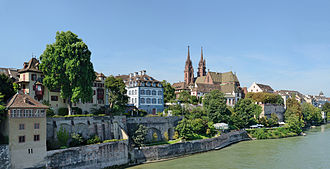
Zurich and Geneva are considered global cities. They are ranked as Alpha and Beta, respectively. Basel is the centre of Switzerland's medicine industry. It is home to Novartis, Roche, and many other companies. It is one of the most important centres for the life sciences in the world.
In 2023, Switzerland had the second-highest rating in the Index of Economic Freedom. The country also provides many public services. Per person, its GDP is higher than in the larger economies of Western and Central Europe, and higher than in Japan.
The European Union called Switzerland the most innovative country in Europe. Switzerland was ranked the most innovative country in the Global Innovation Index in 2026. It has held this top spot every year since 2019. It ranked 20th out of 189 countries in the Ease of Doing Business Index.
Slow growth in the 1990s and early 2000s led more people to support economic reforms. These reforms helped Switzerland work more closely with the European Union. In 2020, IMD ranked Switzerland first for attracting skilled workers. Switzerland also has one of the world's largest account balances as a percentage of GDP.
For much of the 20th century, Switzerland was the wealthiest country in Europe by a large margin. In 2018, the canton of Basel-City had the highest GDP per capita. Zug and Geneva came next.
According to Credit Suisse, only about 37% of residents own their homes. This is one of the lowest home ownership rates in Europe. In 2007, housing and food prices were higher than the EU-25 average. Prices in Germany were closer to average.
Switzerland is home to several large companies that work around the world. The biggest by revenue include Glencore, Gunvor, Nestlé, Mediterranean Shipping Company, Novartis, Hoffmann-La Roche, ABB, Mercuria Energy Group and Adecco. Other well-known companies include UBS, Zurich Insurance, Richemont, Credit Suisse, Barry Callebaut, Swiss Re, Rolex, Tetra Pak, Swatch Group and Swiss International Air Lines.
Manufacturing is Switzerland's most important economic sector. Its products include special chemicals, health and pharmaceutical goods, precision measuring instruments and musical instruments. Services are also important. These include banking, insurance, commodities trading, tourism, and work with international organisations. Exported services make up about a third of all exports.
Switzerland usually supports free trade. However, agricultural protectionism is a rare exception, and it helps keep food prices high. According to the OECD, Switzerland has been slower than many EU countries to open up its product markets. Apart from farming, trade barriers between the European Union and Switzerland are very small. Switzerland has free trade agreements with many countries. It is also a member of the European Free Trade Association (EFTA).
Switzerland is often called the "land of Cooperatives." In 2018, the ten largest cooperative companies made up more than 11% of GDP. They include Migros and Coop, the two largest shop chains in Switzerland.
Taxation and government spending
See also: Taxation in Switzerland
Switzerland is a tax haven where private businesses play the biggest role in the economy. Taxes are low. Tax income makes up one of the smallest shares of GDP among developed countries. The main sources of federal income are the value-added tax and direct federal tax. Total government spending is about 33.8% of GDP.
Labour force
See also: Immigration to Switzerland
Switzerland has a more flexible labour market than its neighbours. Its unemployment rate is consistently low. In 2015, 28.9% of the population were foreign citizens. In 2022, the median monthly gross income was 6,788 francs. Income inequality is relatively low, with a Gini coefficient of 29.7. About 8.2% of people live below the national poverty line.
Science
Main article: Science and technology in Switzerland
See also: List of Swiss Nobel laureates
Switzerland is among the countries with the most Nobel laureates, both in total and per person. Albert Einstein became a Swiss citizen in 1901. He developed his theory of special relativity while living in Bern. Winners who were born in or became citizens of Switzerland include Vladimir Prelog, Heinrich Rohrer, Richard Ernst, Edmond Fischer, Rolf Zinkernagel, Kurt Wüthrich and Jacques Dubochet. The Nobel Peace Prize has been given nine times to organisations based in Switzerland.
Geneva and the nearby French department of Ain share CERN, the world's largest laboratory for particle physics research. The Paul Scherrer Institute carries out multi-disciplinary research in the natural and engineering sciences.
Some famous Swiss inventions include lysergic acid diethylamide (LSD), diazepam (Valium), and Velcro. The scanning tunnelling microscope was also invented in Switzerland. It won Gerd Binnig and Heinrich Rohrer the 1986 Nobel Prize in Physics.
Auguste Piccard was the first person to enter the Stratosphere in a pressurised hydrogen balloon. His son, Jacques Piccard, was one of the first people to explore the deepest known part of the world's ocean. He did this with the American Don Walsh.
The Swiss Space Office was one of the 10 founders of the European Space Agency in 1975. Switzerland is the seventh largest contributor to its budget. Companies such as Oerlikon Space and Maxon Motors work in the space industry.
Energy
See also: Energy in Switzerland
Most electricity in Switzerland comes from hydroelectricity (56%) and nuclear power (39%). This produces very little CO2. In 2011, after the Fukushima nuclear disaster, the government announced plans to stop using nuclear energy within the next 20 to 30 years.
The Swiss Federal Office of Energy manages energy supply and use. It is part of the Federal Department of Environment, Transport, Energy and Communications (DETEC). The agency supports the 2000-watt society initiative. This plan aims to cut the nation's energy use by more than half by 2050. Voters have rejected anti-nuclear referendums. They have also rejected a Green Party proposal to end nuclear power more quickly.
Transport
Main article: Transport in Switzerland
Switzerland's rail network is the densest in Europe. In 2023, it carried 614 million passengers. Most of it is run by the Swiss Federal Railways, and nearly all of it is electrified. The Rhaetian Railway and the Matterhorn Gotthard Bahn run narrow gauge lines. Together, they operate the Glacier Express between Zermatt and St. Moritz/Davos.
Switzerland also has the world's longest and deepest railway tunnel. It is the Gotthard Base Tunnel, part of the New Railway Link through the Alps project. Public transport is very popular. Zurich Airport is the largest international airport in the country, handling 31.2 million passengers in 2024. Other international airports include Geneva Airport, EuroAirport Basel Mulhouse Freiburg, Bern Airport, Lugano Airport, St. Gallen-Altenrhein Airport and Sion Airport. Swiss International Air Lines is the national airline.
Switzerland's roads are free to use. However, drivers of cars on the motorway system need a yearly vignette.
Environment
Main articles: Environment of Switzerland and Waste management in Switzerland
Switzerland has signed the Kyoto Protocol. It was also a founding member of the Environmental Integrity Group. The country is one of the world's top recyclers. It uses incinerators to burn waste and produce energy.
Demographics
Main articles: Demographics of Switzerland, Swiss people, and Crime in Switzerland
Further information: List of Swiss people
Main article: List of cities in Switzerland
Main article: Immigration to Switzerland
Main article: Languages of Switzerland
Main article: Religion in Switzerland
Main article: Education in Switzerland
Main articles: Health in Switzerland and Healthcare in Switzerland
About 9 million people lived in Switzerland as of June 2024. Like other developed countries, Switzerland grew quickly during the industrial era. The number of people about quadrupled between 1800 and 1990. The population is expected to keep growing until 2035, mostly because of immigration. Like most of Europe, Switzerland has an ageing population, with a birth rate close to replacement level. It has one of the world's oldest populations, with an average age of 44.5 years. According to the World Factbook, the largest group in 2020 was Swiss people (69.2%). Other groups included Germans, Italians, Portuguese, French, Kosovans, Turks, and others. The Council of Europe suggests about 30,000 Romani people live in the country. In 2023, foreign residents made up 26.3% of the population. Most of them (83%) came from European countries. Italy was the largest single group, followed by Germany, Portugal, and France. Sri Lanka was the largest Asian group, mostly made up of former Tamil refugees. Some institutions raised concern about xenophobia in the 2000s. In 2018, 59% of people considered racism a serious problem in Switzerland.
Switzerland has four national languages: German, French, Italian, and Romansh. Romansh is a Romance language spoken in the canton of Grisons. In 2016, the most spoken languages at home were Swiss German, French, Standard German, and Italian. English, Portuguese, Albanian, Spanish, and Serbian and Croatian were also common. Many Swiss speak more than one language. Swiss Standard German and Swiss French include words called Helvetisms that are not used outside Switzerland. Pupils must learn another national language at school. Most Swiss also learn English, which often works as a lingua franca.
Religion is also varied. Catholicism (31.9%) and Swiss Protestantism (20.4%) are the largest groups. Islam (5.8%) is the largest non-Christian religion. About one third of people (33.8%) do not belong to any religious community. Switzerland has no official state religion. Most cantons recognise an official church. The Swiss Reformed Church and Old Catholic Church are funded through church tax.
Education is also organised by the cantons. The constitution of Switzerland gives them responsibility for schools. Pupils usually start primary school at about age four to six. Students may take the matura. Switzerland has 12 universities. The largest is the University of Zurich, with nearly 25,000 students. The Swiss Federal Institute of Technology Zurich and École Polytechnique Fédérale de Lausanne are run by the federal government.
Health is generally good. In the 2023 OECD report, the life expectancy was 83.9 years. This is 3.6 years higher than the OECD average. Switzerland also faces some health problems, including high drugs consumption, smoking, and mental illness.
| Rank | Name | Canton | Pop. | Rank | Name | Canton | Pop. | ||
|---|---|---|---|---|---|---|---|---|---|
| 1 | Zurich | Zurich | 421,878 | 11 | Thun | Bern | 43,476 | ||
| 2 | Geneva | Geneva | 203,856 | 12 | Bellinzona | Ticino | 43,360 | ||
| 3 | Basel | Basel-Stadt | 178,120 | 13 | Köniz | Bern | 42,388 | ||
| 4 | Lausanne | Vaud | 140,202 | 14 | La Chaux-de-Fonds | Neuchâtel | 36,915 | ||
| 5 | Bern | Bern | 134,794 | 15 | Fribourg | Fribourg | 38,039 | ||
| 6 | Winterthur | Zurich | 114,220 | 16 | Schaffhausen | Schaffhausen | 36,952 | ||
| 7 | Lucerne | Luzern | 82,620 | 17 | Vernier | Geneva | 34,898 | ||
| 8 | St. Gallen | St. Gallen | 76,213 | 18 | Chur | Graubünden | 36,336 | ||
| 9 | Lugano | Ticino | 62,315 | 19 | Sion | Valais | 34,978 | ||
| 10 | Biel/Bienne | Bern | 55,206 | 20 | Uster | Zurich | 35,337 | ||
Culture
Main article: Culture of Switzerland
See also: Music of Switzerland, Swiss folklore, and Alpine culture
Swiss culture is very varied, and many traditional customs show this. Each region may share some culture with the neighbouring country that speaks its language. All of it is rooted in western European culture. The Romansh culture in Graubünden is different. It lives on only in the upper valleys of the Rhine and the Inn, where people work to keep their rare language alive. Switzerland has produced famous artists, writers, musicians and scientists. It has 1000 museums. Big yearly events include the Paléo Festival, Lucerne Festival, Montreux Jazz Festival, Locarno International Film Festival and Art Basel. Switzerland has hosted the Eurovision Song Contest three times. It has also won the contest three times, with Lys Assia, Celine Dion and Nemo. Life in the Alps has shaped Swiss history and identity. Many people visit the ski resorts for winter sports. In summer, they go mountain biking. The alphorn, yodelling and the accordion are well-known parts of Swiss music.
Swiss food is different in each region. Dishes such as fondue, raclette and rösti are very common. Traditional Swiss cooking also uses special dairy products and cheeses such as Emmental. Chocolate has been made in Switzerland since the 18th century. The Swiss are the world's largest chocolate eaters. The most popular alcoholic drink is Swiss wine. It is mainly made in Valais, Vaud, Geneva and Ticino. The most common grapes are Chasselas and Pinot Noir, while Merlot is the main grape in Ticino. You can also learn about Swiss literature, Swiss media and Swiss cuisine.
Skiing, snowboarding and mountaineering are among the most popular sports, because the country has many mountains. The bobsleigh was invented in St. Moritz. Football and ice hockey are the sports that people watch the most. The headquarters of FIFA and the International Ice Hockey Federation are in Zurich. The International Olympic Committee is in Lausanne. Switzerland hosted the 1954 FIFA World Cup. Many Swiss people follow ice hockey. The National League is the most attended league in Europe. The famous tennis player Roger Federer won 20 Grand Slam tournaments. Sailing is also popular because there are many lakes. Lake Geneva is home to the sailing team Alinghi. Traditional sports include Schwingen, Hornussen and Steinstossen, which is connected to the Unspunnenfest. To learn more about Sport in Switzerland, see that article.

Quiz time!
4 questions about Switzerland
Why doesn't Switzerland have a navy?
Pictures
Keep exploring




This article is a child-friendly adaptation of the Wikipedia article on Switzerland, available under CC BY-SA 4.0.
Images from Wikimedia Commons. Tap any image to view credits and license.