 Safekipedia
Basel-Stadt
Adapted from Wikipedia · Adventurer experience
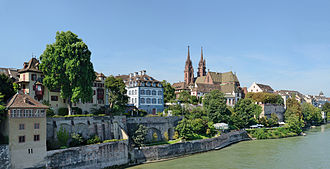
The Canton of Basel-Stadt, also called Basel-City, is one of the 26 cantons that make up the Swiss Confederation. It has three main towns, with Basel being the capital city. Basel-Stadt is very small but has many people living there. It sits on both sides of the Rhine River.
Basel-Stadt shares a border only with its neighbor, Basel-Landschaft, to the south. To the north, it touches France and Germany. This makes it a special spot where three countries meet.
Once part of a larger canton called Canton of Basel, Basel-Stadt became separate from its rural half in 1833 after some disagreements. Today, it is a strong economic center for Switzerland, especially in chemicals and medicines. It has the highest GDP per capita in the country.
History
The canton of Basel-Stadt was created in 1833 when the old canton of Basel split into two parts. This happened after some disagreements about the rights of people living in the countryside. On August 26, 1833, the area became two separate parts: the city of Basel and the nearby countryside area called Basel-Landschaft. Over time, there have been ideas to bring the two parts back together. But in votes in 1969 and again in 2014, the people in Basel-Landschaft chose to stay separate.
Geography
The canton of Basel-Stadt is in the north of Switzerland. The city of Basel is where the Rhine river turns and meets the small Birsig river. This area is the second flattest canton, with a height difference of only 277 metres.
Basel-Stadt is the smallest canton in Switzerland. It covers an area of 37 km2 (14 sq mi). It shares a border with just one other Swiss canton, Basel-Landschaft. It also touches Germany and France.
Municipalities
The canton of Basel-Stadt has three municipalities. The main city is Basel, and it is the capital of the area. These three municipalities work together to form the small but busy canton in Switzerland.
Politics
The canton of Basel-Stadt shares its political structure and administration with the city of Basel. It is a half-canton, meaning it sends only one representative to the Council of States. The capital city is Basel. The current constitution was made in 1889. In 1966, Basel-Stadt became the first German-speaking area in Switzerland to allow women to vote. This happened five years before all Swiss women could vote in 1971.
The canton's parliament is called the Grand Council. It has 100 members who are chosen every four years. Eight political parties have members in this parliament. The largest party is the Social Democratic Party, with 32 seats. The executive group, called the Regierungsrat, has seven members. Basel-Stadt has a special relationship as a sister state with Massachusetts.
| Party | 1971 | 1975 | 1979 | 1983 | 1987 | 1991 | 1995 | 1999 | 2003 | 2007 | 2011 | 2015 | |
|---|---|---|---|---|---|---|---|---|---|---|---|---|---|
| FDP.The Liberalsa | Classical liberalism | 11.5 | 11.4 | 14.1 | 13.5 | 11.2 | 15.8 | 12.2 | 12.1 | 9.9 | 11.3 | 12.3 | 9.8 |
| CVP/PDC/PPD/PCD | Christian democracy | 11.2 | 12.1 | 13.9 | 9.9 | 10.0 | 10.4 | 9.7 | 8.6 | 6.6 | 7.4 | 6.5 | 6.4 |
| SP/PS | Social democracy | 30.4 | 33.3 | 33.3 | 31.0 | 25.9 | 25.3 | 35.5 | 33.3 | 40.9 | 35.2 | 29.1 | 33.3 |
| SVP/UDC | Swiss nationalism | * b | * | * | * | * | 2.0 | * | 13.6 | 18.6 | 18.5 | 16.5 | 17.6 |
| LPS/PLS | Swiss Liberal | 13.0 | 11.6 | 11.2 | 8.3 | 12.3 | 13.3 | 14.9 | 10.7 | 8.5 | 9.2 | 6.8 | 11.5 |
| Ring of Independents | Social liberalism | 12.7 | 9.9 | 7.6 | 7.0 | 9.4 | 7.4 | * | * | * | * | * | * |
| EVP/PEV | Christian democracy | * | 4.0 | * | 4.8 | 4.5 | 3.3 | 4.1 | 3.8 | 2.9 | 3.6 | 2.5 | 2.3 |
| GLP/PVL | Green liberalism | * | * | * | * | * | * | * | * | * | * | 5.8 | 4.8 |
| BDP/PBD | Conservatism | * | * | * | * | * | * | * | * | * | * | 2.2 | 1.1 |
| PdA/PST-POP/PC/PSL | Socialism | 6.1 | 4.6 | 4.7 | 2.3 | 1.9 | 1.4 | 1.3 | * | * | * | * | * |
| POCH | Progressivism | 1.8 | 4.2 | 10.3 | 11.9 | 9.4 | 7.8 | c | * | * | * | * | * |
| GPS/PES | Green politics | * | * | * | * | 1.1 | 4.4 | 5.6 | 8.7 | 9.2 | 12.1 | 13.4 | 11.2 |
| FGA | Feminist | * | * | * | 1.0 | 3.3 | d | 6.0 | e | * | * | * | * |
| Solidarity | Anti-capitalism | * | * | * | * | * | * | 0.7 | * | * | * | * | * |
| SD/DS | National conservatism | 8.0 | 8.2 | 3.9 | 5.3 | 4.5 | 3.2 | 6.9 | 3.8 | 1.1 | 0.7 | * | * |
| Rep. | Republicanism | 4.9 | * | * | * | * | * | * | * | * | * | * | * |
| EDU/UDF | Christian right | * | * | * | * | * | 0.9 | * | * | 0.7 | 0.5 | 0.5 | 0.5 |
| Other | 0.4 | 0.8 | 0.9 | 5.0 | 6.5 | 4.8 | 0.7 | 5.5 | 1.6 | 1.7 | 4.2 | 1.4 | |
| Voter participation % | 46.5 | 43.8 | 39.4 | 45.7 | 43.6 | 45.0 | 46.8 | 47.4 | 49.6 | 52.4 | 50.3 | 50.4 | |
Demographics
The canton of Basel-Stadt has about 201,156 people. Many of these people are from other countries, making up around 30% of the population.
Most people in Basel-Stadt follow either the Roman Catholic or Protestant religions, each with around 25-27% of the population. About 10% follow other religions, and around 36% do not follow any organized religion.
| Historic Population Data | |||
|---|---|---|---|
| Year | Total Population | Swiss | Non-Swiss |
| 1850 | 29,698 | 22,879 | 6,819 |
| 1900 | 112,227 | 69,446 | 42,781 |
| 1950 | 196,498 | 180,145 | 16,353 |
| 1990 | 199,411 | 152,601 | 46,810 |
| 2020 | 196,735 | ||
| Nationalities (0.30% and above) | 1990 | 2000 | 2010 | 2018 |
|---|---|---|---|---|
 Switzerland Switzerland | 77.52% | 72.44% | 67.36% | 63.58% |
 Germany Germany | 2.60% | 3.27% | 7.58% | 8.22% |
 Italy Italy | 6.42% | 5.44% | 4.18% | 4.32% |
 Turkey Turkey | 3.27% | 4.38% | 3.56% | 3.09% |
 Yugoslavia Yugoslavia | 2.79% | 3.13% | —N/a | —N/a |
 Serbia Serbia Montenegro Montenegro Kosovo Kosovo | —N/a | —N/a | 2.46% | 2.14% |
 Spain Spain | 2.78% | 2.16% | 1.52% | 1.92% |
 Portugal Portugal | 0.42% | 0.79% | 1.35% | 1.73% |
 North Macedonia North Macedonia | —N/a | 1.12% | 1.17% | 1.11% |
 France France | 0.59% | 0.54% | 0.76% | 1.10% |
 Great Britain Great Britain | 0.35% | 0.48% | 0.96% | 1.10% |
 India India | 0.12% | 0.17% | 0.65% | 0.83% |
 United States United States | 0.25% | 0.31% | 0.63% | 0.80% |
 Austria Austria | 0.45% | 0.45% | 0.58% | 0.61% |
 Poland Poland | 0.09% | 0.08% | 0.23% | 0.47% |
 Croatia Croatia | —N/a | 0.81% | 0.54% | 0.44% |
 Hungary Hungary | 0.15% | 0.10% | 0.19% | 0.42% |
 Sri Lanka Sri Lanka | 0.30% | 0.63% | 0.49% | 0.41% |
 Eritrea Eritrea | —N/a | 0.00% | 0.10% | 0.40% |
 Netherlands Netherlands | 0.18% | 0.21% | 0.32% | 0.40% |
 Romania Romania | 0.05% | 0.04% | 0.12% | 0.34% |
 Bosnia and Herzegovina Bosnia and Herzegovina | —N/a | 0.68% | 0.41% | 0.32% |
 Brazil Brazil | 0.03% | 0.12% | 0.28% | 0.30% |
Economy
Basel is a very important city for work in Switzerland, just after Zurich. Many large companies, especially in chemicals and medicines, have their offices here. People from nearby areas in Switzerland, France, and Germany come to work in Basel. Banking and many different services are also big parts of the city's work life.
Near Basel, three countries meet at a special spot called Dreiländereck, which is a fun place for school groups to visit. The city's big carnival draws many visitors from all around. Many workers in Basel-Stadt have jobs in health care, education, and selling things in shops. Others work for companies that help people find jobs or give advice on running businesses.
Transport
Basel has an international airport at Basel-Mulhouse, which is in France but easy to reach from the city. You don't need to go through customs.
The city has many trains that connect well to Switzerland and nearby parts of France and Germany. Basel is a key train hub with fast trains to cities like Paris and Berlin.
Basel also has a port on the Rhine River. This port is important for Switzerland because it is the country's only direct link to the sea. The port connects well to roads and railways.
Culture
The Carnival of Basel is a big celebration that happens every year. It starts very early in the morning and has lots of fun activities for three days.
Basel is also famous for its special treats, like the Basler Läckerli biscuit made with honey and almonds, and the Basler Brunsli, a sweet almond treat enjoyed during Christmas. The city hosts important events like Art Basel, a show for modern art, and BaselWorld, a big fair for watches and jewelry. Famous groups from Basel include the Top Secret Drum Corps and the Basel Boys Choir.
Images
Related articles


This article is a child-friendly adaptation of the Wikipedia article on Basel-Stadt, available under CC BY-SA 4.0.
Images from Wikimedia Commons. Tap any image to view credits and license.