Berlin
Berlin is the capital and largest city of Germany. For other uses, see Berlin (disambiguation). With 3.7 million people, it has the highest population within its city limits of any city in the European Union (EU). The city is also one of the states of Germany. It is the third-smallest state in the country by area. Berlin is surrounded by the state of Brandenburg, and it borders Brandenburg's capital, Potsdam, to the southwest.
The urban area of Berlin has about 4.5 million people. This makes it the second most populous urban area in Germany, after the Ruhr. The Berlin-Brandenburg capital region has around 6.2 million people. It is Germany's second-largest metropolitan region, after the Rhine-Ruhr region. Berlin is a global city known for culture, politics, media, and science.
Berlin was built along the banks of the Spree river, which flows into the Havel in the western borough of Spandau. It was first written about in the 13th century. The city was located where two important old trade routes crossed. Over the centuries, Berlin was the capital of several states and kingdoms. These included the Margraviate of Brandenburg, the Kingdom of Prussia, the German Empire, the Weimar Republic, and Nazi Germany. Berlin was an important center for science, art, and ideas during the Age of Enlightenment, Neoclassicism, and the German revolutions of 1848–1849. During the Gründerzeit, factories and new industries helped the city grow quickly. Berlin in the 1920s was one of the largest cities in the world.
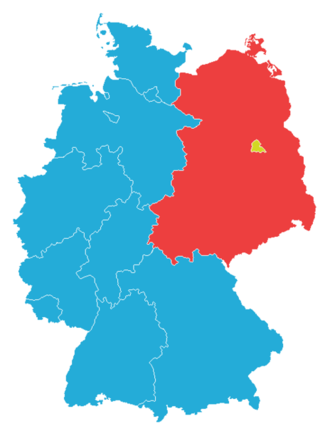
After World War II, the city was split into West Berlin and East Berlin. A wall was built between them. East Berlin became the capital of East Germany, while Bonn became the capital of West Germany. After German reunification in 1990, Berlin became the capital of all of Germany again. Because of its location and history, Berlin has been called "the heart of Europe." Its economy is based on high tech and the service sector. It has many creative industries, startup companies, research centers, and media companies. Berlin is an important hub for air and train travel and has a complex public transportation network. Tourism in Berlin makes it a popular place for visitors from around the world.
Berlin is home to several universities, including the Humboldt University of Berlin, Technische Universität Berlin, the Berlin University of the Arts, and the Free University of Berlin. The Berlin Zoological Garden is the most visited zoo in Europe. Babelsberg Studio is the world's first large-scale movie studio complex, and many films are set in Berlin. The city has three UNESCO World Heritage Sites: Museum Island, the Palaces and Parks of Potsdam and Berlin, and the Berlin Modernism Housing Estates. Other famous places include the Brandenburg Gate, the Reichstag building, Potsdamer Platz, the Memorial to the Murdered Jews of Europe, and the Berlin Wall Memorial. Berlin has numerous museums, galleries, and libraries. The city has lakes in its western and southeastern boroughs. The largest of them is Müggelsee. About one third of the city's area is forests, parks and gardens, rivers, canals, and lakes.
History
Main article: History of Berlin
For a chronological guide, see Timeline of Berlin.
Further information: Greater Berlin Act, 1920s Berlin, Battle of Berlin, West Berlin, and East Berlin
Berlin is in northeastern Germany, in an area that was once settled by Slavs, and many of its place names still come from Slavic languages. People have lived in this area for thousands of years. Long ago, the Maglemosian culture and the Lusatian culture lived here. Germanic tribes and later Slavic tribes also settled the land. In the 1100s, it came under German rule as part of the Margraviate of Brandenburg. Spandau was first mentioned in 1197. The towns of Berlin and Cölln grew close together. Many people see 1237 as the year the city was founded. The Hohenzollern family ruled Berlin until 1918. The city was badly damaged during the Thirty Years' War, but it grew again. In 1701, the Kingdom of Prussia was formed, and Berlin became its capital. In 1871, Berlin became the capital of the new German Empire.
In the early 1900s, Berlin was a place where the German Expressionist art movement grew. Albert Einstein also became well known there. In 1933, Adolf Hitler and the Nazi Party came to power. Berlin hosted the 1936 Summer Olympics, and the Olympic stadium was built for the games. During World War II, parts of the city were destroyed in the bombing of Berlin and the Battle of Berlin. After the war, the city was split into West Berlin and East Berlin. The Berlin Wall fell on 9 November 1989. Germany was reunited on 3 October 1990. On 20 June 1991, the Bundestag voted to move the seat of the German capital from Bonn to Berlin. This move was finished in 1999. In 2006, the FIFA World Cup Final was held in Berlin.
Geography
Main article: Geography of Berlin
Berlin is in northeastern Germany. The land is low and flat, with marshy woods. It is part of the big Northern European Plain. The Spree River flows through the Berliner Urstromtal, a valley that was shaped by ice long ago. This valley lies between the low Barnim Plateau to the north and the Teltow plateau to the south. The Havel River flows through western Berlin and looks like a chain of lakes. The Spree also passes through lakes, including the Großer Müggelsee in eastern Berlin. Parts of Reinickendorf and Pankow are on the Barnim Plateau. Most of Charlottenburg-Wilmersdorf, Steglitz-Zehlendorf, Tempelhof-Schöneberg, and Neukölln are on the Teltow Plateau. Since 2015, the Arkenberge hills in Pankow have been the highest point in Berlin. They are 122 meters (400 ft) high. The Müggelberge are the highest natural point, at 114.7 meters (376 ft). The lowest point is the Spektesee in Spandau, at 28.1 meters (92 ft).
Berlin has an oceanic climate (Köppen: Cfb). It is close to a humid continental climate (Dfb). Summers are mild to very warm. Winters are cold but not very severe. Frosts are common in winter. The difference in temperature between seasons is larger than in many oceanic climates. Berlin gets a modest amount of rain each year, about 570 millimeters (22 in). Snow mainly falls from December through March. The city's buildings and pavement hold heat, so the city can be 4 °C (7 °F) warmer than the areas around it. The hottest month on record was July 1757, and the coldest was January 1709.
Cityscape and architecture
Berlin has a metropolitan area with several centres and many different building styles. Most of what you see in the city today comes from the 20th century. About 17% of the buildings are from the Gründerzeit period or earlier. Nearly 25% are from the 1920s and 1930s, when Berlin helped start modern architecture. During the war, much of the city was damaged in the bombing of Berlin in World War II. Many buildings that survived were later torn down. After Germany was reunited, many important old buildings were reconstructed. These include the Forum Fridericianum, the Berlin State Opera, Charlottenburg Palace, Gendarmenmarkt, the Alte Kommandantur, and the City Palace. The tallest buildings in Berlin are spread across the city, with groups at Potsdamer Platz, City West, and Alexanderplatz. More than a third of the city is green and open space. The Großer Tiergarten, one of Berlin's largest and most loved parks, is in the city centre.
Architecture
Main article: Architecture of Berlin
Further information: List of sights in Berlin and List of tallest buildings in Berlin
The Fernsehturm (TV tower) at Alexanderplatz in Mitte is one of the tallest structures in the European Union. It is 368 m (1,207 ft) tall and was built in 1969. It can be seen from most of central Berlin. The Karl-Marx-Allee avenue starts nearby. It is lined with large apartment buildings in the Socialist Classicism style. The Rotes Rathaus (City Hall), with its red brick, is also close by. The Brandenburg Gate is a famous landmark of Berlin and Germany. It is a symbol of European history, unity, and peace. The Reichstag building is the traditional home of the German Parliament. British architect Norman Foster remodeled it in the 1990s, and it now has a glass dome. The East Side Gallery is an open-air art display painted on the last standing parts of the Berlin Wall. It is a reminder of the city's past division. The Museum Island on the River Spree has five museums. It is a UNESCO World Heritage site. Unter den Linden was once Berlin's most important street. It runs from the Brandenburg Gate to the Berlin Palace. Potsdamer Platz was built from the ground up after the Wall came down. The Memorial to the Murdered Jews of Europe, a Holocaust memorial, is to the north. The Kurfürstendamm has expensive shops. Nearby, KaDeWe is said to be the largest department store in continental Europe. The Rathaus Schöneberg is where John F. Kennedy gave his famous "Ich bin ein Berliner!" speech. It is in Tempelhof-Schöneberg. The Oberbaumbrücke crosses the Spree river. It is Berlin's most iconic bridge and connects Friedrichshain and Kreuzberg. Washingtonplatz, in the Moabit area next to Berlin central station, was renovated between 2010 and 2013. The 10-storey Cube Berlin office building was finished there in 2020.
Demographics
Main article: Demographics of Berlin
At the end of 2024, Berlin had about 3.9 million registered residents. The city covers an area of 891 km2 (344 sq mi). It is the most populous city proper in the European Union. The functional urban area had about 5.2 million people in 2019, and the whole Berlin-Brandenburg capital region has more than 6 million people. In 2014, there were 37,368 babies born, the most since 1991. In 1920, the Greater Berlin Act joined many nearby towns and cities to Berlin, so its population grew from 1.9 million to 4 million.
People have come to Berlin from many places. In 1685, French Huguenot refugees were welcomed through the Edict of Potsdam. This edict gave them religious freedom after the Edict of Nantes was ended in France. Today, people from Turkey, Poland, Russia, and many other countries live in the city. In December 2019, there were 777,345 registered residents who were not German citizens.
German is the official language of Berlin and the one most people speak. Many other languages are also spoken, including Turkish, Polish, English, Arabic, and Russian. Berlinerisch is spoken in Berlin and the area around it, but today it is seen more as a sociolect than a dialect.
Main article: Religion in Berlin
Many Berliners are not religious. In 2022, about 71 percent of residents were not religious or atheist. The largest religious groups are EKD Protestants and Catholics. In 2009, about 249,000 Muslims were reported to be members of mosques and Islamic groups in Berlin.
| Year | Pop. | ±% |
|---|---|---|
| 1721 | 65,300 | — |
| 1750 | 113,289 | +73.5% |
| 1800 | 172,132 | +51.9% |
| 1815 | 197,717 | +14.9% |
| 1825 | 220,277 | +11.4% |
| 1840 | 330,230 | +49.9% |
| 1852 | 438,958 | +32.9% |
| 1861 | 547,571 | +24.7% |
| 1871 | 826,341 | +50.9% |
| 1880 | 1,122,330 | +35.8% |
| 1890 | 1,578,794 | +40.7% |
| 1900 | 1,888,848 | +19.6% |
| 1910 | 2,071,257 | +9.7% |
| 1920 | 3,879,409 | +87.3% |
| 1925 | 4,082,778 | +5.2% |
| 1933 | 4,221,024 | +3.4% |
| 1939 | 4,330,640 | +2.6% |
| 1945 | 3,064,629 | −29.2% |
| 1950 | 3,336,026 | +8.9% |
| 1960 | 3,274,016 | −1.9% |
| 1970 | 3,208,719 | −2.0% |
| 1980 | 3,048,759 | −5.0% |
| 1990 | 3,433,695 | +12.6% |
| 2000 | 3,388,434 | −1.3% |
| 2011 | 3,292,365 | −2.8% |
| 2022 | 3,596,999 | +9.3% |
| Population size may be affected by changes in administrative divisions. | ||


Government and politics
Since German reunification on 3 October 1990, Berlin has been one of the three city-states in Germany. Germany has 16 states of Germany. The Abgeordnetenhaus von Berlin (House of Representatives) is the city and state parliament. It has 141 seats. The Senate of Berlin leads the city, and the Governing Mayor of Berlin leads the Senate. The Governing Mayor works in the Rotes Rathaus (Red City Hall). Since 2023, the mayor has been Kai Wegner of the Christian Democrats. He is the first conservative mayor in Berlin in more than twenty years. Berlin is divided into 12 districts (Bezirke). Many people feel a strong connection to their neighborhood, which is called a Kiez.
Berlin is the capital of Germany. The President of Germany lives at Bellevue Palace. The German Chancellor works in the Chancellery building. The Bundestag, Germany's parliament, meets in the Reichstag building. The Bundesrat represents the 16 states and meets at the former Prussian House of Lords. Most of the federal government moved to Berlin by 1999. Some ministries stayed in Bonn, which was the capital of West Germany. Berlin is also home to 158 foreign embassies. Many think tanks, trade unions, and nonprofit groups have their headquarters in the city.
Economy
Main article: Economy of Berlin
In 2025, Berlin's total economic output, called GDP, was €218.3 billion. It grew by 1.1% from the year before. Between 2013 and 2025, the city grew faster than the whole country every year. The service sector helped the most. Berlin's unemployment rate fell from 18.3% in 2005 to 7.8% in 2019. It rose during the COVID-19 pandemic, dropped for a while in 2022, and averaged 10.3% in 2025. Important industries include life sciences, transportation, media and music, biotechnology, construction, online shopping, and medical engineering. Companies such as Volkswagen, Pfizer, and SAP run innovation labs in the city. Berlin has become a center for business and international investments in the eurozone. Deutsche Bahn, the largest railway company in the world, has its headquarters in Berlin. So does Deutscher Sparkassen- und Giroverband, the second-largest financial services group in the European Union. Many companies have offices in the city, and Berlin is known as a major center for business founders. In 2015, it attracted the most money from investors for young startup companies in Europe. Other large employers and headquarters include Charité, Vivantes, BVG, Siemens, Deutsche Telekom, Zalando, Delivery Hero, Axel Springer, HelloFresh, Mercedes-Benz Group, BMW builds motorcycles, Tesla, which opened its first European Gigafactory in Grünheide (Mark), Bayer, and Berlin Chemie.
Tourism and conventions are also important. In 2014, Berlin had 788 hotels with 134,399 beds. It has become the 3rd-most-visited city destination in Europe. Popular places include Brandenburger Tor, Museumsinsel, and Holocaust-Mahnmal. In 2015, Berlin became the world's leading organizer of international conferences. The Messe Berlin is the main company that organizes conventions. Large trade fairs such as IFA and Berlin Fashion Week are held in the city each year. The creative arts and entertainment business is another important part of the economy. It includes fashion, video games, and the German film industry. Berlin is also a center for media. Many publishers are based there, and national publications such as Der Spiegel and Die Zeit have offices in the city. The public broadcaster RBB and Deutsche Welle have studios there, and ZDF and RTL also work in the city.
Quality of life
In a 2023 European Commission survey, most people in Berlin were happy with the city as a place to live. Many were also happy with their own jobs. In the 2025 Global Power City Index, Berlin ranked fourth for livability out of 48 cities. This ranking looks at working conditions, the cost of living, safety, health and well-being, and access to everyday services.
Berlin's 2025 Social Report, which covers the years through 2023, found that about 1 in 5 residents were at risk of poverty. Many households also spent a large part of their money on rent.
Transport
Main article: Transport in Berlin
Main article: Cycling in Berlin
Berlin is served by Berlin Brandenburg Airport (BER). It is in Schönefeld, Brandenburg, just outside the city's south-eastern edge. Building began in 2006, and the airport opened in October 2020 after many delays and extra costs. It brought flights from Tegel Airport and Schönefeld Airport together at one place. In 2025, BER served 26.1 million passengers and was Germany's third-busiest airport. The BER Airport station, under Terminal 1, is served by the Berlin S-Bahn, regional trains, long-distance trains, and the Airport Express (FEX). Since December 2025, the FEX has linked the airport with Berlin Hauptbahnhof in about 23 minutes. Until it closed in 2008, Berlin was also served by Tempelhof Airport. Its former airfield became the public park Tempelhofer Feld in 2010. Berlin's roads total 5,422 km (3,369 miles). This includes 77 km (48 miles) of motorways called Autobahn. Long-distance trains connect Berlin with all of Germany's major cities. Regional rail lines of the Verkehrsverbund Berlin-Brandenburg reach Brandenburg and the Baltic Sea.
The Berlin Hauptbahnhof (Berlin Central Station) is the largest grade-separated railway station in Europe. The Deutsche Bahn runs the high-speed Intercity-Express (ICE) trains to Hamburg, Munich, Cologne, Stuttgart, and Frankfurt am Main. The Spree and Havel rivers flow through the city. Berlin's largest inland port, the Westhafen in Moabit, is used for storing and moving goods. It is becoming more important.
There are more and more intercity bus services. Berlin has more than 10 bus stations. Buses to destinations in Germany and Europe run through the Zentraler Omnibusbahnhof Berlin. The Berliner Verkehrsbetriebe (BVG) and the state-owned Deutsche Bahn (DB) run several large public transport systems.
Public transport has a long and complicated history. The city was divided in the 20th century, and movement between the two halves was not served. Since 1989, the network has grown a lot. It still includes some older trains from the early 20th century, such as the U1. Berlin is well known for its bicycle lane system. There are an estimated 710 bicycles per 1,000 residents. In 2010, around 500,000 people rode bikes every day, which was 13% of all traffic. People may take bicycles on Regionalbahn (RE) trains, S-Bahn and U-Bahn trains, trams, and night buses if they buy a bike ticket. Taxis in Berlin are yellow or beige. Around 8,000 taxicabs were in service in 2024. As in most of Europe, app-based sharing cab services are available, but they are limited.
| System | Stations / Lines / Net length | Annual ridership | Operator / Notes |
|---|---|---|---|
| S-Bahn | 166 / 16 / 331 km (206 mi) | 431,000,000 (2016) | DB / Mainly overground rapid transit rail system with suburban stops |
| U-Bahn | 173 / 9 / 146 km (91 mi) | 563,000,000 (2017) | BVG / Mainly underground rail system / 24h-service on weekends |
| Tram | 404 / 22 / 194 km (121 mi) | 197,000,000 (2017) | BVG / Operates predominantly in eastern boroughs |
| Bus | 3227 / 198 / 1,675 km (1,041 mi) | 440,000,000 (2017) | BVG / Extensive services in all boroughs / 62 Night Lines |
| Ferry | 6 lines | BVG / Transportation as well as recreational ferries |
Energy
Most of Berlin's electricity comes from combined heat and power (CHP) plants. These plants also supply the city's district heating networks. In summer, when local CHP plants make less power, Berlin gets some electricity from nearby Brandenburg. The Berlin 380-kV electric line runs across the city from Spandau to Marzahn and is a key part of the city's power network. When West Berlin connected to the wider regional grid in 1994, it stopped being a separate power island.
BEW Berliner Energie und Wärme has been owned by the state of Berlin since 2024. It runs several large CHP plants and the city's biggest district heating network, which heats about one third of Berlin's homes. More electricity now comes from renewable sources, especially photovoltaics (solar panels). By the end of 2025, Berlin had 55,861 solar installations, which produce about 6% of the city's electricity. Berlin's climate laws also ask the Senate to work toward ending the use of hard coal for power by 2030.
Berlin has a long history of medical discoveries and new medical tools. Scientists from Berlin have helped shape modern medicine. Rudolf Virchow started the study of cells in disease, called cellular pathology. Robert Koch made vaccines for anthrax, cholera, and tuberculosis. Because of this work, Koch is seen as one of the founders of modern medicine.
The Charité (Universitätsklinik Charité) is the largest university hospital in Europe. It began in the year 1710. Many German winners of the Nobel Prize in Physiology or Medicine have worked there. These include Emil von Behring, Robert Koch, and Paul Ehrlich. The Charité is spread over four campuses. It has about 3,000 beds and 15,500 staff members. It also has 8,000 students and more than 60 operating theaters.
Education and research
Main article: Education in Berlin
As of 2014, Berlin had 878 schools, with 340,658 students in 13,727 classes. Children go to primary school for six years. After that, they go to a Sekundarschule (a comprehensive school) or a Gymnasium (a college preparatory school). The Europaschule is a special bilingual program where children learn lessons in German and a foreign language, starting in primary school and continuing into high school. The Französisches Gymnasium Berlin was founded in 1689 for the children of Huguenot refugees. It teaches in German and French. The John F. Kennedy School, a bilingual German–American public school in Zehlendorf, is popular with children of diplomats and English-speaking families. 82 Gymnasien teach Latin, and 8 teach Classical Greek.
Main article: Universities and research institutions in Berlin
The Berlin-Brandenburg capital region is one of the most important centers of higher education and research in Germany and Europe. Many Nobel Prize winners have worked at universities in Berlin. The city has four public research universities and more than 30 smaller colleges. A record 175,651 students started studying in the winter term of 2015/16, and many of them came from other countries. The three largest universities together have about 103,000 students: the Freie Universität Berlin (FU Berlin), the Humboldt Universität zu Berlin (HU Berlin), and the Technische Universität Berlin (TU Berlin). The Charité Medical School has around 8,000 students. The FU, HU, TU, and Charité form the Berlin University Alliance, which has received funding from the Excellence Strategy program of the German government. Other schools include the Universität der Künste (UdK), with about 4,000 students, ESMT Berlin, one of only four business schools in Germany with triple accreditation, the Hertie School, a private public policy school in Mitte, the Berlin School of Economics and Law, the Berlin University of Applied Sciences and Technology, and the Hochschule für Technik und Wirtschaft. The city also has many well-known research institutions, such as the Fraunhofer Society, the DLR Institute for Planetary Research, the Leibniz Association, the Helmholtz Association, and the Max Planck Society. In 2012, around 65,000 scientists worked in research and development in the city. Berlin is also one of the knowledge and innovation communities (KIC) of the European Institute of Innovation and Technology (EIT), and it works with major companies such as Siemens, Deutsche Telekom, and SAP. One of Europe's successful research, business, and technology clusters is based at WISTA in Berlin-Adlershof, with more than 1,000 connected firms, university departments, and science institutions. The Staatsbibliothek zu Berlin is a major research library, with its two main locations on Potsdamer Straße and on Unter den Linden. The city also has 86 public libraries, and ResearchGate, a global social networking site for scientists, is based in Berlin.
Culture
Main article: Culture in Berlin
Berlin is home to many cultural places, and many of them are famous around the world. The city's variety and energy helped it set trends. In the 21st century, new music, dance, and art scenes grew there. As of 2011, Berlin had 138 museums and more than 400 art galleries. The Museum Island is a World Heritage Site recognized by UNESCO. In 2005, UNESCO named Berlin a "City of Design." The city has been part of the Creative Cities Network since then.
For a longer list, see List of museums and galleries in Berlin.
Berlin's nightlife is known for being diverse and lively. The Berghain and Tresor nightclubs are among the best known. The city hosts the Berlin International Film Festival, which many people attend, and it holds one of the largest New Year's Eve celebrations in the world. Berlin has 44 theaters and stages and three opera houses. The Berlin Philharmonic Orchestra is one of the most respected orchestras in the world. Berlin is also famous for its food. The Currywurst and the modern döner kebab, which evolved in Berlin in the 1970s, are icons of German popular culture. The Zoologischer Garten Berlin, founded in 1844, is the most visited zoo in Europe.
Main article: Music in Berlin
Main article: Cuisine of Berlin
Sports
Main article: Sport in Berlin
Berlin has hosted many big international sports events. It hosted the 1936 Summer Olympics and the final of the 2006 FIFA World Cup. The World Athletics Championships were held at Olympiastadion in 2009. The city also hosted the Euroleague Final Four basketball competition in 2009 and 2016. Berlin was also one of the hosts of EuroBasket 2015. In 2015, Berlin hosted the UEFA Champions League Final. The city once tried to host the 2000 Summer Olympics, but Sydney was chosen instead. In 2023, Berlin hosted the 2023 Special Olympics World Summer Games. It was the first time Germany had hosted the Special Olympics World Games.
Sport is also part of everyday life in the city. The yearly Berlin Marathon and the ISTAF are well-known athletics events. The Mellowpark in Köpenick is one of the biggest skate and BMX parks in Europe. Friedrich Ludwig Jahn is often called the "father of modern gymnastics". Around 1811, he invented several pieces of gymnastics equipment in Berlin. His Turners movement was the start of modern sports clubs. Today, Berlin has more than 2,300 sport and fitness clubs. The oldest and most popular first-division football team in the city is Hertha BSC. It was a founding member of the Bundesliga in 1963. Other professional team sport clubs include:
| Club(s) | Sport(s) | Founded | League(s) | Venue(s) |
|---|---|---|---|---|
| 1. FC Union Berlin | Football | 1966 | Bundesliga | Stadion An der Alten Försterei |
| Hertha BSC | Football | 1892 | 2. Bundesliga | Olympiastadion |
| ALBA Berlin | Basketball | 1991 | BBL | Uber Arena |
| Berlin Thunder | American football | 2021 | ELF | Friedrich-Ludwig-Jahn-Sportpark |
| Eisbären Berlin | Ice hockey | 1954 | DEL | Uber Arena |
| Füchse Berlin | Handball | 1891 | HBL | Max-Schmeling-Halle |
| Berlin Recycling Volleys | Volleyball | 1991 | Bundesliga | Max-Schmeling-Halle |
| Berliner Hockey Club | Lacrosse | 2005 | Bundesliga | Ernst-Reuter-Feld |
| Berliner RC | Rugby Union | 1926 | Rugby-Bundesliga | Sportanlage Jungfernheide |
| RK 03 Berlin | Rugby Union | 1967 | Rugby-Bundesliga | Stadion Buschallee |
| FC Liria Berlin | Futsal | 1985 | Futsal Bundesliga | Bezirkssporthalle Neukölln - Werner-Seelenbinder-Sportpark |

Quiz time!
4 questions about Berlin
Berlin has more people living inside its city limits than any other city in which group?
Pictures
Keep exploring



This article is a child-friendly adaptation of the Wikipedia article on Berlin, available under CC BY-SA 4.0.
Images from Wikimedia Commons. Tap any image to view credits and license.