 Safekipedia
Late Middle Ages
Adapted from Wikipedia · Adventurer experience
The Late Middle Ages or late medieval period was the period of European history lasting from 1300 to 1500 AD. It followed the High Middle Ages and came before Early modern Europe.
Around 1350, Europe faced many serious problems. Famines and plagues, like the Great Famine of 1315–1317 and the Black Death, reduced the number of people. This caused unrest and wars. In France and England, there were big uprisings by peasants, such as the Jacquerie and the Peasants' Revolt. Also, France and England fought each other for over a hundred years in what is called the Hundred Years' War. Even the Catholic Church had problems during this time because of something called the Western Schism.
Even with these troubles, the 1300s were also a time of big changes and progress. There was a new interest in old ideas from Greece and Rome, which helped start the Italian Renaissance. The invention of printing made it easier for people to share books and learn new things. These changes helped lead to the Reformation later on. Toward the end of this period, explorers began looking for new trade routes. This led to big discoveries, like when Christopher Columbus reached the Americas in 1492 and Vasco da Gama sailed to Africa and India in 1498.
Because of these many changes, many people think the Late Middle Ages marked the end of the Middle Ages and the start of what we call modern history and early modern Europe. However, the change was not sudden, and learning from the past continued to influence the future.
Historiography and periodization
The term "late Middle Ages" is one of the three periods of the Middle Ages, along with the early and High Middle Ages. The idea of dividing history this way began with the Italian historian Leonardo Bruni in 1442. It became common after Christoph Cellarius wrote about it in 1683.
Historians in the 1700s often talked about the Renaissance when they discussed the 1300s and 1400s. They highlighted a new interest in learning and individual ideas, especially in Italy. Later, some historians, like Johan Huizinga, described this time as a period of difficulty and decline.
Today, historians know that this time was different in various parts of Europe. They see it as a time of change, including population shifts, the end of religious unity in Western Europe, and the start of nations forming.
History
The borders of Christian Europe were still changing during the 1300s and 1400s. While the Grand Duchy of Moscow fought back against the Mongols, and the Iberian kingdoms finished taking back their land, the Balkans came under the control of the Ottoman Empire. Nations across the continent had many wars and conflicts.
This time saw central governments grow stronger and nations begin to form. Wars cost more money, leading to higher taxes and groups like the English Parliament to help make decisions. The power of leaders grew as the influence of the church decreased.
Northern Europe
After Sweden and Norway tried to join together in the late 1300s, the Kalmar Union was formed in 1397 to unite Denmark, Norway, and Sweden. Sweden did not like this union and left in 1523. Norway stayed with Denmark until 1814. Iceland was one of the last Scandinavian lands affected by a major disease. The Norse people in Greenland disappeared, likely due to harsh weather.
Northwest Europe
When Alexander III of Scotland died in 1286, it caused a fight over who would be the next leader. This brought in the English king, leading to wars between Scotland and England. The Scots eventually won and built a stronger government.
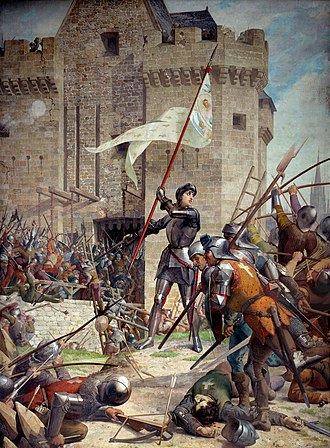
England then focused on France in a long war called the Hundred Years' War. A big victory at the Battle of Agincourt helped for a time, but later losses caused problems at home. After the war ended, fights between different family groups, known as the Wars of the Roses, began. These ended when Henry VII took power and worked to build a stronger central government. Meanwhile, Irish leaders were slowly mixing more with local people, and the island gained more independence under English rule.
Western Europe
The French royal family, known as the House of Valois, struggled at first due to English attacks and the power of the Duchy of Burgundy. A leader named Joan of Arc helped turn the war in favor of the French. Later, King Louis XI continued to strengthen France.
Charles the Bold, Duke of Burgundy, tried to grow his lands but faced resistance, especially from the Swiss Confederation. After his death in 1477, Burgundy was taken back by France. The County of Burgundy and the Burgundian Netherlands became part of the Holy Roman Empire, leading to future conflicts.
Central Europe
Bohemia was successful in the 1300s, but a big change called the Hussite revolution caused trouble. The Holy Roman Empire came under the control of the Habsburg family in 1438. Though they held many lands, the Empire stayed divided, with local rulers having much power. Rich trading groups like the Hanseatic League also had significant influence.
Hungary had a golden age in the 1300s under kings Charles Robert and Louis the Great. The country became wealthy from gold and silver and expanded its influence across Europe. After Louis the Great died without a son, a fight over who should be the next ruler caused an internal war. Sigismund of Luxemburg eventually took control. Later, King Matthias Corvinus built a large army and expanded Hungary's lands. Hungary was one of the first places where the Renaissance began.
Eastern Europe
Kievan Rus' fell in the 1200s due to attacks by the Mongols. The Grand Duchy of Moscow grew stronger after that, winning an important battle against the Golden Horde in 1380. Though Tatar rule continued, Moscow became a key power in the region. Under Ivan the Great, Moscow grew even more, taking over large areas like the Republic of Novgorod. After the fall of Constantinople in 1453, Russian leaders began to see themselves as the successors of the Byzantine Empire and took on the title of Tzar, with Moscow being called the Third Rome.
Southeast Europe
The Byzantine Empire had weakened by the 1300s and became a vassal of the Ottoman Empire. The Fall of Constantinople in 1453 marked the end of the Byzantine Empire. The Bulgarian Empire was also declining, and Serbia rose to power after defeating the Bulgarians in 1330. However, Serbian dominance was short-lived. The Serbian army was defeated by the Ottoman Empire at the Battle of Kosovo in 1389, leading to Ottoman control over much of the region. By the end of the medieval period, the entire Balkan peninsula had either been taken over by or made subordinate to the Ottomans.
Southwest Europe
From 1309 to 1376, the leaders of the Christian church lived in Avignon. When they returned to Rome, the Papal State became a significant power. Florence became a leading city in Italy through banking and became a center for the Renaissance, thanks to the support of the Medici family for artists. Other Italian cities like Milan, Venice, and Genoa also grew stronger. In southern Italy, the War of the Sicilian Vespers split the area between two kingdoms under the control of Aragon and Anjou. In 1442, these kingdoms were united under Aragon.
The marriage of Isabella I of Castile and Ferdinand II of Aragon in 1469 and the death of John II of Aragon in 1479 led to the creation of modern Spain. In 1492, the city of Granada was taken from the Moors, completing the Reconquista. Portugal, under Henry the Navigator, explored the coast of Africa. In 1498, Vasco da Gama found a sea route to India. The Spanish monarchs supported Christopher Columbus's journey to find a western sea route to India, which led to the discovery of the Americas in 1492.
Late medieval European society
See also: Crisis of the Late Middle Ages, Black Death, and Little Ice Age
Around 1300 to 1350, the warm weather changed to colder times called the Little Ice Age. This made it hard to grow enough food, causing a big hunger time known as the Great Famine of 1315–1317.
The biggest problem came later with a sickness called the Black Death, which killed many people. By about 1420, because of this sickness happening again and again, along with hunger times, the number of people in Europe was much smaller than before.
With fewer people around, there was more land for everyone, and work became harder to find. This made workers more valuable. Some leaders tried to keep wages low, but this made people upset and led to protests. Over time, this helped end a system where people were tied to the land they worked on in Western Europe. However, in Eastern Europe, leaders made life harder for workers.
During this difficult time, some groups, like Jewish people, faced unfair treatment. Sadly, many Jewish people were treated very badly.
Even though it was a tough time, women found new chances to take part in business, learning, and religious life. Cities continued to grow and become important places for trade, learning, and government. By 1500, some cities like Venice, Milan, and Paris had over 100,000 people living in them.
Military history
Main article: Medieval warfare
Important battles like Courtrai, Bannockburn, and Morgarten showed that knights on horses were not always the best soldiers. Strong foot soldiers became more important. The English learned about the powerful longbow during the Welsh Wars, and it helped them in their fight with France.
Early firearms did not change battles right away, but cannons used to attack castles did. These new weapons led to changes in how forts were built. Gunpowder also changed how armies were organized and helped countries grow stronger.
Armies changed too. Leaders began hiring professional soldiers, sometimes from other countries. Swiss mercenaries were very popular. France created one of the first standing armies that stayed together all the time.
During this time, knights began to follow a more detailed code of behavior. This idea of chivalry was not just about fighting. New groups like the Order of St. George and the famous English Order of the Garter showed this spirit.
Christian conflict and reform
The Papal Schism
Main article: Western Schism
In the late Middle Ages, the French king had strong influence over the Christian church leaders. This caused a big problem when two leaders were chosen: one in France and one in Rome. This split, called the Western Schism, lasted from 1378 to 1417. It divided Europe, with France and some countries supporting the leader in France, while England and others supported the leader in Rome.
Later, leaders from many parts of Europe met and agreed to have one leader again in Rome. Even though the church was united once more, the split caused people to question the church's power. This led to ideas about changing how the church worked.
Protestant Reformation
Main articles: Reformation, Hussites, and Lollardy
During this time, many people began to question the rules and teachings of the Christian church. In England, a teacher named John Wycliffe said that the Bible should be the main guide for faith and spoke out against some church practices. His ideas spread.
In the Czech lands, a priest named Jan Hus shared similar ideas. When he was asked to explain his beliefs, he was treated unfairly, which upset many people. Though his followers tried to make changes, they could not alter the church's rules.
Later, a German monk named Martin Luther shared his concerns about the church in 1517. He was asked to take back his words but refused, and many people listened to him instead of the church leaders. This led to big changes in Europe, with different areas choosing different leaders for their faith.
Trade and commerce
Major trade routes
The growing power of the Ottoman Empire in the eastern Mediterranean made trade harder for western Christian nations. To fix this, Portuguese and Spanish explorers found new routes. They sailed south of Africa to reach India, and crossed the Atlantic Ocean to reach America. As Genoese and Venetian merchants made sea routes to Flanders, the Champagne fairs became less important.
Shifts in exports and the commercial revolution
During this time, England changed what it sold from raw wool to processed cloth. This hurt cloth makers in the Low Countries. In the Baltic and North Sea, the Hanseatic League was very strong in the 1300s but lost power in the 1400s.
Big changes happened in trade and business, mostly in Italy but also in parts of Europe. New ideas included different types of partnership and insurance to make trade safer. There were also new ways to send money, like the bill of exchange, which helped avoid carrying valuable metals. Better accounting methods, especially double-entry bookkeeping, made business more organized.
As money became more important, only some groups controlled trade rights. Towns gained more power in guilds, and some special companies got exclusive rights to certain trades, like the English wool Staple. Wealthy families such as the Fuggers in Germany, the Medicis in Italy, and the de la Poles in England, as well as individuals like Jacques Cœur in France, became very rich and even influenced kings.
Technology
Main articles: Glasses § Invention, Venetian glass, and Printing press § Circulation of information and ideas
In the Late Middle Ages, new inventions changed everyday life and learning. Around 1290, the first eyeglasses were made in Italy. Soon, many people in Europe used them to see better. By the mid-1400s, glassmakers in Venice made very clear glass for windows and mirrors.
The printing press was invented around 1440 in Germany. It let books be made faster and cheaper, so more people could read and learn. This helped share ideas across Europe. Other tools like the compass helped sailors travel farther across the oceans.
Arts and sciences
In the 1300s, a new way of thinking called humanism began to grow. This movement brought back ideas from old Greece and Rome. It also helped create new ways of thinking about science, art, and writing.
Artists started to try new things. They began to paint and build in ways that made things look more real. In places like Italy, rich families helped artists create beautiful paintings and buildings. Farther north, in places like the Netherlands, artists also made new kinds of paintings.
Writers began using their own languages instead of just Latin. This made stories and poems easier for everyone to read. Famous books from this time include stories written in Italian and English.
Music was also important. Singers and composers made new kinds of songs in churches and at parties.
Plays became popular too. Some were about religious stories, while others were funny or told about everyday life. As time went on, these plays changed and new kinds of stories began to appear.
Ottomans and Europe
Main article: Ottoman wars in Europe
By the end of the 15th century, the Ottoman Empire had spread across Southeast Europe, taking over the Byzantine Empire and controlling the Balkan states. Hungary was the last strong Christian nation in the east, fighting for over two centuries to defend itself. After the young king Vladislaus I of Hungary died in the Battle of Varna in 1444, Count John Hunyadi took charge of Hungary until 1453. Hunyadi was a great military leader and was called Athleta Christi, or Champion of Christ, by Pope Pius II for his efforts to stop the Ottomans.
Hunyadi had a major victory during the siege of Belgrade in 1456. This battle was supported by many people who believed in fighting for their faith, thanks to a Franciscan friar named Saint John of Capistrano from Italy. After Hunyadi died, his son Matthias became king of Hungary. Matthias came from an aristocratic family, not a royal one. King Matthias Corvinus led Hungary from 1458 to 1490. He fought against groups called the Hussite Protestants and also dealt with conflicts with the German emperor Frederick III of Habsburg. Matthias created a large group of soldiers called the Black Army, which was one of the biggest armies of its time. He used this army to defend against the Ottoman forces. After Matthias died and the Black Army ended, the Ottoman Empire became stronger. In the Battle of Mohács, the Ottoman forces defeated the Hungarian army. Many leaders died in this battle, marking one of the last major battles of medieval times.
Timeline
Main article: Timeline of the Middle Ages
Dates are approximate, consult particular articles for details Middle Ages themes Other themes
See also: World history (field)
Main article: 14th century
- 1305: William Wallace died.
- 1307: The Knights Templar were no longer active.
- 1309: The Pope moved to Avignon papacy.
- 1310: Dante started writing Divine Comedy.
- 1314: Battle of Bannockburn happened.
- 1315–1317 There was a Great Famine.
- 1321–1328 There was a Byzantine civil war.
- 1328: The First War of Scottish Independence ended.
- 1337: The Hundred Years' War started.
- 1346: Stephen Dušan made a Serbian Empire.
- 1347: The Black Death started.
- 1347: The University of Prague opened.
- 1348: Giovanni Villani finished Nuova Cronica.
- 1348–1349 There was a Byzantine–Genoese War.
- 1362: Battle of Blue Waters
Lithuania defeated Golden Horde. Kiev became part of the Grand Duchy of Lithuania.
- 1364: Jagiellonian University opened.
- 1371: Battle of Maritsa happened; Bulgaria was divided.
- 1376: The Avignon Papacy ended.
- 1380: Battle of Kulikovo happened.
- 1380: The Canterbury Tales were written.
- 1381: There was a Peasants' Revolt in England.
- 1381: John Wycliffe translated the Bible.
- 1385: The Union of Krewo began the Polish–Lithuanian union.
- 1385: Battle of Aljubarrota happened.
- 1386: The University of Heidelberg opened.
- 1389: Battle of Kosovo happened.
- 1342–1392 The Kingdom of Rus was divided between Poland and Lithuania (Galicia–Volhynia Wars).
- 1396: Battle of Nicopolis happened.
- 1397: Kalmar Union formed.
Main article: 15th century
- 1402: Battle of Ankara happened.
- 1409: Venetian Dalmatia was under Venice.
- 1410: Battle of Grunwald happened.
- 1415: Conquest of Ceuta happened.
- 1415: Battle of Agincourt happened.
- 1417: The Council of Constance happened.
- 1419–1434 There were Hussite Wars in Bohemia.
- 1428–1429 The Siege of Orléans happened.
- 1434: The Medici family led Florence.
- 1439: Johannes Gutenberg began printing in Europe.
- 1444: Battle of Varna happened.
- 1445: Battle of Suzdal happened.
- 1453: Constantinople falls to the Ottomans.
- 1455: The Gutenberg Bible was printed.
- 1456: Siege of Belgrade happened.
- 1461: The Empire of Trebizond fell to the Turks.
- 1469: The Catholic Monarchs were married.
- 1470: Battle of Lipnic happened.
- 1474–1477 There were Burgundian Wars.
- 1478: Muscovy took Novgorod.
- 1478: The Catholic Monarchs started the Spanish Inquisition.
- 1479: Battle of Breadfield happened.
- 1480: The Great Stand on the Ugra River happened.
- 1485: Thomas Malory wrote Le Morte d'Arthur.
- 1492: The Alhambra Decree was issued.
- 1492: The Reconquista ended with the fall of Granada.
- 1492: Christopher Columbus reached the "New World".
- 1494: The Treaty of Tordesillas was signed.
- 1496: Nicolaus Copernicus joined the University of Bologna.
- 1497–1498 Vasco da Gama reached India by sailing around Africa.
- 1499: Battle of Zonchio happened.
Images
Related articles




This article is a child-friendly adaptation of the Wikipedia article on Late Middle Ages, available under CC BY-SA 4.0.
Images from Wikimedia Commons. Tap any image to view credits and license.