 Safekipedia
Economy of Sudan
Adapted from Wikipedia · Adventurer experience
Sudan has a developing economy that mostly relies on farming and selling oil. It also gets money from mining and making things. In 2006 and 2007, Sudan’s economy grew very fast, by more than 10% each year. By 2019, Sudan’s total money from all its work and products, called gross domestic product (GDP), was about $30.873 billion. The country works with the International Monetary Fund (IMF) to improve its money rules.
Farming is a big part of Sudan’s work. It gives jobs to most people and makes a lot of the country’s money. But problems like the War in Darfur, the effects of a long war in the south called the Second Sudanese Civil War, poor roads, and tools mean many people stay poor. In January 2007, Sudan started using a new kind of money called the Sudanese pound. Today, Sudan is still considered a least developed country by the United Nations.
History
Main article: Economic history of Sudan
Sudan's economy grew quickly in the 1960s and 1970s, but then slowed down in the 1980s and 1990s. In the 1970s, Sudan started exporting food and cash crops, but falling prices caused problems. The government tried to fix the economy, but faced many challenges.
Since April 2023, a civil war has caused big problems for Sudan's economy. Economic activity dropped, and many important areas were damaged. The value of Sudan's currency fell, and trade decreased. Much of the farmland could not be used, making it hard to grow food. Both sides in the conflict have used money from selling gum arabic to support their efforts.
Sectors
Main article: Agriculture in Sudan
Sudan’s economy depends a lot on agricultural resources. Important crops include cotton, peanuts, gum arabic, and sesame seeds. Cotton and peanuts are key exports. Sorghum is the main food crop, and wheat is grown for local use. Livestock such as cows, sheep, and camels are also important and often exported. Sudan still needs to import some food because of challenges in investment, production, and transportation.
Sudan has plenty of usable land, with major farming projects to grow more food locally. The country grows valuable crops like sugarcane, dates, and citrus fruits in irrigated areas. Cotton is very important, and Sudan is a leading producer of sesame worldwide.
Main article: Manufacturing in Sudan
Sudan’s industry is growing quickly. Factories process farm products and make electronics, plastics, furniture, and sugar. There are also factories for meat and other light goods. Sudan is working to become a center for medical supplies in East Africa. Some factories now build small cars and trucks, as well as tools and equipment. The country also has valuable minerals like gold, which is mined and sold to help the economy.
Main article: Petroleum industry in Sudan
Sudan began finding oil in the 1970s and started exporting it in 2000. Today, oil is a major export and makes up most of Sudan’s sales to other countries. Japan, China, South Korea, Indonesia, and India are the biggest buyers. Most of Sudan’s oil comes from fields in the south, and pipelines carry it to refineries in Khartoum and Port Sudan for processing.
Main article: Mining industry of Sudan
Before oil was found, mining did not add much to Sudan’s economy. Today, besides oil, Sudan has many useful minerals such as gold, chrome, copper, and others that are being explored and used for export.
Employment
See also: Labor unions in Sudan
It can be hard to know exactly how many people work in Sudan because there isn't always good information. Many women and girls in rural areas help with jobs like farming but might not always be counted.
In 1989, it was estimated that more than 7.9 million people had jobs in Sudan. Later, many workers returned from places like Kuwait and Iraq after the 1991 Persian Gulf War, which changed the job situation. By 2000, about 12 million people were part of the labor force, with 9.6 million having jobs. About 30 percent of these workers were women.
Unemployment
Unemployment was made harder by a severe drought in the 1980s. Many people moved to cities like Khartoum looking for work, which added to unemployment and underemployment in urban areas. By 2009, the government thought about 20 percent of people were unemployed, though this might not be completely accurate because many people worked in small farms or informal jobs.
Labor force by sector
For a long time, most people in Sudan worked in agriculture, such as farming, raising animals, or fishing. In the 1950s, about 86 percent of workers were in these jobs. By 1998, this dropped to about 70–80 percent. The services sector, including government jobs, became more important, and by 1998 it employed about 13–22 percent of workers. Industry jobs, like manufacturing and construction, made up about 7–9 percent.
Child labor
Although laws said the minimum working age was 18, these rules were not always followed. Many children aged 10 to 14 worked, sometimes in factories making things like edible oils. Children also commonly helped on family farms from a young age. Laws to protect children from hard work existed but were not well enforced, especially in smaller, informal jobs.
Forced labor
Main article: Slavery in Sudan
Although laws said forced labor was not allowed, some people, especially women and children, were still treated badly and made to work against their will. The government tried to help by forming a committee to find and free people who were taken, but these efforts were not always effective. Even years later, some people were still being forced to work in certain areas.
Infrastructure
Transport
Main article: Transport in Sudan
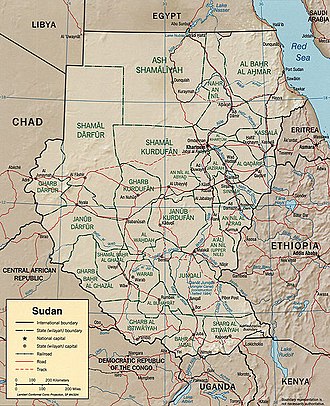
Two big roads cross Sudan. One road goes from north to south. The other road goes from west to east.
Sudan has about 4,700 kilometers of railway tracks. These tracks connect different parts of the country. The main railway starts at the border with Egypt. It goes to the capital, Khartoum, and then to cities in the south and west.
Energy
Main article: Energy in Sudan
In 2010, Sudan's main energy sources were wood, charcoal, hydroelectric power, and oil.
Sudan is working to make more electricity. In 2010, it made about 300 MW of electricity. Most of this came from hydroelectric power. Some European investors are helping with this work. Most of Sudan's hydropower comes from a dam on the Blue Nile. There are plans to build more power sources, but getting money for these plans has been hard. Another dam opened in 2008, and it adds more electricity to the power grid.
Currency and banking
Main articles: Sudanese pound, Inflation in Sudan, and Banking in Sudan
Sudan uses the Sudanese pound for money. The country works with groups like the International Monetary Fund to help manage its money and economy. This includes changes to how the value of the Sudanese pound is set compared to other currencies.
Trade, sanctions, and foreign aid
Main articles: Foreign trade of Sudan and Foreign aid to Sudan
See also: Foreign relations of Sudan
In 1997, the U.S. government placed restrictions on trade with Sudan. The U.S. was concerned about Sudan. Because of this, American companies could not invest in Sudan's oil industry. Instead, businesses from China, Malaysia, and India became the main investors.
Traditionally, Sudan received help from countries like the United States, the United Kingdom, the Netherlands, Italy, Germany, Saudi Arabia, Kuwait, and members of the Organization of Petroleum Exporting Countries. Sudan also worked as a bridge between Arab and African nations, with important offices in its capital, Khartoum. The World Bank used to be a big source of loans for Sudan's development.
Macro-economic trend
See also: Inflation in Sudan
The table below shows key economic numbers from 1980 to 2024. Inflation under 5% is shown in green.
| Year | GDP (in bn. US$ PPP) | GDP per capita (in US$ PPP) | GDP (in bn. US$ nominal) | GDP growth (real) | Inflation, CPI | Government debt (Percentage of GDP) |
|---|---|---|---|---|---|---|
| 1980 | 20.6 | 1,103 | 9.1 |  2.5% 2.5% |  26.5% 26.5% | n/a |
| 1985 | 27.2 | 1,241 |  5.5 5.5 | −0.6% | 45.6% | n/a |
| 1990 | 39.6 | 1,538 | 2.2 | 0.8% | −0.9% | n/a |
| 1995 | 58.5 | 2,092 | 6.7 | 8.9% | 68.4% | 239% |
| 2000 | 86.9 | 2,794 | 13.1 | 8.4% | 7.1% |  143% 143% |
| 2005 | 135.1 | 3,828 | 35.2 | 5.6% | 8.5% | 75% |
| 2006 | 148.4 | 4,098 | 45.3 | 6.5% | 7.2% | 64% |
| 2007 | 161.2 | 4,337 | 59.4 | 5.7% | 14.8% | 54% |
| 2008 | 170.6 | 4,475 | 64.8 | 3.8% | 14.3% | 56% |
| 2009 | 166.9 | 4,267 | 54.8 | −2.8% | 11.3% | 71% |
| 2010 | 175.4 | 4,371 | 65.7 | 3.9% | 13.0% | 75% |
| 2011 | 173.3 | 5,306 | 66.4 | −3.2% | 18.1% | 78% |
| 2012 | 146.5 | 4,180 | 48.9 | −17.0% | 35.6% | 118% |
| 2013 | 151.9 | 4,201 | 52.9 | 2.0% | 36.5% | 106% |
| 2014 | 161.8 | 4,338 | 60.7 | 4.7% | 36.9% | 84% |
| 2015 | 171.3 | 4,456 | 64.5 | 4.9% | 16.9% | 93% |
| 2016 | 181.0 | 4,572 | 64.9 | 4.7% | 17.8% | 110% |
| 2017 | 185.7 | 4,553 | 48.9 | 0.8% | 32.4% | 150% |
| 2018 | 192.3 | 4,580 | 33.6 | −2.3% | 63.3% | 210% |
| 2019 | 183.6 | 4,248 | 31.5 | −2.5% | 51.0% | 217% |
| 2020 | 197.6 | 4,455 | 35.2 | −3.6% | 163.3% | 278% |
| 2021 | 171.1 | 3,761 | 35.1 | 0.5% | 359.1% | 190% |
| 2022 | 178.7 | 3,829 | 33.5 | −2.5% | 138.8% | 187% |
| 2023 | 151.3 | 3,158 | 38.1 | −18.3% | 77.2% | 252% |
| 2024 | 123.5 | 2,513 | 29.8 | −20.3% | 200.1% | 344% |
Related articles



This article is a child-friendly adaptation of the Wikipedia article on Economy of Sudan, available under CC BY-SA 4.0.
Images from Wikimedia Commons. Tap any image to view credits and license.