 Safekipedia
Euro
Adapted from Wikipedia · Adventurer experience
The euro (symbol: €; currency code: EUR) is the money used by 21 of the 27 member states of the European Union. These countries are called the euro area or the eurozone. The euro is split into 100 euro cents.
Besides these countries, the euro is also used by the institutions of the European Union, four small European states that are not EU members, one British Overseas Territory, and two other European states. Some special areas of EU member countries also use the euro.
Over 350 million people use the euro every day. It is also the second-most traded currency in the world after the United States dollar. The name euro was chosen on 16 December 1995 in Madrid. The euro started as a way to keep track of money on 1 January 1999 and became real money people could use on 1 January 2002.
Characteristics
Administration
The euro is looked after by the European Central Bank and the Eurosystem, which includes the banks of the eurozone countries. The ECB decides on important money rules, like interest rates. The Eurosystem helps make and send out euro banknotes and coins for all the countries that use the euro.
Many countries in the European Union agreed to use the euro when they met certain financial goals. Denmark has special rules, and Sweden chose not to use the euro in a vote in 2003. Countries that joined the EU after 1993 have promised to use the euro later. The rules were updated with the Treaty of Nice in 2001.
Countries that use the euro
The euro is used by 44 different countries and areas. These include members of the eurozone and some places that are not part of this group but still use the euro.
Eurozone members
The 21 members that use the euro as their main money are:
- Austria
- Belgium
- Bulgaria
- Croatia
- Cyprus
- Estonia
- Finland
- France
- Germany
- Greece
- Ireland
- Italy
- Latvia
- Lithuania
- Luxembourg
- Malta
- Netherlands
- Portugal
- Slovakia
- Slovenia
- Spain
Special territories of members of the European Economic Area
Main article: Special territories of members of the European Economic Area
Some special areas of European countries also use the euro. These include places like French Guiana, Guadeloupe, and the Azores.
Other users
Some smaller places and territories also use the euro, even if they are not part of the eurozone. These include Andorra, Monaco, and Kosovo
EU members not using the euro
Main articles: Enlargement of the eurozone and Currencies of the European Union
See also: Czech Republic and the euro, Hungary and the euro, Poland and the euro, Romania and the euro, and Sweden and the euro
Some European Union countries plan to use the euro as their money later, but they don’t have to yet. These countries are:
See also: Denmark and the euro and United Kingdom and the euro
Two countries, Denmark and the United Kingdom, can keep their own money. Denmark uses the Danish krone, and the United Kingdom used the pound sterling before it left the European Union in 2020.
Coins and banknotes
Coins
See also: List of Euro coin series and Identifying marks on euro coins
The euro is divided into 100 cents, also called euro cents. All coins show their value and a map. The coins have different values: €2, €1, 50c, 20c, 10c, 5c, 2c, and 1c. Some places round amounts to the nearest five cents so they don’t need to use the smallest coins.
Banknotes
Euro banknotes have different colors and values: €500, €200, €100, €50, €20, €10, and €5. Each banknote is a different color and shows pictures of windows and bridges. These images represent connections between countries.
The newer set of banknotes no longer includes the €500 note. Both the old and new banknotes are still used.
In December 2021, plans were announced to create a new design for euro banknotes by 2024.
Payments clearing, electronic funds transfer
Main article: Single Euro Payments Area
Money can be sent between any countries in the EU with no extra fees when using euros. Credit and debit card payments within the eurozone are treated the same as local transactions.
| Image | Value | Year | Dimensions (millimetres) | Main colour | Design | Printer code position | |||||
|---|---|---|---|---|---|---|---|---|---|---|---|
| Obverse | Reverse | Architecture | Century | ||||||||
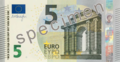 |  | €5 | 2013 | 120 × 62 mm | Grey | Classical | 8th BC–4th AD | Top right | |||
 |  | €10 | 2014 | 127 × 67 mm | Red | Romanesque | 11–12th | ||||
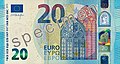 | 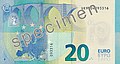 | €20 | 2015 | 133 × 72 mm | Blue | Gothic | 13–14th | ||||
| €50 | 2017 | 140 × 77 mm | Orange | Renaissance | 15–16th | ||||||
| €100 | 2019 | 147 × 77 mm | Green | Baroque & Rococo | 17–18th | ||||||
| €200 | 153 × 77 mm | Yellow-brown | Art Nouveau | 19th | |||||||
| These images are to scale at 0.7 pixel per millimetre (18 pixel per inch). For table standards, see the banknote specification table. | |||||||||||
History
Main article: History of the euro
The euro was created because of rules set in 1992. Countries needed to follow rules about their money and economy to use the euro. The name "euro" was chosen in 1995.
The euro started being used for bank accounts and electronic payments on January 1, 1999. Real euro coins and notes came later, on January 1, 2002. People could still use their old money for a short time after that.
Currency sign
A special symbol for the euro (€) was designed after people voted for their favorite. The symbol looks like the letter "E" with two lines through it.
Eurozone crisis
See also: 2008–2011 Icelandic financial crisis
After a big money problem in 2008, some countries that use the euro had trouble paying their debts. This was hard for Greece and also affected Cyprus, Ireland, Italy, Portugal, and Spain. These countries got help from EU funds, except Italy. The crisis showed that the euro area needed stronger rules to work well together.
| Currency | Code | Rate | Fixed on | Yielded |
|---|---|---|---|---|
| Austrian schilling | ATS | 13.7603 | 31 December 1998 | 1 January 1999 |
| Belgian franc | BEF | 40.3399 | 31 December 1998 | 1 January 1999 |
| Dutch guilder | NLG | 2.20371 | 31 December 1998 | 1 January 1999 |
| Finnish markka | FIM | 5.94573 | 31 December 1998 | 1 January 1999 |
| French franc | FRF | 6.55957 | 31 December 1998 | 1 January 1999 |
| German mark | DEM | 1.95583 | 31 December 1998 | 1 January 1999 |
| Irish pound | IEP | 0.787564 | 31 December 1998 | 1 January 1999 |
| Italian lira | ITL | 1,936.27 | 31 December 1998 | 1 January 1999 |
| Luxembourg franc | LUF | 40.3399 | 31 December 1998 | 1 January 1999 |
| Portuguese escudo | PTE | 200.482 | 31 December 1998 | 1 January 1999 |
| Spanish peseta | ESP | 166.386 | 31 December 1998 | 1 January 1999 |
| Greek drachma | GRD | 340.750 | 19 June 2000 | 1 January 2001 |
| Slovenian tolar | SIT | 239.640 | 11 July 2006 | 1 January 2007 |
| Cypriot pound | CYP | 0.585274 | 10 July 2007 | 1 January 2008 |
| Maltese lira | MTL | 0.429300 | 10 July 2007 | 1 January 2008 |
| Slovak koruna | SKK | 30.1260 | 8 July 2008 | 1 January 2009 |
| Estonian kroon | EEK | 15.6466 | 13 July 2010 | 1 January 2011 |
| Latvian lats | LVL | 0.702804 | 9 July 2013 | 1 January 2014 |
| Lithuanian litas | LTL | 3.45280 | 23 July 2014 | 1 January 2015 |
| Croatian kuna | HRK | 7.53450 | 12 July 2022 | 1 January 2023 |
| Bulgarian lev | BGN | 1.95583 | 8 July 2025 | 1 January 2026 |
Direct and indirect usage
The euro is the main money used by 21 countries in the European Union. These countries are known as the eurozone. The euro is also the official money in four small European countries because of special agreements with the European Union. Other countries that are not part of the European Union also use the euro, either by choice or because they have agreed to use it.
Many other countries tie their money to the euro. This means that the value of their money changes only a little compared to the euro. This helps these countries keep their economies stable and encourages trade with other countries that use the euro. Some of these countries include Bosnia and Herzegovina, Cape Verde, Comoros, and several countries in Africa and the Pacific.
Economics
Optimal currency area
Further information: Optimum currency area
An optimum currency area is a place where it makes sense for everyone to use the same money. Robert Mundell thought the euro was a good idea. But some people worried that countries' economies were different. A big money problem in Greece made some people, like a former British leader named Jack Straw, worry about the euro.
Transaction costs and risks
Having one money for many countries costs less to trade. Before the euro, people and businesses had to pay to change money when they bought things from other countries. Now, banks in the eurozone charge the same for sending money between countries as they do inside one country.
Price parity
With one money, prices should get closer together. This means things should cost about the same in different places. If prices are different, people might buy from the cheaper place, which can change prices over time.
Macroeconomic stability
Before the euro, some countries kept prices from going up too fast by having their own banks control money. Germany had a strong bank called the Bundesbank, and the European Central Bank was made to work like it.
Trade
The euro made it easier to see prices and helped people trade more with each other. Studies show trade went up a little, but it's not clear if this was just because of the euro or other rules helping Europe work together.
Investment
Having one money helped people invest more. Companies could get money more easily, especially in countries that used to have weaker money.
Inflation
When the euro started, many people thought prices went up, but this was not true for most things. It mainly seemed to happen with cheap things that people buy often.
Exchange rate risk
With one money, there is less risk that the value of money will change when people trade with each other. This helped companies, especially in Europe, to feel safer when they bought and sold things.
Financial integration
The euro helped Europe work together more in money matters. It became cheaper for companies to borrow money, and people could invest more easily in other countries.
Effect on interest rates
Since the euro started, the cost of borrowing money went down in many countries. But after a big money problem in 2008, some countries borrowed too much and had to help their banks, which made their debt very big.
Price convergence
It's not clear if prices got closer together after the euro started. Some studies say yes, some say no. It might have taken time to see any big changes.
Tourism
The euro seems to have made it easier for people to travel inside Europe, with more people visiting different countries.
Exchange rates
The European Central Bank works to control inflation and usually does not try to change the value of the euro compared to other currencies. This is because trying to control both interest rates and exchange rates at the same time is very hard.
The euro is the second most commonly used currency in the world after the U.S. dollar. When it started on January 4, 1999, its value went down against other major currencies like the British pound, U.S. dollar, and Japanese yen. It later went back up and reached its highest points in 2008. Even during financial troubles, the euro stayed fairly stable. In July 2022, the euro and the U.S. dollar were worth the same for a short time. By April 17, 2026, the euro had reached its highest value ever against the Japanese yen.
Political considerations
The euro was created to help Europeans feel more connected. Leaders talked about this idea, but a study showed the euro didn’t really make people feel more connected.
Public support for the euro in different EU countries, according to a poll in 2025:
Eurozone
Countries not using the euro


Euro in various official EU languages
Main article: Language and the euro
The euro is the main unit of money, and a cent is one-hundredth of a euro. Most languages in the eurozone use these same words for official purposes.
In English, we use "euro" and "cent" for both singular and plural, like saying "one euro" or "two euros". Bulgaria uses a special spelling for the euro: eвро (evro). Greece uses the word ευρώ (evró) for euro and λεπτό/ά (leptó/á) for cent. Bulgaria also has its own word for cent: стотинка/и (stotìnka/i). The way people say "euro" changes depending on their language's pronunciation rules.
For more details on how amounts are written and said in different languages, see Language and the euro.
| Language(s) | Name | IPA |
|---|---|---|
| In most EU languages | euro | Croatian: [ěuro], Czech: [ˈɛuro], Danish: [ˈœwʁo], Dutch: [ˈøːroː], Estonian: [ˈeu̯ro], Finnish: [ˈeu̯ro], French: [øʁo], Italian: [ˈɛuro], Polish: [ˈɛwrɔ], Portuguese: [ˈewɾɔ] or [ˈewɾu], Slovak: [ˈewrɔ], Spanish: [ˈewɾo] |
| Bulgarian | евро evro | Bulgarian: [ˈɛvro] |
| German | Euro | [ˈɔi̯ʁo] |
| Greek | ευρώ evró | [eˈvro] |
| Hungarian | euró | [ˈɛuroː] or [ˈɛu̯roː] |
| Latvian | euro or eiro | [ɛìro] |
| Lithuanian | euras | [ˈɛʊrɐs] |
| Maltese | ewro | [ˈɛʊ̯rɔ] |
| Slovene | evro | [ˈéːʋrɔ] |
Related articles


This article is a child-friendly adaptation of the Wikipedia article on Euro, available under CC BY-SA 4.0.
Images from Wikimedia Commons. Tap any image to view credits and license.