 Safekipedia
Federally recognized tribe
Adapted from Wikipedia · Adventurer experience
A federally recognized tribe is a Native American tribe that the United States Bureau of Indian Affairs officially recognizes. This means these tribes have their own governments and rights, recognized by the U.S. government. They can make decisions about their lands and people in many ways, similar to small countries within the country.
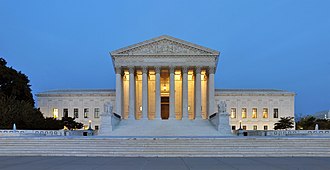
The idea of tribal recognition started with important court cases. In 1831, the Supreme Court of the United States decided in Cherokee Nation v. Georgia that Native American tribes have a special relationship with the United States. This decision helped the U.S. recognize many tribes and their lands, called Indian reservations, where tribes can govern themselves.
Over time, the U.S. government made rules to decide which tribes should be recognized. This became important in the 1970s when many tribes wanted to protect their rights. The Indian Self-Determination and Education Assistance Act of 1975 helped tribes regain control over their own affairs and decisions. Today, more than 574 tribes are federally recognized, each with its own unique culture and history.
Native American sovereignty and the Constitution
The United States Constitution mentions Native American tribes in three places:
- Article I, Section 2, Clause 3 says that when counting people for taxes and representatives, "Indians not taxed" were not included. This means some Native Americans were not treated as citizens at that time.
- Article I, Section 8 gives Congress the power to deal with Native American tribes, showing they are separate from the federal government, states, and foreign nations.
- The Fourteenth Amendment, Section 2 changes how representatives are counted, updating the rule from Article I, Section 2.
These parts of the Constitution help explain three important ideas about Native American tribes today:
- Territorial sovereignty: Tribes have their own authority on their land, and this power does not come from the states.
- Plenary power doctrine: Congress has the main responsibility for decisions affecting tribes, more so than the President or the Courts.
- Trust relationship: The federal government has a duty to protect tribes, which means it must use its powers to support them.
History
Colonial and early U.S. history
When Europeans first came to America, they often took land from Indigenous peoples. They did this in many ways, including making unfair treaties, forcing people off their land, and using violence. These actions caused many problems, like tribes losing their homes.
Early English settlers made agreements, called treaties, with Native American tribes. This helped them take control of the land even though these treaties were not fair. The first reservation was made in 1758 by a treaty between Native American leaders and the governments of New Jersey and Pennsylvania. It was called the Brotherton Indian Reservation and was in southern New Jersey.
In 1824, the U.S. Vice President John C. Calhoun started the Office of Indian Affairs to help manage land issues with Native American tribes.
The Marshall Trilogy, 1823–1832
The Marshall Trilogy was a series of important court decisions in the early 1800s. These decisions helped define the rights of Native American nations. They talked about whether private citizens could buy land from Native Americans, the relationship between tribes and the U.S. government, and the role of the federal government in dealing with tribes.
Letters from the presidents of the United States on Indian reservations (1825–1837)
President Andrew Jackson signed a document in 1825 about Indigenous reservations. Later, President Martin Van Buren made agreements with tribes to build lighthouses and talked about how reservations worked. These agreements often involved tribes selling their land.
Early land sales in Virginia (1705–1713)
In Virginia, there were early land agreements between Indigenous peoples and the colonial government. These agreements recognized the land rights of tribes like the Nottoway after wars.
The beginning of the Indigenous Reservation System in America (1763–1834
The Indigenous Reservation System in America began with laws from Great Britain and the United States. These laws included the Royal Proclamation of 1763, the Indian Removal Act of 1830, and the Non-Intercourse Act of 1834. These laws led to Indigenous peoples being moved to specific reservations.
Treaty between America and the Menominee Nation (1831)
In 1831, there was a treaty between the Menominee Nation and the United States. This treaty caused disputes over land between the Menominee and the State of Wisconsin.
1834 Trade and Intercourse Act (1834)
The Trade and Intercourse Act of 1834 defined the boundaries of Indian Country. This act was created because the U.S. government needed land for troops and for people traveling to places like Oregon and California. The government took Indigenous lands for its own needs.
Indigenous Reservation System in Texas (1845)
Texas had its own way of handling reservations before becoming a state. Texas created small reservations for Indigenous peoples, but the U.S. government later took control of managing these matters.
Rise of Indian removal policy (1830–1868
The Indian Removal Act of 1830 led to a policy of moving Native populations from areas where Europeans lived. One well-known example was the forced move of the Five Civilized Tribes from the Southeastern United States to Indian Territory, known as the Trail of Tears.
Forced assimilation (1868–1887
In 1868, President Ulysses S. Grant tried a new policy called the "Peace Policy". This policy aimed to avoid violence by moving tribes to specific lands and having religious groups help them learn new ways. However, this policy had many problems, including poor conditions on reservations. It was later changed because it led to conflicts.
Allotment Era (1887–1934)
In 1887, the Dawes Act changed reservation policy by giving small pieces of land to individual tribe members instead of whole tribes. This led to a lot of tribal land being lost. This policy ended in 1934 with the Indian Reorganization Act.
The Reorganization Era
The Indian Reorganization Act of 1934, also called the Indian New Deal, gave new rights to Native Americans. It encouraged tribal self-government and helped tribes manage their own lands. The government also invested in infrastructure, healthcare, and education on reservations.
The Termination Era
In 1953, Congress passed a law that gave some states control over legal matters involving Native Americans on their lands. This was seen as unfair by many because it changed the system without the approval of tribal nations.
The Self-Determination Era
In 1969, President Richard Nixon changed U.S. policy towards Native Americans to focus on self-determination instead of termination. This meant that Native American tribes should make their own decisions about their future. Important laws and actions during this time helped tribes govern themselves better and protect their rights. Today, the United States recognizes many Tribal nations, each with its own government and rights.
Federal acknowledgment
After some important decisions in the 1950s, the Bureau of Indian Affairs made rules in 1978 for groups to follow to be recognized as tribes. There are seven main rules that groups need to meet.
Some of these rules can be hard to prove. For example, groups need to show they have a long history together, are known as Native American outside their group, have their own leaders, and come from an old tribe.
To be officially recognized, a tribe can ask the U.S. Congress for recognition or follow these seven rules set by the Office of Federal Acknowledgment. The process can take many years, sometimes even up to 14 years or more. For example, the Shinnecock Indian Nation asked to be recognized in 1978 but was only recognized in 2010, 32 years later. Some people felt the process was very slow, costly, and unfair.
Recently, more tribes have been recognized. In May 2016, the number of recognized tribes grew to 567 when the Pamunkey tribe in Virginia was recognized in 2015. By January 2018, six more tribes in Virginia were recognized under the Thomasina E. Jordan Indian Tribes of Virginia Federal Recognition Act. In July 2018, the U.S. government published an official list of 573 recognized tribes. Then, in December 2019, the Little Shell Tribe of Chippewa Indians of Montana became the 574th recognized tribe. The website USA.gov keeps an updated list of these tribal governments.
Images
Related articles




This article is a child-friendly adaptation of the Wikipedia article on Federally recognized tribe, available under CC BY-SA 4.0.
Images from Wikimedia Commons. Tap any image to view credits and license.