 Safekipedia
Trail of Tears
Adapted from Wikipedia · Adventurer experience
Trail of Tears
The Trail of Tears was a sad and important event in Native American history. It happened between 1830 and 1850 when the United States government made about 60,000 Native Americans from the "Five Civilized Tribes" leave their homes. These tribes included the Cherokee, Muscogee, Seminole, Chickasaw, and Choctaw.
They were forced to move from their lands in the Southeastern United States to a place called Indian Territory west of the Mississippi River. This happened after a law called the Indian Removal Act was passed in 1830.
During the journey, many people got very sick, and some died from diseases, cold weather, and lack of food. This event is remembered as a very difficult and unfair time for Native American communities.
Overview
In 1830, five groups of Native American nations—the Cherokee, Chickasaw, Choctaw, Muscogee, and Seminole—lived in the area known as the American Deep South. Pressure from American settlers led the government to pass the Indian Removal Act that same year, allowing the government to take land from these nations.
Starting in 1831, these nations were required to leave their homes. The Choctaw were the first to go in 1831, followed by the Seminoles in 1832, the Creek in 1834, the Chickasaw in 1837, and finally the Cherokee in 1838. Some stayed behind, but most were forced to travel west to a new area called Indian Territory. During this journey, known as the Trail of Tears, many faced hard conditions like bad weather. Over time, many Native Americans were moved from their lands east of the Mississippi River to make way for settlers.
Legal background
Further information: Worcester v. Georgia
The idea of a special land for Native American nations, called Indian Territory, started with laws that took land away from them east of the Mississippi River. This led to a system where the U.S. government could control Native lands.
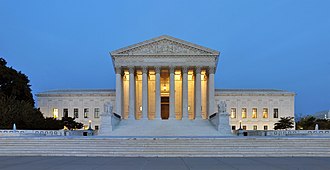
In 1831, the U.S. Supreme Court decided in the case of Cherokee Nation v. Georgia, that the Cherokee nation was not a separate country. This meant they could not ask the court for help.
In 1832, the Supreme Court decided in the case of Worcester v. Georgia, that the Cherokee nation was only under federal law, not state laws. This meant Georgia could not make laws for Cherokee lands. Chief Justice Marshall said the Cherokee had their own land where Georgia's laws did not apply.
However, President Jackson did not use federal officers to make this decision happen. Instead, he tried to make a treaty with the Cherokee for land exchange. At that time, Native Americans were not considered United States citizens, and their land rights were not respected by many states.
Choctaw removal
Main article: Choctaw Trail of Tears
The Choctaw people lived in parts of what are now Alabama, Mississippi, and Louisiana. After many treaties, the United States took their land, and in 1831, they agreed to move west of the Mississippi River. They were the first group to agree to this move.
The Choctaw people traveled in groups, facing very hard conditions. The weather was very cold, and food was scarce. Many became very sick during the journey. About 17,000 Choctaw people made it to a place called Indian Territory, which later became Oklahoma. Sadly, some died along the way. Those who stayed behind faced many problems but later formed their own groups.
Seminole resistance
Main article: Seminole Wars
The United States took control of Florida from Spain in 1821. In 1832, leaders of the Seminole people were asked to talk about moving west. Some agreed to look at the new land, but many later changed their minds. In 1835, a group of Seminoles attacked soldiers, which started a long fight against the U.S. Army. Over time, many Seminoles were forced to move west, but some stayed hidden in the Everglades. By 1842, the fighting stopped, and the remaining Seminoles in the Everglades were allowed to live in peace. They were the only group that never signed a peace treaty with the United States.
Creek dissolution
Main article: Muscogee
After the War of 1812, some leaders of the Muscogee people, also known as the Creek, agreed to give up land to the state of Georgia. This ended the Creek Nation in the South. Even though some leaders wanted peace, they were still forced to give up their lands.
In 1825, some Creek leaders agreed to give up most of their land in Georgia. This made many Creeks very angry, and one leader who agreed was killed. The U.S. government later said the agreement was unfair, but Georgia still tried to force the Creeks to leave their land.
Finally, the Creeks living in Alabama were also forced to leave. They could sell their land and move west, or stay and live under state laws. Many Creeks felt treated unfairly and sometimes fought back, which caused more trouble. By 1836, about 15,000 Creeks were forced to leave their homes and travel west across the Mississippi River. Many did not survive the journey.
Chickasaw monetary removal
See also: Chickasaw
The Chickasaw people got money from the United States for their lands east of the Mississippi River. In 1836, they agreed to buy land from the Choctaw people. They paid the Choctaw people $530,000. The first group of Chickasaw people moved in 1837, led by John M. Millard. They gathered in Memphis on July 4, 1837, with all their things and animals. After crossing the Mississippi River, they followed paths used by other groups. Once in Indian Territory, the Chickasaw people joined with the Choctaw nation.
Cherokee forced relocation
Main article: Cherokee removal
By 1838, many Cherokee had already moved from Georgia to Indian Territory, now Oklahoma. In May 1838, General Winfield Scott was ordered by President Martin Van Buren to move the remaining Cherokees.
The Cherokee Trail of Tears happened because of the Treaty of New Echota. This treaty was made under the Indian Removal Act of 1830. It agreed to trade Indian lands in the East for lands west of the Mississippi River, but most Cherokee did not agree to this.
During this time, the way Cherokee families worked changed. Usually, Cherokee children were part of their mother’s family group, and women controlled property and family matters. But in the 1830s, Cherokee society began to follow more Anglo-American ways, where men had more power.
The land the Cherokee lived on became very wanted, especially after gold was found near Dahlonega, Georgia in 1829. This led to pressure for the Cherokee to leave. In 1830, Georgia tried to control Cherokee lands, but the U.S. Supreme Court said Georgia could not do this. However, President Andrew Jackson did not enforce this decision. Instead, he agreed to move the Cherokee west.
President Van Buren let Georgia, Tennessee, North Carolina, and Alabama use soldiers to move about 13,000 Cherokees to Cleveland, Tennessee. The U.S. military then watched over their journey to Oklahoma. Many Cherokee became very sick and died from disease, hunger, and cold during the trip.
The Cherokee started their long walk of about 1,000 miles in winter 1838. They had little clothing and shoes. They faced many problems, like having to go far around towns and paying a lot to cross rivers. Many died along the way.
Some Cherokee chose to move earlier by water, which was faster. But those who had to walk suffered a lot. This move caused the loss of many lives and also made it hard for the Cherokee to keep their land and traditions. The Cherokee who stayed in places like North Carolina were allowed to stay only under special rules.
The Cherokee Nation grew strong again, and today they are the largest American Indian group in the United States.
Statistics
The Trail of Tears was a sad and difficult time for many people. Many families had to leave their homes and travel long distances to new places. This move was very hard on everyone involved, and many faced many challenges along the way.
Legacy
The forced relocation of Native American nations, called the Trail of Tears, was very sad, especially for the Cherokee people who traveled through Tennessee, Kentucky, and Missouri in 1838.
Historians talk about different ways to describe the Trail of Tears. Some see it as very unfair to a group of people, while others have different ideas. Views vary about what the term "Trail of Tears" really means.
In 1987, a Trail of Tears National Historic Trail was created. It covers about 2,200 miles (3,500 km) across nine states to remember the journeys of the Cherokee people.
The play Unto These Hills has been performed since 1950 to remember this history. There is also a yearly "Remember the Removal Bike Ride" where cyclists follow the old trail. Cherokee artist Troy Anderson made a special medallion to mark the 150th anniversary.
Books and poems, like Family Stories From the Trail of Tears, Walking the Trail by Jerry Ellis, and a poem by Ruth Muskrat Bronson, help keep the memory of this sad time alive.
Images
Related articles




This article is a child-friendly adaptation of the Wikipedia article on Trail of Tears, available under CC BY-SA 4.0.
Images from Wikimedia Commons. Tap any image to view credits and license.