 Safekipedia
Geography of London
Adapted from Wikipedia · Adventurer experience
London is the largest urban area and the capital city of the United Kingdom. It sits in the southeast of Great Britain.
The London region covers 1,579 square kilometres. It is one of the busiest cities in the world.
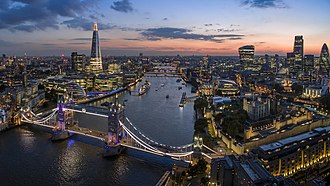
The Thames river is very important to London. The city started on the north side of the river. For a long time, London Bridge was the only way to cross. More bridges were built in the 1700s. This helped London grow. The land around is flat, which made building easier. Today, the Port of London still plays a big role in the city.
360 degree panorama
A nice view of London can be seen from the Golden Gallery of Saint Paul's Cathedral. This view shows the city's many buildings and streets, giving a sense of what London looks like from high up.
Rivers and canals
River Thames
The River Thames is the main river of London, flowing west to east across the London Basin. It is protected by the Thames Barrier at Woolwich to stop flooding. Many smaller rivers and streams flow into the Thames, some of which are now underground.
Left bank tributaries
Larger rivers on the left side of the Thames include the Colne, Crane, Brent, Lea, Roding, Rom, and Ingrebourne. These rivers helped shape the land and provided travel routes and power for old mills. They also helped London grow with factories and industries.
Right-bank tributaries
On the right side of the Thames are rivers like the Mole, Wandle, Ravensbourne, Darent, and Cray. These rivers also provided paths for travel and supported mills and small industries.
Canals
Many canals were built in London in the late 1700s and early 1800s to move goods. Today, most canals are used for fun rather than transport. Important canals include the Regent's Canal, Grand Union, and Lee Navigation, which connect different parts of London and beyond.
Islands in the Thames
Some of the larger islands in the Thames include Chiswick Eyot, Eel Pie Island, and the Isle of Dogs, which includes Millwall and Cubitt Town.
Topography
London is located in a big, bowl-shaped area called the London Basin. Most of the city sits on layers of soil and rock from a time long ago, called the Tertiary period. Only a small part of southern London, near places like Sutton, Banstead, and Croydon, rests on chalk hills that rise up from the ground.
The city is centered around the valley of the River Thames, which runs from west to east like a straight path. The river’s floodplain, where it can sometimes overflow, is about half a mile wide in the western part of London and grows to two miles wide in the east. Around this floodplain are higher, older areas of land called terraces, which stretch several miles away. Important rivers such as the Colne, Crane, Brent, Lea, Wandle, and Ravensbourne also flow towards the Thames, shaping the land around them.
London has a few small hills, but none are very tall. These hills didn’t stop the city from growing in all directions, so the city looks almost circular from above. Some of the well-known hills in central London, like Ludgate Hill, Corn Hill, and Tower Hill, may have helped decide where the very first parts of the city were built. To the north, there are higher areas of land, such as Hampstead Heath and Highgate Hill, formed from sandy soil called the Bagshot formation. South of the Thames, chalk comes closer to the surface, creating ridges like the one that includes Shooter's Hill, Greenwich Park, and Blackheath.
Climate
Main article: Climate of London
London has a mild climate with warm summers and cool winters. The weather changes often, but it is never extremely wet or dry. Because of the urban heat island effect, central London is usually a little warmer than areas farther out.
Winter daytime temperatures are often around 8 °C (46 °F). They can sometimes be as warm as 16 °C (61 °F) or as cold as −7 °C (19 °F). Summer temperatures are usually about 23 °C (73 °F), and on very hot days, they can reach above 31 °C (89 °F). London gets plenty of sunshine, especially in the western parts, with some areas seeing over 1,600 hours of sunshine each year.
Images
Related articles


This article is a child-friendly adaptation of the Wikipedia article on Geography of London, available under CC BY-SA 4.0.
Images from Wikimedia Commons. Tap any image to view credits and license.