Great Britain
Great Britain is an island in the North Atlantic Ocean, off the north-west coast of continental Europe. It covers 209,331 km2 (80,823 sq mi). This makes it the largest of the British Isles, the largest European island, and the ninth-largest island in the world. The island has a maritime climate, so the temperatures change only a little from one season to the next. To the west is the island of Ireland, which is about 40 per cent the size of Great Britain. Together with over 1,000 smaller surrounding islands and named substantial rocks, these islands make up the British Isles archipelago.
The name "Great Britain" can also mean the political territory of England, Scotland and Wales, along with their nearby islands. This territory, together with Northern Ireland, forms the United Kingdom.
Long ago, Great Britain was joined to mainland Europe by a land bridge called Doggerland. This land bridge disappeared about 9,000 years ago. People have lived on the island for around 30,000 years. In 2011, about 61 million people lived there. This made it the world's third-most-populous island, after Honshu in Japan and Java in Indonesia. It was also the most populated island outside of Asia.
The name is also used for a historical state, the Kingdom of Great Britain, and for other meanings found in Great Britain (disambiguation).
Terminology
See also: Terminology of the British Isles
Main article: Britain (place name)
The archipelago has been called by one name for over 2000 years. The name 'British Isles' comes from words that early geographers used for this group of islands. By 50 BC, Greek geographers used a word similar to Prettanikē for the whole group. Later, after the Roman conquest of Britain, the Latin word Britannia was used for the island of Great Britain. The oldest known name for Great Britain is Albion, which may come from a Latin word meaning "white". This may be because of the white cliffs of Dover, which people see first when they come to Britain from the continent. The name Britain comes from the Latin Britannia, meaning the land of the Britons. In the 1st century BC, the Romans used Britannia for the British Isles as a whole. Ptolemy, a Greco-Egyptian scientist, called the larger island "great Britain" in his work Almagest. The term Great Britain was first used officially in 1474.
Today, Great Britain refers to the island itself. In politics, it means England, Scotland and Wales together, but not Northern Ireland. The name Britain is sometimes used for the whole United Kingdom, and even government documents do not always use the names in a clear way. In 1707, the Acts of Union joined the parliaments of England and Scotland. This formed the Kingdom of Great Britain, which covered the entire island.
History
Main article: Prehistoric Britain
The oldest known signs of archaic humans in Britain are the Happisburgh footprints and stone tools found in Norfolk. They are about 850,000 to 950,000 years old. Before 450,000 years ago, Britain was joined to mainland Europe. Then a great flood created the English Channel, and Britain became an island. This happened during warm interglacial periods, such as the Last Interglacial/Eemian. Modern humans arrived about 40,000 years ago, after the Neanderthals had disappeared. Remains found in Kents Cavern in Devon show this. Until about 9,000 years ago, a low, marshy land called Doggerland still linked Britain to what are now Denmark and the Netherlands. During the Mesolithic period, hunter gatherers lived in Britain. Later, Neolithic farmers from Anatolian lands arrived around 4000 BC and came to live there instead. Around 2000 BC, the Bell Beaker Culture of the Bronze Age arrived. During the Iron Age, various Celtic tribes lived in Britain.
Main articles: Roman Britain, Medieval England, Medieval Scotland, and Medieval Wales
The Romans took control of most of the island, up to Hadrian's Wall in northern England. This land became the Ancient Roman province of Britannia. After the Roman Empire fell, the Britons of the south and east lost much of their land to invading Germanic tribes. These included the Angles, Saxons, and Jutes, often called Anglo-Saxons. At about the same time, Gaelic tribes from Ireland settled in the north-west. They mixed with the Picts and Britons of northern Britain. Over time, this led to the Kingdom of Scotland, formed in the 9th century. The south-east of Scotland was settled by the Angles and was part of the Kingdom of Northumbria until 1018. The people of south-east Britain came to be called the English people, named after the Angles. Germanic speakers had called Britons "Welsh", a name that survives in Wallace and in Cornwall. Many Britons moved to Brittany, where Breton, a language related to Welsh and Cornish, is still spoken. In 959, Edgar united the English kingdoms under one ruler. In 1066, England was conquered by the Normans. Wales came under Anglo-Norman control in 1282.
Main article: Early modern Britain
Further information: History of the United Kingdom
In 1604, King James, who ruled both England and Scotland, called himself "King of Great Brittaine, France, and Ireland". England and Scotland had remained separate countries with their own parliaments. In 1707, an Act of Union joined them into a single kingdom with one parliament. The Treaty of Union named the new state "Great Britain". Historians often call the state that existed from 1707 to 1800 the "Kingdom of Great Britain".
Geography
Further information: Geography of England, Geography of Scotland, and Geography of Wales
See also: Geography of the United Kingdom
Great Britain lies on the Eurasian Plate, off the north-west coast of continental Europe. The North Sea and the English Channel separate it from the mainland. The Channel narrows to 34 km at the Straits of Dover. The island covers 209,331 km2, not counting the smaller islands around it. Other seas separate it from Ireland to the west. Since 1993, it has been connected to continental Europe by the Channel Tunnel. This is the longest undersea rail tunnel in the world. The east and south have low, rolling countryside. The west and north have hills and mountains. More than 1,000 smaller islands lie around it. About 10,000 years ago, sea levels were lower, and Great Britain was not an island. The land that is now the North Sea was a land bridge called Doggerland. Later, sea levels rose. By around 6500 BC, Doggerland had flooded, and Great Britain was cut off from Europe.
The island's rocks are very old and varied, so it has many kinds of landscapes. The oldest rocks are the Lewisian gneisses. They are found in the far north-west and on the Hebrides. They are at least 2,700 million years old. The island has fewer plants and animals than much larger continental Europe. This is partly because it is small and separated from the mainland. Animals include red deer, red foxes, and golden eagles. The island has 628 recorded bird species. It has 3,354 vascular plant species, including the Douglas firs, which are the tallest trees. The Fortingall Yew is the oldest tree in Europe. Many fungi species also live on the island, and experts think many more are still to be discovered.
Demographics
Main article: Demographics of the United Kingdom
Further information: Demographics of England, Demographics of Scotland, and Demographics of Wales
See also: List of urban areas in the United Kingdom
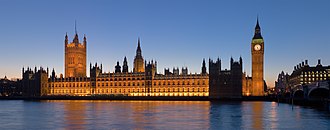
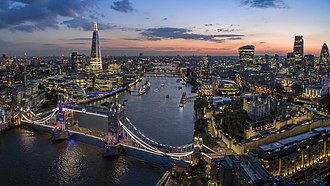
London is the capital of England and the whole United Kingdom. It is also where the United Kingdom's government works. Edinburgh is the capital of Scotland. It is home to the Scottish Government and the highest courts in Scotland. The Palace of Holyroodhouse in Edinburgh is an official residence of the British monarch in Scotland. Cardiff is the capital of Wales and is home to the Welsh Government.
The Celtic languages began long ago with the Hallstatt culture. The Welsh, Cornish, and Breton languages all come from one shared old language. During the Roman period, some Latin words were added to it. Today, British English is spoken across the island. It grew from the Old English that Anglo-Saxon settlers brought in the mid 5th century. About 1.5 million people speak Scots, and about 700,000 speak Welsh, which is an official language in Wales. In parts of north-west Scotland, people still speak Scottish Gaelic widely.
Christianity has been the largest religion since the Early Middle Ages. It was first brought here under the ancient Romans. The most popular form is Anglicanism. The Catholic Church is the second largest Christian group. The Church of Scotland is the third largest, and Methodism is the fourth. Many other religions are practised too, including Islam, Hinduism, Sikhism, Buddhism, and Judaism. The first patron saint of Great Britain was Saint Alban. Saint George and Saint Andrew appear on the flags of England and Scotland.
| Rank | City-region | Built-up area | Country | Population (2011 Census) | Area (km2) | Density (people/km2) |
|---|---|---|---|---|---|---|
| 1 | London | Greater London | England | 9,787,426 | 1,737.9 | 5,630 |
| 2 | Manchester–Salford | Greater Manchester | England | 2,553,379 | 630.3 | 4,051 |
| 3 | Birmingham–Wolverhampton | West Midlands | England | 2,440,986 | 598.9 | 4,076 |
| 4 | Leeds–Bradford | West Yorkshire | England | 1,777,934 | 487.8 | 3,645 |
| 5 | Glasgow | Greater Glasgow | Scotland | 1,209,143 | 368.5 | 3,390 |
| 6 | Liverpool | Liverpool | England | 864,122 | 199.6 | 4,329 |
| 7 | Southampton–Portsmouth | South Hampshire | England | 855,569 | 192.0 | 4,455 |
| 8 | Newcastle upon Tyne–Sunderland | Tyneside | England | 774,891 | 180.5 | 4,292 |
| 9 | Nottingham | Nottingham | England | 729,977 | 176.4 | 4,139 |
| 10 | Sheffield | Sheffield | England | 685,368 | 167.5 | 4,092 |

Quiz time!
4 questions about Great Britain
Which of these is true about Great Britain?
Pictures
Keep exploring




This article is a child-friendly adaptation of the Wikipedia article on Great Britain, available under CC BY-SA 4.0.
Images from Wikimedia Commons. Tap any image to view credits and license.