Safekipedia

Greco-Persian Wars

Adapted from Wikipedia · Adventurer experience

An ancient Greek painting showing two soldiers from the Greek-Persian Wars, made around 400 BC. This artwork helps us learn about history and how people dressed and fought long ago.

Greco-Persian Wars

The Greco-Persian Wars (also often called the Persian Wars) were a series of conflicts between the Achaemenid Empire and Greek city-states. They started in 499 BC and lasted until 449 BC.

The wars began when the Persians, under Cyrus the Great, took control of Greek areas in Ionia. The Greeks there were hard to govern, and this caused tension.

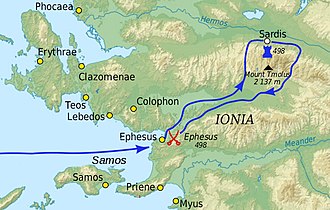
The wars truly began when a leader from Miletus, Aristagoras, tried to attack the island of Naxos with Persian help but failed. He then led a rebellion of Greek cities in Asia Minor against Persian rule, known as the Ionian Revolt. With help from Athens and Eretria, they attacked the Persian city of Sardis.

The Persians tried to conquer Greece twice. The first attempt ended with a big defeat at the Battle of Marathon. Later, Darius’s son Xerxes led a larger army. Although they burned Athens, the Greeks won important sea battles at the Battle of Salamis and Battle of Mycale. These victories helped the Greeks protect their lands.

Images

A marble bust of Herodotus, the ancient Greek historian.
An ancient Roman bust of the historian Thucydides, displayed in the Royal Ontario Museum.
Ancient Persian warrior relief from the ruins of Persepolis, Iran.
Historical illustration of the Ceremony of Presenting Earth and Water from the Achaemenid Empire.
An ancient coin from Athens, dating back to around 510 to 490 BC, showcasing early Greek artistry and history.
Historical map showing key events of the Ionian Revolt around 500 BC in the Aegean region.
A historical map showing the strategic movements of Greek forces during the Battle of Marathon.
Ancient engraved artwork showing a Persian king and Greek soldiers from history.
Historical drawings and analysis related to the Tomb of Xerxes I
An ancient cylinder seal showing a Persian soldier and a Greek hoplite from the Greco-Persian Wars, showcasing historical art from the British Museum.
An ancient Greek hoplite warrior depicted on the Vix krater, circa 500 BCE, showcasing early military armor and design.
Map showing troop movements during the Battle of Thermopylae and the naval battle at Salamis in 480 BC.
A view of the ancient Thermopylae pass in Greece, showing where the coastline once lay near the Phocian Wall.

Related articles

This article is a child-friendly adaptation of the Wikipedia article on Greco-Persian Wars, available under CC BY-SA 4.0.

Images from Wikimedia Commons. Tap any image to view credits and license.