 Safekipedia
Influence of French on English
Adapted from Wikipedia · Adventurer experience
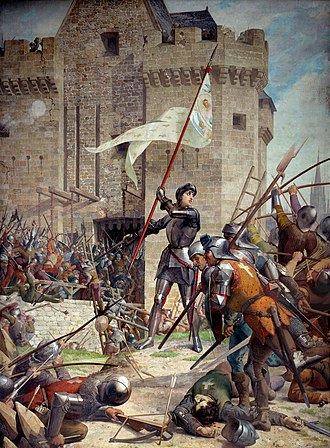
The influence of French on English is mostly seen in the words we use, how we spell them, and a little in how we put sentences together and say words. Most French words entered English after the Norman Conquest in 1066, when Old French, especially the Old Norman dialect, became the language of the new Anglo-Norman court, government, and wealthy people. This lasted for many years, even through the Hundred Years' War from 1337 to 1453. Even today, English still gets ideas and words from French. Experts think that about one-third to two-thirds of English words come from French.
Background
Main article: History of English
In the early 1000s, Old English had many different forms spoken across England. One form, from the area around Winchester, became the main language for writing.
In 1066, William, Duke of Normandy, came to rule England. His followers brought their French language, which became the language of the king, the government, and rich people. For many years, French was spoken by those in power in England.
Over time, English grew stronger. By the 1300s, English was used more in schools and government. The printing press, which came in the late 1400s, helped English spread even more. By then, English was the main language of England once more.
Main article: Norman Conquest
See also: Anglo-Norman language and Norman language
Lexical
Main article: List of English words of French origin
French has had a big effect on the English language, especially in the words we use. About a third of English words come from French. Some experts think it may be even more. Over 40,000 English words are taken directly from French.
These French words came into English slowly over a long time. They entered many parts of life, such as government, the church, law, war, fashion, food, and learning. For example, words like authority, religion, justice, army, gown, feast, paper, and study all have French roots.
Sometimes, the same French word came into English more than once, leading to pairs of words with similar spellings but different meanings, like catch and chase. The biggest wave of these borrowed words happened between 1250 and 1400. After that, fewer French words entered English, but they still do today.
Morphological and syntactical
Over time, English changed some of its words because of French. For example, instead of using old words like thou and thee, English started using you, which is similar to how French uses vous in formal situations.
French also helped shape how we make words that are more than one. In English, we often add -s to make plurals, like "cats" or "dogs." This habit might have been strengthened by French, where they also use a similar way to show more than one thing.
English also uses some special beginning and ending parts of words that came from French, such as pre-, -ous, -ity, -tion, -ture, -ment, -ive, and -able. These join with natural English word parts like over-, -ish, -ly, -ness, -ship, -some, -less, and -ful.
Phonological
French influence on English pronunciation is small but there are a few examples. Some French loan words have stress patterns that are not used at the start of English words. Also, the sounds /z/ and /v/ became separate sounds in English, while in Old English they were variations of /s/ and /f/.
Some English words use special sound combinations like /ui/ and /oi/ from French. The sound sequence /juː/ also developed from French influences. Some experts think certain French sounds, like those in bon, could be part of British English pronunciation, but many speakers do not make the same distinctions as French speakers do.
Orthographic
After the Norman Conquest in 1066, many English words started to be written with French spelling rules. This changed how English words looked on the page.
Some of these changes included using "qu-" instead of "cw-" as in queen, "gh" instead of "h" as in night, and "ch" instead of "c" as in church. Words also began using "ou" instead of "u" like in house, and doubled vowels to show long sounds like in see. Some older letters were no longer used because they were not familiar to the new French-speaking writers.
Miscellaneous
The Norman conquest changed how English developed. Before this, important writing came from places like Hampshire, Wiltshire, and Somerset. After the Normans took over, the capital moved to London, and the influence of the East Midlands area grew. This area's dialect became the standard form of written English by the 15th century.
Personal names
The Normans also changed common English names. Old names like Alfred and Harold were replaced with new names such as John, Peter, and William. These new names came from Hebrew, Greek, Christian traditions, and Normanized Germanic roots.
Norman culinary myth
The Norman culinary myth is an old idea that tries to explain why some English food words come from French. It says that after the Norman Conquest in 1066, English people took care of animals, while French nobles ate the meat. This created a split where English words like cow, sheep, and pig talk about the live animals, and French words like beef, mutton, and pork talk about the meat.
This idea started in the 1600s and became popular in stories like Sir Walter Scott’s Ivanhoe. But experts now know this isn’t true. They found that French food words were used for both live animals and meat long after 1066. The idea of French words only for meat and English words only for animals became common much later, in the 1800s. Even though it’s not accurate, the myth remains popular because it fits ideas about class and language from later times.
Examples of English words of French origin
Many English words come from French. After the year 1066, French words began to join English, especially from the French spoken by leaders.
Some common words we use today from French include:
- Law and society: Words like crown, custom, justice, and marriage came from French.
- Commerce: Words such as pay, ticket, debt, and budget have French roots.
- Sport: Words like champion, sport, challenge, and tennis are from French.
- Domestic life: Words like aunt, chamber, blanket, and chair also came from French.
- Food and cooking: Foods such as bacon, toast, beef, and menu have French origins.
- Art of living and fashion: Words like gown, blouse, salon, and boutique are from French.
- Other domains: Words such as proud, grief, change, and rendezvous also came from French.
These words show how French has helped shape the English language over many years.
Related articles




This article is a child-friendly adaptation of the Wikipedia article on Influence of French on English, available under CC BY-SA 4.0.