 Safekipedia
Isosceles triangle
Adapted from Wikipedia · Adventurer experience
In geometry, an isosceles triangle (/aɪˈsɒsəliːz/) is a triangle with two sides of equal length and two angles of equal size. This shape is found in many places, like buildings and nature. The two equal sides are called the legs, and the third side is called the base.
Isosceles triangles have been studied for thousands of years, with records in ancient Egyptian mathematics and Babylonian mathematics. They are often used in architecture, like in the pediments and gables of buildings, because they look balanced and nice. There are many types of isosceles triangles, including the isosceles right triangle, the golden triangle, and shapes on the faces of bipyramids and some Catalan solids.
Every isosceles triangle has a special property called reflection symmetry. This means if you draw a line from the middle of the base to the opposite corner, the two halves match exactly. The angles at the base are always smaller than 90 degrees, or acute.
Terminology, classification, and examples
An isosceles triangle is a triangle that has at least two sides of the same length. This means that equilateral triangles, which have three equal sides, are a special type of isosceles triangle. Triangles that do not have any equal sides are called scalene.
In an isosceles triangle with exactly two equal sides, these sides are called legs. The third side is called the base. The angles at the base are called base angles. The angle opposite the base is called the vertex angle or apex angle. Special types of isosceles triangles include the isosceles right triangle and the golden triangle.
Formulas
In an isosceles triangle, two sides are the same length. The angles opposite these sides are also the same. This makes some calculations easier.
The height of an isosceles triangle is the distance from the top point to the base. If the equal sides are a and the base is b, the height h is:
h = √(a² - b²⁄4)
This formula uses the Pythagorean theorem. The height splits the triangle into two right triangles.
The area of an isosceles triangle can also be found easily. Using the base b and height h, the area T is:
T = (b × h)⁄2
If you know the length of the equal sides a and the top angle θ, you can use this formula:
T = ½ × a² × sin θ
Isosceles triangulation of other shapes
Any triangle can be split into smaller triangles called isosceles triangles. In a right triangle, drawing a line from the middle point of the longest side to the opposite corner makes two isosceles triangles. This works because the middle point is the center of a special circle called the circumcircle.
Some four-sided shapes like rhombuses and kites can also be split into isosceles triangles using their diagonals. These shapes have special features that make this possible, and this method helps us learn more about their areas.
Applications
Isosceles triangles are used in architecture and design. You can see them in the shapes of roofs called gables and the tops of buildings called pediments. Ancient Greek buildings used obtuse isosceles triangles, while Gothic architecture used acute ones.
In mathematics, isosceles triangles help us solve problems with three moving objects, like planets. Arranging these objects in an isosceles triangle can make the problem easier to solve.
History and fallacies
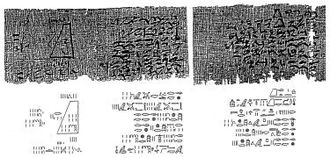
Long ago, people in Ancient Egypt and Babylon knew how to find the area of isosceles triangles. We see this in old writings like the Moscow Mathematical Papyrus and the Rhind Mathematical Papyrus.
There is an idea called the pons asinorum that tells us the base angles of an isosceles triangle are equal. Some think the name comes from the shape in the math proof, which looks like a bridge. There is also a known mistake where someone tried to prove that all triangles are isosceles. This mistake was first shared by W. W. Rouse Ball in 1892 and later by Lewis Carroll. This mistake happens because of confusion about what is inside and outside shapes.
Images
Related articles




This article is a child-friendly adaptation of the Wikipedia article on Isosceles triangle, available under CC BY-SA 4.0.
Images from Wikimedia Commons. Tap any image to view credits and license.