 Safekipedia
Johnson Space Center
Adapted from Wikipedia · Adventurer experience
The Lyndon B. Johnson Space Center (JSC) is NASA's center for human spaceflight in Houston, Texas. It was named after the late U.S. president and Texas native, Lyndon B. Johnson.
JSC is a large complex with 100 buildings spread over 1,620 acres (660 hectares) in Clear Lake. It is where astronauts from the U.S. and other countries are trained. The center also has the Christopher C. Kraft Jr. Mission Control Center, which manages the flight control for NASA's human spaceflights. People often call it "Mission Control" and "Houston".
The original center started as the Space Task Group (STG) led by Robert R. Gilruth. It was first based at the Langley Research Center in Hampton, Virginia. As the U.S. human spaceflight program grew, a new facility was built. This new center opened in September 1963. Today, JSC is one of ten major NASA field centers.
History
The Johnson Space Center started as part of NASA's Space Task Group (STG). In 1958, engineers at Langley Research Center, led by Robert R. Gilruth, worked on Project Mercury and other human space missions. The group reported to the Goddard Space Flight Center and grew quickly. As the U.S. space program grew, a new location was needed for bigger missions like the Apollo Program.
Choosing a location took time. In 1961, Houston, Texas was chosen. It had good weather, transportation links, and space to grow near Rice University. The center opened in 1963 on land donated for the purpose.
The Johnson Space Center became important for controlling space missions. A new Mission Control Center was built to manage more complex flights. It first helped with uncrewed tests and later became the main control point for all U.S. human space missions.
The center was renamed the Johnson Space Center in 1973 to honor President Lyndon B. Johnson, who supported NASA's creation. Today, it is a key place for training astronauts, researching space, and controlling missions from Earth.
Facilities
Further information: List of buildings in the Johnson Space Center
The Johnson Space Center is where NASA controls and watches over all human spaceflights for the United States. The main control room, called the Christopher C. Kraft Jr. Mission Control Center, directs missions like those of the Space Shuttle and current work on the International Space Station. Mission Control helps spacecraft from the time they leave Earth until they return.
The center also helps train astronauts. One important training place is the Neutral Buoyancy Laboratory, a big pool where astronauts practice moving and working like they are in zero gravity. This helps them get ready for spacewalks. The center also keeps special samples brought back from the Moon.
Personnel and training
About 3,200 civil servants work at Johnson Space Center, including 110 astronauts. Many contractors also help with the work. Astronauts train here to learn about spacecraft and basic sciences such as mathematics and physics. They also learn how to stay safe in water and in conditions that copy space travel. Astronauts practice flying and learn how to handle many different situations.
Research
The Johnson Space Center helps NASA with important research about space travel. Scientists there study how space can affect health and how to keep astronauts safe. They also work on new technologies that can help doctors, build better cars, grow more food, improve phones, and create new machines.
One team at the center studies rocks and soil from Earth and space. This helps astronauts explore other planets. They also work with doctors to learn how long trips in space might affect people’s health. The center made special software to study how air and water move. This helps design better spacecraft.
List of JSC directors
The Johnson Space Center has had many directors who helped guide its work.
| No. | Image | Director | Term start | Term end |
|---|---|---|---|---|
| 1 | 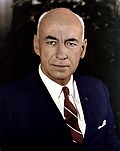 | Robert R. Gilruth | November 1, 1961 | January 17, 1972 |
| 2 |  | Christopher C. Kraft Jr. | January 17, 1972 | August 7, 1982 |
| 3 |  | Gerald D. Griffin | August 8, 1982 | January 14, 1986 |
| 4 |  | Jesse W. Moore | January 23, 1986 | October 2, 1986 |
| 5 |  | Aaron Cohen | October 12, 1986 | August 20, 1993 |
| 6 |  | Carolyn L. Huntoon | January 6, 1994 | August 4, 1995 |
| Acting |  | George W. S. Abbey | August 4, 1995 | January 23, 1996 |
| 7 | January 23, 1996 | February 23, 2001 | ||
| Acting |  | Roy S. Estess | February 23, 2001 | March 31, 2002 |
| 8 |  | Jefferson D. Howell Jr. | April 1, 2002 | November 23, 2005 |
| 9 |  | Michael L. Coats | November 23, 2005 | December 31, 2012 |
| 10 |  | Ellen Ochoa | January 1, 2013 | May 24, 2018 |
| 11 | Mark S. Geyer | May 25, 2018 | May 3, 2021 | |
| acting | 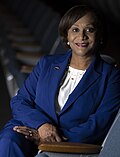 | Vanessa Wyche | May 4, 2021 | June 29, 2021 |
| 12 | June 30, 2021 | February 24, 2025 | ||
| acting |  | Stephen Koerner | February 25, 2025 | September 3, 2025 |
| 13 | | Vanessa Wyche | September 3, 2025 | Present |
Memorial Grove
The Memorial Grove is a special area near the entrance of the Johnson Space Center. It is a place to honor astronauts, center directors, and other NASA workers. Trees are planted there to remember them. Some trees are close to the entrance, while others line a road leading to the main door.
Space Shuttle retirement
The Johnson Space Center wanted to display one of the retired Space Shuttle orbiters, but it was not selected.
Images
Related articles


This article is a child-friendly adaptation of the Wikipedia article on Johnson Space Center, available under CC BY-SA 4.0.
Images from Wikimedia Commons. Tap any image to view credits and license.