 Safekipedia
Light-second
Adapted from Wikipedia · Adventurer experience
The light-second is a special unit of length. It helps scientists who study astronomy, telecommunications, and relativistic physics.
A light-second measures how far light travels in a vacuum during one second. This distance is exactly 299,792,458 meters, or about 186,282 miles.
Just like seconds measure time, light-seconds can measure very long distances. Scientists also use units like the light-nanosecond, light-minute, light-hour, and light-day. One famous unit is the light-year. A light-year equals 31,557,600 light-seconds. This is based on a Julian year of 365.25 days, with each day having 86,400 seconds.
Use in telecommunications
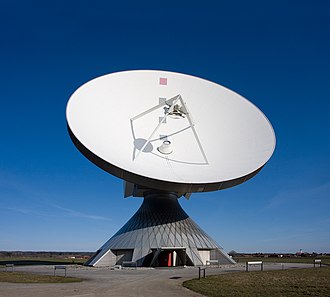
Communications signals on Earth travel at the same speed as light in space. Measuring distances in parts of a light-second helps when planning networks for phones and the internet.
For example, one light-nanosecond is almost 300 millimetres. This affects how fast data can move inside a computer. One light-microsecond is about 300 metres. The distance across the Earth is around 66.8 light-milliseconds. Communications satellites are usually between 1.337 and 119.4 light-milliseconds away from Earth. This causes a small delay in signals. You might notice this delay in phone calls or TV interviews that use satellites.
Use in astronomy
The light-second helps us measure distances inside our Solar System. It works well with the data we use to find these distances. The distance between Earth and the Sun, called the astronomical unit, is very important. We measure it in light-seconds.
Some distances in light-seconds are:
- The width of Earth is about 0.0425 light-seconds.
- The distance from Earth to the Moon is about 1.282 light-seconds.
- The width of the Sun is about 4.643 light-seconds.
- The distance from Earth to the Sun is 499.0 light-seconds.
We can also use bigger units like light-minutes and light-hours. For example:
Related articles




This article is a child-friendly adaptation of the Wikipedia article on Light-second, available under CC BY-SA 4.0.
Images from Wikimedia Commons. Tap any image to view credits and license.