Pluto
Pluto (minor-planet number 134340) is a dwarf planet in the Kuiper belt, a ring of icy and rocky bodies beyond the orbit of Neptune. It is one of the largest known objects that orbit the Sun directly. It is also one of the largest known trans-Neptunian objects, but it is a little less massive than Eris. Like other Kuiper belt objects, Pluto is made mostly of ice and rock. It is much smaller than the inner planets. Pluto has about one-sixth the mass of the Moon and one-third of its volume. It was once thought to be a planet, but its status changed when astronomers agreed on a definition of the word with new rules.
Pluto has a stretched-out and tilted orbit. It ranges from 30 to 49 astronomical units from the Sun. That is about 4.5 to 7.3 billion kilometres (2.8 to 4.6 billion miles). Sunlight takes 5.5 hours to reach Pluto at its average distance. Because its orbit is so stretched out, Pluto sometimes comes closer to the Sun than Neptune does. A steady orbital resonance keeps the two from crashing into each other.
Pluto has five known moons. The largest is Charon, which is just over half of Pluto's width. The others are Styx, Nix, Kerberos, and Hydra. Pluto and Charon are sometimes called a binary system because they both move around a point that is not inside either body. They are also tidally locked. The spacecraft New Horizons was the first to visit Pluto and its moons. It flew past Pluto on July 14, 2015, and took detailed pictures and measurements.
Pluto was discovered in 1930 by Clyde W. Tombaugh. It was the first known object in the Kuiper belt. It was quickly called the ninth planet, but people began to question whether it was a planet when it was found to be much smaller than expected. These doubts grew after astronomers found more objects in the Kuiper belt starting in the 1990s. One of them, the scattered disk object Eris, was found in 2005 and is more massive than Pluto. In 2006, the International Astronomical Union (IAU) officially changed the meaning of the word planet so that it no longer included dwarf planets such as Pluto. Many planetary scientists, however, still think of Pluto and other dwarf planets as planets.
History
Further information: Planets beyond Neptune
Further information: Definition of planet
Main article: IAU definition of planet
In the 1840s, Urbain Le Verrier predicted where the then-unknown planet Neptune was. He did this by studying how the orbit of Uranus was pulled off course. Later, Percival Lowell began a long search for a ninth planet, which he called "Planet X." Lowell died in 1916 without finding it. In 1930, Clyde Tombaugh, a young astronomer at Lowell Observatory, found a moving object that became known as Pluto. At first, it was called the ninth planet. Later, scientists questioned this because Pluto was much smaller than expected. The name Pluto came from the Roman god of the underworld. It was suggested by Venetia Burney, an eleven-year-old girl in England.
From 1992 onward, many similar bodies were found in the Kuiper belt. This made Pluto's place as a planet a topic of debate. In 2006, the International Astronomical Union (IAU) decided that Pluto is not a full planet. Instead, it is a dwarf planet, because it has not cleared the area around its orbit. Some scientists and members of the public still disagree with this decision. Pluto's symbol is a monogram of the letters "PL." The name has also been used in many ways in culture. For example, Walt Disney used it for a character, and Glenn T. Seaborg used it for the element plutonium.
| Year | Mass | Estimate by |
|---|---|---|
| 1915 | 7 Earths | Lowell (prediction for Planet X) |
| 1931 | 1 Earth | Nicholson & Mayall |
| 1948 | 0.1 (1/10) Earth | Kuiper |
| 1971 | 0.11 (1/9) Earth | Seidelmann, Klepczynski, Duncombe, & Jackson |
| 1976 | less than 0.01 (1/100) Earth 0.002–0.005 (1/200–1/500) Earth | Cruikshank, Pilcher, & Morrison |
| 1978 | 0.0017 (1/588) Earth | Christy & Harrington |
| 2006 | 0.00218 (1/459) Earth | Buie et al. |
Orbit
Pluto takes about 248 years to go around the Sun. The planets follow nearly circular paths close to a flat plane called the ecliptic. Pluto's orbit is different. It is tilted more than 17° from the ecliptic, which means it is inclined. It is also somewhat stretched out, which means it is eccentric. Because of this stretched shape, part of Pluto's orbit lies closer to the Sun than Neptune's does. Pluto's movements are also hard to predict far into the future. Computers can predict its position for several million years, but after much longer times the results are not reliable.
Pluto's orbit seems to cross Neptune's path when viewed from above or below the Solar System, but the two orbits never meet. When Pluto is closest to the Sun, it is also farthest north of Neptune's path. Pluto is kept safe by a special pattern called an orbital resonance with Neptune. For every two orbits Pluto makes around the Sun, Neptune makes three. Many other objects share this pattern, and they are called plutinos. Because the pattern is so steady, the two bodies can never pass near each other.
Rotation
A day on Pluto lasts 6.387 Earth days. Like Uranus and 2 Pallas, Pluto spins on its "side" as it travels around the Sun. Its tilt is 120°, so its seasons are very extreme. At its solstices, one-fourth of its surface gets constant daylight, and another fourth stays in constant darkness. Scientists are still trying to understand why Pluto is tilted this way. Research from the University of Arizona suggests that a body's spin may change so it uses the least energy possible. This could mean a body turns so that extra mass moves near the equator, while areas with little mass move toward the poles. This is called polar wander.
A paper from the University of Arizona says this could be caused by masses of frozen nitrogen building up in shadowed areas of the dwarf planet. These masses could make the body turn, which may have led to its unusual tilt. Nitrogen builds up because Pluto is so far from the Sun. At the equator, it can get cold enough for nitrogen to freeze, much like water freezes on Earth. The same polar wandering seen on Pluto would happen on Earth if the Antarctic ice sheet were several times larger.
Geology
Main articles: Geology of Pluto and Geography of Pluto
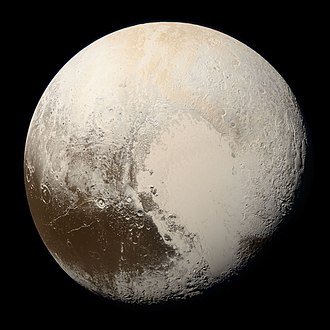
Pluto's plains are made of more than 98 percent nitrogen ice. They also have small amounts of methane and carbon monoxide. The mountains are made of water ice. Pluto's surface is very varied. It is one of the most contrasting objects in the Solar System, as contrasting as Iapetus, a moon of Saturn. Its colors range from charcoal black to dark orange and white. Some notable features are Tombaugh Regio, also called the "Heart," Belton Regio, also called the "Whale," and the "Brass Knuckles." The western lobe of the Heart, Sputnik Planitia, is a basin about 1,000 km wide and 3 km deep. It is partly filled with frozen nitrogen and carbon monoxide ice. Scientists think its surface is divided into cells that are convection cells. Winds have formed fields of transverse dunes in its western parts.
Pluto's density is 1.853±0.004 g/cm3. Scientists expect that its rocky material has settled into a dense core, surrounded by a mantle of water ice. Heating may create a possible subsurface ocean of liquid water 100 to 180 km thick. In 2016, scientists at Brown University simulated the impact that may have formed Sputnik Planitia. Their results suggested an ocean at least 100 km deep. In 2020, astronomers reported evidence that Pluto may have had a subsurface ocean. It may have been habitable when it first formed. In 2022, researchers proposed that the mountains Wright Mons and Piccard Mons are a merger of many smaller cryovolcanic domes.
Mass and size
Pluto is about 2,377 km across. It has about 17.7% of the Moon's mass and 0.22% of Earth's mass. Its surface area is slightly bigger than Russia. Its surface gravity is 0.063 g. For comparison, Earth has 1 g and the Moon has 0.17 g. Pluto is more than twice as wide as Ceres, the largest object in the asteroid belt, and it has about twelve times Ceres' mass. Pluto is less massive than Eris, a trans-Neptunian object discovered in 2005, but Pluto is wider.
Pluto is much less massive than the terrestrial planets. It is also less massive than seven moons, including Ganymede, Titan, Callisto, Io, the Moon, Europa, and Triton. Scientists found Pluto's moon Charon in 1978. This helped them work out the mass of the Pluto–Charon system using Kepler's third law. Pluto's size has been hard to measure because of a haze made of hydrocarbon. Using data from NASA's New Horizons mission, including its Long Range Reconnaissance Imager (LORRI), scientists measured Pluto's diameter as 2,370 km in 2015. Later, they used radio occultation data and measured it as 2,376.6±1.6 km.
Atmosphere
Main article: Atmosphere of Pluto
Pluto has a thin atmosphere. It is mostly made of nitrogen (N2), methane (CH4), and carbon monoxide (CO). These gases stay in balance with their ices on the surface. Measurements from New Horizons show the surface pressure is about 1 Pa (10 μbar). That is much lower than the air pressure on Earth. Scientists first thought the atmosphere would freeze onto the surface as Pluto moved away from the Sun. Later studies of New Horizons data and ground-based observations showed something different. The air gets denser and likely stays a gas through Pluto's whole orbit.
Pluto has almost no troposphere, the lowest layer of air. However, New Horizons found a thin boundary layer, though it is not continuous. In July 2019, an occultation showed that Pluto's air pressure had dropped by 20% since 2016. Astronomers at the Southwest Research Institute confirmed this in 2021. A 2026 study found that the pressure stayed the same until 2021 and then dropped in 2022. Methane is a powerful greenhouse gas. It creates a temperature inversion, which means the air is warmer than the surface, even though the upper atmosphere is colder than expected.
Natural satellites
Main article: Moons of Pluto
Pluto has five known moons. The largest and closest one is Charon. James Christy first found it in 1978. Charon is so big compared to Pluto that the two seem to balance each other, and their shared balance point is outside Pluto. Beyond Charon are four much smaller circumbinary moons. In order of distance from Pluto, they are Styx, Nix, Kerberos, and Hydra. Nix and Hydra were found in 2005, Kerberos in 2011, and Styx in 2012.
For a long time, astronomers wondered where Pluto came from. One early idea was that Pluto was a moon of Neptune that was pushed out of orbit by Neptune's largest moon, Triton. Later studies showed this could not have happened, because Pluto never gets close to Neptune in its orbit. Pluto's true place in the Solar System became clearer in 1992. That was when astronomers began finding small icy objects beyond Neptune that were like Pluto. Pluto is the largest member of the Kuiper belt. Most astronomers think that Neptune moved suddenly early in the Solar System's history, and this helped shape Pluto's position. This idea is described in the Nice model.
Observation and exploration
Observation
Pluto is very far from Earth, so exploration of it is hard. Its apparent magnitude is about 15.1, so you need a telescope to see it. Even in large telescopes, it looks like a star, because its angular diameter is very small. The first maps of Pluto were made in the late 1980s. They were based on changes in brightness when its largest moon, Charon, passed in front of it. Better maps came from the Hubble Space Telescope. It had higher resolution and showed details several hundred kilometers across. These stayed the most detailed maps until the 2015 flyby of New Horizons, because the cameras used for them stopped working.
Exploration
Main articles: Exploration of Pluto and New Horizons
The New Horizons spacecraft flew by Pluto in July 2015. It is the first spacecraft to explore Pluto up close, and so far the only one. It took its first faraway pictures of Pluto in late September 2006. In early 2007, it used a gravity assist from Jupiter to speed up. It came closest to Pluto on July 14, 2015. Its remote sensing tools, including imaging and spectroscopic instruments, studied Pluto and Charon. Scientists have since suggested sending a Cassini-style orbiter back to Pluto. A NIAC study also described an orbiter and lander that could use fusion, based on the Princeton field-reversed configuration reactor. Some surface features in Pluto's southern areas may be studied using Charon-shine, which is light reflected off Charon.

Quiz time!
4 questions about Pluto
What kind of object is Pluto?
Pictures
Keep exploring




This article is a child-friendly adaptation of the Wikipedia article on Pluto, available under CC BY-SA 4.0.
Images from Wikimedia Commons. Tap any image to view credits and license.