 Safekipedia
List of possible dwarf planets
Adapted from Wikipedia · Adventurer experience
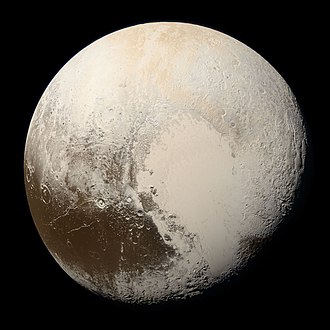
The number of dwarf planets in our Solar System is still not known. Scientists think there could be many, but recent studies suggest there might be fewer than expected. The International Astronomical Union (IAU) has officially recognized six dwarf planets: Ceres in the inner Solar System, and five farther out: Pluto, Eris, Haumea, Makemake, and Quaoar.
Only Pluto and Ceres have been proven to be round enough to be dwarf planets, thanks to space missions like New Horizons and Dawn. Eris is thought to be a dwarf planet because it is about the same size as Pluto. Haumea and Makemake are also often called dwarf planets, even though they haven’t been fully confirmed yet.
Other objects like Gonggong, Orcus, and Sedna are sometimes called dwarf planets if they seem solid enough. Scientists are still learning more about these interesting objects in our Solar System, and new discoveries may change what we know about dwarf planets in the future.
Limiting values
A dwarf planet must be big enough for its gravity to make it round. But it is hard to know if faraway space objects are round. We only have rough guesses about their sizes.
Some scientists think many objects beyond Neptune could be dwarf planets. Others think only a few are big and dense enough to be round. This depends on if they are made of ice or rock, and how tightly they are packed inside. Right now, we know for sure that only a few objects might be dwarf planets.
| Brown's categories | Min. ⌀ | Number of objects |
|---|---|---|
| Nearly certain | > 900 km | 10 |
| Highly likely | 600–900 km | 17 (27 total) |
| Likely | 500–600 km | 41 (68 total) |
| Probably | 400–500 km | 62 (130 total) |
| Possibly | 200–400 km | 611 (741 total) |
| Source: Mike Brown, as of October 22, 2020 | ||
Likeliest dwarf planets
The International Astronomical Union (IAU) has rules for naming objects in space, but these rules don't always tell us if an object is a dwarf planet. Besides Ceres and four large objects beyond Neptune, Quaoar was called a dwarf planet in a report.
Scientists think objects need to be bigger than about 800 kilometers across to be dwarf planets. Some objects, like Charon, a moon of Pluto, might also be dwarf planets.
Largest measured candidates
Many objects in space have been measured and found to be at least 600 kilometers wide. These include moons like Charon and Dysnomia, which are large enough to possibly be dwarf planets themselves. Ceres, already accepted as a dwarf planet, is also listed for comparison.
Brightest unmeasured candidates
For objects that haven't been measured yet, scientists estimate their sizes based on how bright they appear. These estimates depend on guesses about how reflective the objects are. Some of these objects might be large enough to be dwarf planets, but we need more data to know for sure.
| Designation | H | Geometric albedo | Diameter (km) | Method | Mass (1018 kg) | Density (g/cm3) | moons | Category | ID'd as a dwarf | |
|---|---|---|---|---|---|---|---|---|---|---|
| Emery et al. | Grundy et al. | |||||||||
| Neptune I Triton | −1.2 | 60% to 95% | 2707±2 | direct | 21389±28 | 2.061 | satellite of Neptune | |||
| 134340 Pluto | −0.45 | 49% to 66% | 2377±3 | direct | 13025±6 | 1.854±0.006 | 5 | 2:3 resonant |  | |
| 136199 Eris | −1.21 | 96% | 2326±12 | occultation | 16466±85 | 2.43±0.05 | 1 | SDO | | |
| 136108 Haumea | 0.21 | 49% | 1559 | occultation | 3986±43 | ≈ 2.018 | 2 | classical | | |
| 136472 Makemake | −0.21 | 83% | 1430±14 | occultation | 2690±200 | 1.76±0.17 | 1 | classical | | |
| 225088 Gonggong | 1.86 | 14% | 1230±50 | thermal | 1750±70 | 1.74±0.16 | 1 | 3:10 resonant | | |
| 134340 Pluto I Charon | 1 | 20% to 50% | 1212±1 | direct | 1586±15 | 1.702±0.017 | satellite of Pluto | |||
| 50000 Quaoar | 2.42 | 11% | 1098±2 | occultation | 1212±5 | 1.75±0.013 | 1 (2?) | classical | | |
| 1 Ceres | 3.33 | 9% | 939.4±0.2 | direct | 938.35±0.01 | 2.16±0.01 | 0 | asteroid belt | | |
| 90482 Orcus | 2.18 | 23% ± 2% | 910+50 −40 | thermal | 548±10 | 1.4±0.2 | 1 | 2:3 resonant | ||
| 90377 Sedna | 1.52 | 41% | 906+314 −258 (occult. chord 1025±135) | thermal | 0 | detached | | |||
| 120347 Salacia | 4.26 | 5% | 838±44 | thermal | 492±7 | 1.50±0.12 | 1 | classical |  | |
| 307261 Máni | 3.62 | 10% | 796±24 | occultation | 0 | classical | ||||
| 208996 Achlys | 3.77 | 11% | 772±12 | occultation | 0.87 (assuming HE) | 1 | 2:3 resonant |  | ||
| 55565 Aya | 3.47 | 11% | 768+39 −38 | thermal | 0 | classical | ||||
| 174567 Varda | 3.46 | 11% | 749±18 | occultation | 245±6 | 1.78±0.06? or 1.23±0.04? | 1 | classical | | |
| 532037 Chiminigagua | 3.12 | 18% | 742+78 −83 | thermal | § | 1 | SDO | |||
| 28978 Ixion | 3.85 | 11% | 696.78+10.75 −8.87 | occultation | 0 | 2:3 resonant | ||||
| 90568 Goibniu | 3.99 | 8% | 680±34 | thermal | 1.14–1.49 (assuming a Jacobi ellipsoid) | 0 | classical | |||
| 145452 Ritona | 3.69 | 11% | 679+55 −73 | thermal | 0 | classical | | |||
| 55637 Uni | 3.85 | 12% | 659±38 | thermal | 125±3 | 0.82±0.11 | 1 | classical | | |
| 20000 Varuna | 3.79 | 12% | 654+154 −102 | thermal | 0.992+0.086 −0.015 (assuming HE) | 0 (1?) | classical | | ||
| 145451 Rumina | 4.63 | 11% | 644 | occultation | 0 | SDO | ||||
| 229762 Gǃkúnǁʼhòmdímà | 3.5 | 14% | 642±28 | occultation | 136±3 | 1.04±0.17 | 1 | SDO | | |
| 2014 UZ224 ("DeeDee") | 3.48 | 14% | 635+65 −72 | thermal | § | 0 | SDO | |||
| 136199 Eris I Dysnomia | 5.6 | 5±1% | 615+60 −50 | thermal | 0.7±0.5 | satellite of Eris | ||||
| (303775) 2005 QU182 | 3.75 | 13% | 584+155 −144 | thermal | § | 0 | SDO | |||
| 78799 Xewioso | 4.86 | 4% | 565+71 −73 | thermal | 0 | classical | ||||
| H | Objects with this magnitude (H) | Diameter of object at the bright end of this range, for an assumed albedo (p) of: | ||||||||
|---|---|---|---|---|---|---|---|---|---|---|
| 4% | 6% | 8% | 10% | 12% | 14% | 16% | 18% | 20% | ||
| 3.60–3.69 | §2021 DR15 (H = 3.61 ± 0.15) | 1,270 | 1,030 | 900 | 800 | 730 | 680 | 630 | 600 | 570 |
| 3.70–3.79 | §2017 OF201 (H = 3.72 ± 0.09) | 1,210 | 990 | 860 | 770 | 700 | 650 | 610 | 570 | 540 |
| 3.80–3.89 | §2010 RF43, 2015 RR245, §2010 JO179, §2014 EZ51 | 1,160 | 940 | 820 | 730 | 670 | 620 | 580 | 540 | 520 |
| 3.90–3.99 | §2018 VG18 ("Farout"; H = 3.94 ± 0.52) | 1,100 | 900 | 780 | 700 | 640 | 590 | 550 | 520 | 490 |
| 4.00–4.09 | 2010 KZ39, §2012 VP113 ("Biden"), §2021 LL37 (H = 4.09 ± 0.31) | 1,050 | 860 | 750 | 670 | 610 | 560 | 530 | 500 | 470 |
| 4.10–4.19 | §2015 KH162, 2020 MK53 (lost; H = 4.12 ± 0.35) | 1,010 | 820 | 710 | 640 | 580 | 540 | 500 | 470 | 450 |
| 4.20–4.29 | 2008 ST291, 2018 AG37 ("FarFarOut"; H = 4.22 ± 0.1), §2013 FZ27, 2010 RE64 | 960 | 780 | 680 | 610 | 560 | 510 | 480 | 450 | 430 |
| 4.30–4.39 | §2014 WK509, §2015 BP519 ("Caju"), §2017 OF69, §2014 AN55, §2017 FO161, 2016 NY210 (H = 4.38 ± 0.74) | 920 | 750 | 650 | 580 | 530 | 490 | 460 | 430 | 410 |
| 4.40–4.49 | §2014 WP509, §2013 XC26, 2007 JJ43, 2014 YA50 | 880 | 720 | 620 | 550 | 510 | 470 | 440 | 410 | 390 |
| 4.50–4.59 | §2010 FX86, 2010 OO127 | 840 | 680 | 590 | 530 | 480 | 450 | 420 | 390 | 370 |
| 4.60–4.69 | 2007 XV50, 2006 QH181, 2025 MZ348, 2014 OE394, 2002 WC19, §2014 HA200, §2014 US277, §2010 DN93 | 800 | 650 | 570 | 510 | 460 | 430 | 400 | 380 | 360 |
| 4.70–4.79 | §2014 BV64, 2014 FC69, §2015 BZ518, 2014 FC72, 2020 FY30 (H = 4.71 ± 0.16), §2014 US224, §2015 AM281, 2010 VK201, §2014 TZ85 | 760 | 620 | 540 | 480 | 440 | 410 | 380 | 360 | 340 |
| 4.80–4.89 | §2011 WJ157, §2007 JH43, §2008 OG19, 2014 FT71 | 730 | 600 | 520 | 460 | 420 | 390 | 360 | 340 | 330 |
| 4.90–4.99 | 2011 HP83, 2013 FS28, §2014 UM33, §2014 VU37, 2013 AT183, 2014 BZ57, §2014 JR80, §2003 UA414, §2011 OA60, §2013 SF106 (H = 4.96 ± 0.27) | 700 | 570 | 490 | 440 | 400 | 370 | 350 | 330 | 310 |
Images
Related articles




This article is a child-friendly adaptation of the Wikipedia article on List of possible dwarf planets, available under CC BY-SA 4.0.
Images from Wikimedia Commons. Tap any image to view credits and license.