Magnetic monopole
In particle physics, a magnetic monopole is a hypothetical particle. It would be an isolated magnet with only one magnetic pole, either a north pole without a south pole, or a south pole without a north pole. Such a particle would have a net north or south "magnetic charge". Some particle theories, such as grand unified and superstring theories, predict that magnetic monopoles exist, which is why scientists are interested in the idea. The known elementary particles that carry electric charge are electric monopoles.
Magnets like bar magnets and electromagnets do not get their magnetism from magnetic monopoles. Scientists have not yet found any evidence that magnetic monopoles exist. A magnetic monopole is not necessarily an elementary particle. Ideas for how they could be made include spin-0 monopoles or spin-1 massive vector mesons. The term "magnetic monopole" describes what kind of particle something is, rather than naming one specific particle.
Some condensed matter systems contain effective, non-isolated magnetic monopole quasi-particles. Others contain effects that are mathematically similar to magnetic monopoles.
Historical background
Many early scientists thought that the magnetism of lodestones came from two "magnetic fluids" ("effluvia"). One was a north-pole fluid and the other was a south-pole fluid. They pulled toward or pushed away from each other, a bit like positive and negative electric charge. In the nineteenth century, a better understanding of electromagnetism showed that lodestones are instead explained by electric currents, the electron magnetic moment, and the magnetic moments of other particles. Gauss's law for magnetism, one of Maxwell's equations, says that magnetic monopoles do not exist. Even so, Pierre Curie pointed out in 1894 that they could possibly exist, even though no one had seen one.
The quantum theory of magnetic charge began with a paper by physicist Paul Dirac in 1931. Dirac showed that if any magnetic monopoles exist, then all electric charge in the universe must be quantized. Electric charge is quantized, which fits with monopoles existing but does not prove it. Experiments in 1975 and 1982 produced events that were first thought to be monopoles, but these are now seen as inconclusive. So whether monopoles exist is still an open question. Progress in particle physics, especially grand unified theories and quantum gravity, has led to stronger arguments that they do exist. Joseph Polchinski, a string theorist, called their existence "one of the safest bets that one can make about physics not yet seen." In some models, monopoles are too heavy to make in particle accelerators (see § Searches for magnetic monopoles below) and too rare to enter a particle detector easily. Some condensed matter systems have a similar structure called a flux tube. Its ends act like separate magnetic monopole quasiparticles, even though the whole thing forms a magnetic dipole. These are only slightly related to true monopoles, and they remain an active area of research (see § "Monopoles" in condensed-matter systems below).
Poles and magnetism in ordinary matter
Main article: Magnetism
All matter studied so far, including every atom on the periodic table and every particle in the Standard Model, has zero magnetic monopole charge. So the everyday effects of magnetism and magnets do not come from magnetic monopoles. Instead, they come from two other sources. First, electric currents create magnetic fields, as described by Ampère's law. Second, many elementary particles have an intrinsic magnetic moment. The most important one is the electron magnetic dipole moment, which is linked to the quantum-mechanical spin of the electron.
Scientists often describe a magnetic field using a multipole expansion. This splits the field into simpler parts that add together. The first part is the monopole term, followed by dipole, quadrupole, and octupole. For a magnetic field from ordinary matter, the "monopole" term is always exactly zero. A magnetic monopole, if it exists, would be one that has a non-zero monopole term.
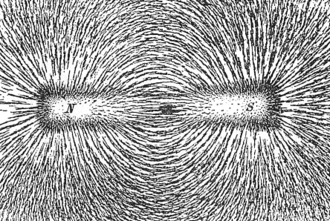
A magnetic dipole has a north pole on one side and a south pole on the other. This is a bit like an electric dipole, which has positive charge on one side and negative charge on the other. However, the two are very different. In an electric dipole, the positive charge comes from protons and the negative charge comes from electrons. A magnetic dipole does not have different kinds of matter making each pole. Its two poles always have equal and opposite strength, and they cannot be separated.
Maxwell's equations
Maxwell's equations of electromagnetism describe how electric and magnetic fields are connected. They also describe how these fields relate to electric charge and electric current. The usual version allows electric charge but assumes there is no magnetic charge. Other than that, the equations treat electric and magnetic fields in a similar way. In empty space, with no charge or current, the equations are fully balanced between the two fields.
The equations can also be written in a fully balanced form if magnetic charge is included, along with a magnetic current density. In SI units, magnetic charge can be measured in weber (Wb) or in ampere-meters (A⋅m). If magnetic charge does not exist, the extra parts of the equations become zero, and the equations return to their usual form. One example is the rule that the divergence of the magnetic flux density is zero.
The equations have a special kind of balance called a duality transformation. Because of this balance, watching how a particle moves cannot show whether it has electric charge, magnetic charge, or both. Every particle ever observed has the same ratio of magnetic charge to electric charge. A duality transformation can set this ratio to zero, so particles have no magnetic charge. This choice is the basis of the usual ideas about electricity and magnetism.
Dirac's quantization
One big step forward in quantum theory came from the work of Paul Dirac. He worked on a relativistic version of quantum electromagnetism. In 1931, Dirac showed that quantum mechanics means electric charge comes in fixed amounts. He also showed that magnetic charges could still exist while following Maxwell's equations. If magnetic monopoles exist, then electric charge must come in fixed amounts. Scientists call this being quantized.
Dirac described this connection with the Dirac quantization condition. In 1931, it was not clear whether magnetic monopoles existed or had to exist. Since then, no other widely accepted explanation of why electric charge comes in fixed amounts has appeared.
Topological interpretation
Main article: Dirac string
Main article: 't Hooft–Polyakov monopole
A gauge theory such as electromagnetism uses a gauge field. This field connects a group element to each path through space and time. In electromagnetism, the group is U(1). A charged particle that travels around a loop gets a phase change equal to the magnetic flux through that loop. This is described by the Wilson loop or holonomy. A thin solenoid that carries flux can be detected by interference fringes. If all charges are whole multiples of e, a solenoid with flux 2π/e would be hidden. Its leaking flux would look like a monopole. Dirac's monopole is an extremely thin solenoid that ends at a point. The line it creates is called the Dirac string. Dirac strings connect monopoles and antimonopoles. Because the string cannot be seen, it can be moved to a place where it is hidden.
Grand unified theories explain why electric charges come in fixed amounts. They also predict that monopoles exist. Any U(1) group that comes from such a theory is compact. The irreducible representations of U(1) all have the same size. A topological argument called lassoing the sphere shows that the magnetic flux through a sphere comes in fixed amounts. This is the Dirac quantization condition. The core of a monopole can be a topological defect. On a lattice U(1), the core size is the lattice size. In the universe, quantum gravity may limit how small things can get, and the monopole may become a black hole. A connection on a principal G-bundle describes a gauge field. The total magnetic flux is the Chern number of that bundle, which is a topological invariant. Since string theory always gives monopoles with finite mass, the mass limit is close to the Planck mass for ordinary electromagnetism.
Grand unified theories
In the early 1970s, scientists had success with quantum field theory and gauge theory. These helped them build electroweak theory and understand the strong nuclear force. Many scientists then tried to join these ideas into one theory called a Grand Unified Theory (GUT). Most of these theories suggested that a real magnetic monopole particle could exist. They predicted a group of particles called dyons, and the simplest of these is a monopole. Depending on the theory, the charge on these monopoles is 1 or 2 gD. Most particles are unstable and break apart into other particles, following conservation laws. A particle is stable when no lighter particles can form while still following these laws. For example, the electron has a lepton number of one and an electric charge of one, and no lighter particles share these values. The muon is like a heavy electron. It can break apart into an electron and energy, so it is not stable.
The dyons in these theories are stable for a different reason. They may have formed during a "freezing out" of the early universe, or during a symmetry breaking. This came from the way the vacuum was arranged in one part of the universe. They do not stay stable because of a conservation law. Instead, there is no simpler topological state they could change into. Early models of events after the Big Bang predicted far too many monopoles. This was called the "monopole problem." Newer cosmic inflation theory predicts far fewer monopoles, which solved the problem. Monopoles became a major interest in the 1970s and 1980s, along with proton decay. Particles called X and Y bosons are so heavy that no particle accelerator could create them.
Searches for magnetic monopoles
Scientists look for magnetic monopoles in two main ways. They search for ones that already exist, and they try to make new ones. When a magnetic monopole passes through a coil of wire, it creates an electric current. This current can be detected in a superconducting loop using a very sensitive SQUID. Many searches for existing monopoles have been made. One possible event was recorded by Blas Cabrera Navarro on February 14, 1982, sometimes called the "Valentine's Day Monopole." However, no one has ever seen this result again. In 1975, a team led by P. Buford Price announced a moving monopole in cosmic rays, but Price later took back the claim. Luis Walter Alvarez suggested that the event could instead be explained by a platinum nucleus decaying first to osmium and then to tantalum.
Powerful particle colliders have also been used to try to make magnetic monopoles. Monopoles must be made in pairs, one north and one south. Only those lighter than half the energy of the colliding particles can be made. Scientists know little about how they would form in these collisions, so collider searches cannot yet set a smallest possible mass for them. The ATLAS experiment at the Large Hadron Collider has the strictest limits so far for certain monopoles made through Drell–Yan pair production. A team led by Wendy Taylor carries out this search. The MoEDAL experiment, also at the Large Hadron Collider, uses plastic detectors and aluminum bars placed around the LHCb VELO detector. The bars can be checked with a SQUID to look for trapped monopoles.
"Monopoles" in condensed-matter systems
Since around 2003, some condensed-matter physics groups have used the term "magnetic monopole" for a different idea that is mostly unrelated. A true magnetic monopole would be a new elementary particle and would break Gauss's law for magnetism. No one has ever seen such a particle in experiments. It could help explain charge quantization, an idea that Paul Dirac described in 1931. The monopoles studied by condensed-matter groups are not new particles. They are an emergent phenomenon that appears in systems made of everyday particles such as protons, neutrons, electrons, and photons. They are quasi-particles, and they are not directly linked to grand unified theories.
Some group behavior in condensed-matter physics looks like magnetic monopoles, most clearly in spin ice materials. Some researchers use the word magnetricity for controlling these monopole quasiparticles, by comparison to "electricity." In September 2009, a paper in Science described quasiparticles that look like monopoles in a crystal of dysprosium titanate, cooled to between 0.6 kelvin and 2.0 kelvin. Using neutron scattering, the researchers saw magnetic parts form tube-like bundles, similar to Dirac strings, with a monopole-like field at the defect at the end of each tube. A 2011 paper in Nature Physics reported that monopole currents lasted a long time in the same material. The heat capacity of spin ice was also linked to these quasiparticles. In superfluids, a related "synthetic magnetic field" was studied, and in 2014 monopole quasiparticles for this field were reported in a spinor Bose–Einstein condensate.

Quiz time!
4 questions about Magnetic monopole
What is a magnetic monopole?
Keep exploring




This article is a child-friendly adaptation of the Wikipedia article on Magnetic monopole, available under CC BY-SA 4.0.
Images from Wikimedia Commons. Tap any image to view credits and license.