 Safekipedia
Olympic flame
Adapted from Wikipedia · Adventurer experience
The Olympic flame is a special symbol used in the Olympic movement. It links the ancient Olympic Games to the modern ones.
The flame is lit in a ceremony at Olympia, Greece. This starts the Olympic torch relay, which carries the flame to the host city.
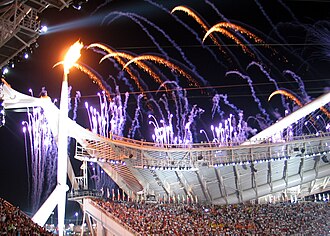
During the opening ceremony, the flame lights a big cauldron. The flame burns in the cauldron for the whole time the Games are happening. At the Olympic closing ceremony, the flame is put out to show the end of the Games.
Origins
The Olympic flame first appeared at the Summer Olympic Games in Amsterdam during the 1928 Summer Olympics. It was placed in a large bowl on top of a tower called "Marathon Tower" to show people where the Olympic Games were happening. This idea came from ancient Greek traditions where a special fire burned during celebrations.
In Ancient Greek mythology, fire was very important and was thought to be a gift from the gods. Sacred fires were kept burning at many places in ancient Greece, including Olympia. Every four years, extra fires were lit to honor Zeus and Hera during the ancient Olympic Games. Today, the Olympic flame is lit every two years in front of the ruins of the temple of Hera in Olympia, Greece. The torch relay began at the 1936 Summer Olympics in Berlin.
Main ceremonies
Lighting of the flame
The Olympic flame is lit weeks or months before the Olympic Games at the ancient Olympics site in Olympia, Greece.
Women representing the Vestal Virgins perform a ceremony at the Temple of Hera. They light a fire using the Sun's rays focused by a mirror. This fire lights the first torch of the Olympic Torch Relay. An actress plays a priestess and gives the torch and an olive branch to the first runner, usually a Greek athlete. After this, a poem by Pindar is read, and doves are released to show peace. The Olympic hymn and the national anthems of the host country and Greece are sung, and flags are raised.
After the ceremony in Olympia, the flame goes to Greece. It first goes to the Coubertin Grove at the International Olympic Academy, where it lights an altar near Pierre de Coubertin's heart. The flame is then given to the current year's National Olympic Committee and local Organizing Committee hosts at the Panathenaic Stadium in Athens.
The Olympic torch relay, which carries the flame from Olympia to the Games, was started by Carl Diem at the 1936 Summer Olympics in Berlin, Germany.
The relay ends with lighting the Olympic cauldron during the opening ceremony in the main stadium. The last runner is often a famous athlete from the host country.
Re-igniting the flame
The Olympic flame can sometimes go out during the relay. To prevent this, extra flames are carried with the relay or kept in safe places. If a torch goes out, it is relit from one of these extra flames.
Some torches have two flames. One flame is easy to see but can go out easily. The other flame is smaller and protected, and can relight the first flame if needed.
Selected relays in detail
The flame travels from Greece to the host country, where it is carried by torch around the nation to the main stadium.
Olympic cauldron lighting
During the opening ceremony, the last runner brings the torch to the cauldron, often at the top of stairs, and lights the flame in the stadium. This moment starts the Games symbolically.
IOC rules say that the lighting must be seen by everyone at the opening ceremony and by people in the host city.
It is a great honor to light the Olympic cauldron, and famous athletes often do this. Sometimes, less famous people who show Olympic ideals light the cauldron. Japanese runner Yoshinori Sakai was born on the day of the atomic bombing of Hiroshima. He lit the cauldron at the 1964 Tokyo Games to show Japan's peace after the war. At the 1976 Games in Montreal, two teenagers—one from French-speaking Canada and one from English-speaking Canada—lit the cauldron to show unity.
At the 2012 Games in London, the torch was carried by Sir Steve Redgrave to seven young British athletes. They each lit a small flame, which came together to form the cauldron.
Olympic cauldron designs
The cauldron and its stand are always designed in a special way. The flame in the cauldron burns during the Games and is put out at the closing ceremony to show the Games have ended.
Coinage
The Olympic flame is sometimes shown on special coins. In 2002, a coin was made to celebrate the 50th anniversary of the Helsinki Olympic Games. On the coin, you can see the Olympic flame above the Earth. The coin mainly shows Finland, the country that hosted the 1952 games.
Commercialization
Before the 2002 Winter Olympics, a professor named Bob Barney wrote a book called Selling the Five Rings. In the book, he talked about how companies help the Olympic Games and get to show their brands on TV. He said that the Olympic torch, which carries the flame, has always helped companies get more attention for their brands. But the medal podium ceremonies have not been used for ads because no ads are allowed inside the Olympic venues.
| Olympic torches displayed inside the Olympic Museum in Lausanne, Switzerland | |
Images
Related articles



This article is a child-friendly adaptation of the Wikipedia article on Olympic flame, available under CC BY-SA 4.0.
Images from Wikimedia Commons. Tap any image to view credits and license.