 Safekipedia
Orchestra
Adapted from Wikipedia · Adventurer experience
An orchestra is a large group of musicians who play together. They usually play classical music or jazz. An orchestra has four main sections of instruments.
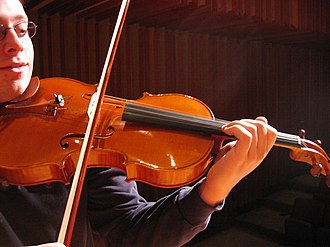
The string section has violin, viola, cello, and double bass. The woodwind section has flute, oboe, clarinet, and bassoon. The brass section has French horn, trumpet, and tuba. The percussion section has instruments like timpani and cymbals. Sometimes, they also use a piano or harpsichord.
An orchestra is led by a conductor. The conductor uses hand movements or a conductor's baton to guide the musicians. The conductor helps set the speed and style of the music. There is also a concertmaster, who leads the first violin players and helps organize the group.
Orchestras play many types of music, such as symphonies, music for solo instruments, and music for operas and ballets. They can be very large, with more than one hundred musicians, or smaller groups called chamber orchestras. The word "orchestra" comes from ancient Greek. It was a space in front of a stage used by choirs in ancient Greek theatre.
History
In the Baroque era, orchestras were different sizes and used different instruments. Some were small with one player per part. Others were very large, sometimes with up to 150 players for special events. By the classical era, orchestras became more the same size, usually having a string section and wind instruments.
Beethoven helped shape the orchestra as we know it. He used pairs of flutes, oboes, clarinets, bassoons, horns, and trumpets in most of his works. Later, new designs for brass instruments changed what orchestras could do. Richard Wagner also expanded orchestral music, writing complex scores that needed more musicians. By the 20th century, orchestras grew larger and more skilled, letting composers like Gustav Mahler create big and ambitious works.
Instrumentation
A symphony orchestra has four main groups of musical instruments. These groups are called the woodwinds, brass, percussion, and strings. Sometimes, other instruments like the piano, accordion, and celesta join the orchestra. They might be in a group called the keyboard section or play alone. The concert harp and electric and electronic instruments can also be part of an orchestra.
Over time, orchestras have added more instruments. By the time of Ludwig van Beethoven, the orchestra had a more set group of instruments. In the 20th and 21st centuries, orchestras became more flexible. They now use many different instruments and combinations for new kinds of music.
Percussion 2 timpani (only if trumpets are required) | Strings (sometimes several players per part) 1st & 2nd violins violoncello da spallas (neck cello in tenor clef) violones (contrabbasso a viola da braccio) viols (in various type) contrabass viols (contrabbasso a viola da gamba) theorbo (a baroque lute) |
Woodwinds 2 oboes 2 bassoons 1 contrabassoon (occasionally with Mozart, and Haydn, but not yet a standard instrument) Percussion 2 timpani (one player) | Keyboards harpsichord (until the late 18th century, by which time it was gradually phased out of the orchestra) pipe organ (until the late 18th century, by which time it was gradually phased out of the orchestra) |
Woodwinds 2 oboes 2 soprano clarinets of which both might also play 2 Basset horns (occasionally with Beethoven) Brass 4 natural (valveless) or valved horns 2 natural or valved trumpets 3 tenor trombones of which some might play 1–2 serpents or ophicleides (gradually replaced by tubas) |
Woodwinds 3–4 oboes, of which some may double on 3–4 bassoons Brass 4–8 French horns, German horns, or Vienna horns (more rarely natural horns) of which some might play 2–4 Wagner tubas – 2 tenors, 2 bass 3–4 tenor trombones (alto trombone parts from the classical era usually played on tenor trombone) 1–2 bass trombones of which 1 might play | Percussion 4 or more timpani (one player) Strings 2 or more concert harps |
Woodwinds 2–4 flutes of which some might play: 2–4 oboes of which 1–2 might play: 2–4 bassoons, of which 1 might play: Brass 4–8 horns (double horns) in F/B♭ of which some might play 2–4 Wagner horns 3–6 trumpets in B♭ of which some might play: 2–3 cornets 1 piccolo trumpet (often for playing very high parts originally for natural trumpets) 2-4 tenor horns 1 alto trombone (restored to the postmodern orchestra for playing music of the classical era) 3–6 tenor trombones (current modern orchestra standard) 1–2 bass trombones of which 1 might play: 1–2 tubas of which 1 might play Other percussion instruments, includes sound effect percussion instruments (such as crotales, waterphone, mark tree, sleigh bells, bell tree, vibraslap, flexatone, whip & finger cymbals) and folk, ethnic or world music percussion instruments (such as taiko, temple block, wind chimes, tabla, hang drum, steel drum, castanets, cowbell, agogô, güiro, cuíca, bongos, conga, cajón, darbuka, timbales, claves, maracas, cabasa & rain sticks) specified by composers. | Strings 16 1st violins 14 2nd violins 12–14 violas 10–14 cellos 6-8 double basses 1–2 harps (1 or more classical guitars of various types) Miscellaneous Other miscellaneous sound effect instruments (such as slide whistle, Aztec death whistle & Acme siren) specified by composers. Electrophone As required by the compositions in the program, various electric instruments or electronic instruments may be used in the orchestra. These performers are not typically permanent orchestra members. They are typically freelancers hired on contract for one or more concerts. Instruments may include: electric & electric bass guitar electric organ (Hammond) grand digital music keyboard (Lowrey) Non-musical instruments such as a typewriter or reel-to-reel tape player |
Organization
In an orchestra, each group of instruments has a main player who leads that group. The violins are split into two groups, with the concertmaster leading the first violins. The concertmaster is the second most important person in the orchestra after the conductor. Other groups also have main players, like the main trombone or the main trumpet.
Most orchestras today have a conductor who leads them. In the past, some orchestras did not have conductors, and the concertmaster or a harpsichord player would lead instead. Orchestras usually play classical music or opera, but they also play popular music, music for movies, TV, video games, and some rock music. The word "orchestra" can also mean a large jazz group, called a big band.
Amateur ensembles
School orchestras are groups of students from elementary or secondary schools. They may have students from a music class or the whole school. A music teacher usually leads them. Some school orchestras focus only on string instruments. Others include woodwinds, brass, and percussion as a concert band.
University or conservatory orchestras have students from universities or music schools. Some are open to all students. Others are for music majors. Youth orchestras bring together teens and young adults from a city, region, or country. Community orchestras are made up of amateur musicians from a local area. They range from beginner to advanced levels and sometimes include a few professional players.
Repertoire and performances
Orchestras play many kinds of music, from old dance music to music from movies and symphonies. They are best known for playing symphonies, which are long pieces of music with several parts. A conductor leads the orchestra using a musical score, and each musician plays their own part of the music.
Orchestras also play overtures, which are pieces of music that start operas. They play concertos, where one musician, like a violinist or pianist, plays with the orchestra. Orchestras perform during operas, ballets, and some musical shows, helping the singers and dancers.
Role of conductor
Main article: Conducting
A conductor helps guide an orchestra or choir during a performance. The conductor sets the speed of the music and makes sure everyone starts and stops at the right time. They shape how the music feels using hand movements, often with a special stick called a baton. They may also talk to the musicians before the show starts.
The conductor stands on a raised platform with a music book that has all the parts for every instrument. Most conductors today do not play an instrument while they lead, but in the past, someone would play the harpsichord or violin to guide the group. Conductors choose which pieces to play, study the music, and help musicians understand how to perform it. They also help with scheduling and choosing new members for the orchestra. Many different types of musical groups, like choirs and big jazz bands, are led by conductors.
Conductorless orchestras
Main article: Conductorless orchestra
In the past, orchestras were often led by one of the musicians, like the main violin player. In 1922, a group in the Soviet Union tried an orchestra without a conductor, led by a committee instead. This worked for a while but had some problems with changing speeds during songs. Today, some orchestras in Western countries work without a conductor, letting the main players guide the group. Others still have a main player, often a violinist, lead the orchestra.
Multiple conductors
Some pieces of music need extra help to keep everyone together. For example, if a trumpet plays from offstage to create a special effect, a second conductor might help make sure they stay in sync. In modern music, some works have many orchestras playing at once, each with its own conductor, while one main conductor helps coordinate them all.
Images
Related articles


This article is a child-friendly adaptation of the Wikipedia article on Orchestra, available under CC BY-SA 4.0.
Images from Wikimedia Commons. Tap any image to view credits and license.