 Safekipedia
Salyut 3
Adapted from Wikipedia · Adventurer experience
Salyut 3
Salyut 3 (Russian: Салют-3, lit. 'Salute 3', also known as OPS-2 or Almaz 2) was a Soviet space station launched on 25 June 1974. It was the second Almaz military space station, and the first such station to launch successfully. It was part of the Salyut program to hide its military purpose. Because it was a military station, the Soviet Union did not share much information about it.
The station flew at an altitude of 219 to 270 km, and NASA said its final height was 268 to 272 km. Only one of the three planned crews could reach and use the station, arriving in Soyuz 14. Soyuz 15 tried to bring a second crew but could not connect to the station, so the third planned visit was cancelled.
Not much official information was shared about the station, but some reports say it had cameras to watch Earth and a gun on board. The station was brought down and burned up in the atmosphere on 24 January 1975. The next Soviet space station was the civilian station Salyut 4; the next military station was Salyut 5, the last Almaz space station.
Background
The first space station, Salyut 1, was launched by the Soviet Union in April 1971. Only one mission, Soyuz 11, docked with Salyut 1. Its three-person crew spent 22 days on the station in June 1971.
At that time, the Soviet Union had both civilian and military space programs. Salyut 1 was part of the civilian program, called Long-term Orbital Stations (DOS). The military space stations, called Almaz stations or Orbital Piloted Stations (OPS), looked similar but had different designs. To hide their military purpose, they were also called Salyut stations. The first Almaz station, Salyut 2, launched in April 1973 but did not stay in orbit long and was never crewed.
Description
Salyut 3 was a space station with many parts, like a place for spacewalks, a big work area, and a small living space. It had about 90 cubic metres of room for people to live inside. It had solar panels for power, a place for spacecraft to connect, and engines to move.
The station had special tools for the astronauts, like a shower, a place to sleep standing up, and a bed that could be folded away. The floors had a special material called Velcro to help astronauts move. For fun, there was a magnetic chess set, books, and a music player with tapes. There was also exercise equipment, such as a treadmill and a special suit for working out. The station had an early system to recycle water, called Priboy.
One of the main features of Salyut 3 was a big telescope called Agat-1, used to take pictures of Earth from space. This telescope could take very detailed photos and was mostly used for looking at things from far away. Astronauts could develop film right on the station and send some images back to Earth quickly. They also had several other cameras for different purposes.
Station operations
Only one crewed spacecraft, Soyuz 14, successfully connected to Salyut 3. Another spacecraft, Soyuz 15, tried to connect but could not because of a problem.
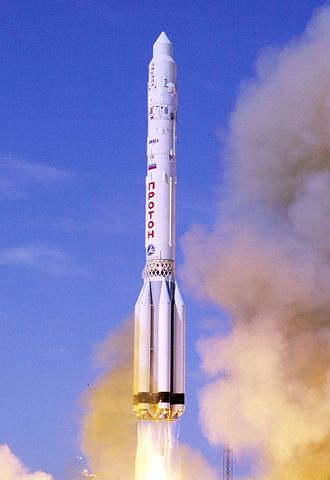
The station was launched on 25 June 1974 by a Proton launch vehicle. It was the first space station to keep its position steady compared to Earth. Its orbit was 219 km to 270 km above Earth.
On 4 July, Soyuz 14 joined Salyut 3. The crew, made up of Pavel Popovich and Yury Artyukhin, stayed for 15 days. They used cameras to take photos of places in central Asia and brought some film back to Earth when they landed on 19 July.
Soyuz 15 was launched on 26 August 1974 with Gennadi Sarafanov and Lev Demin. They tried to connect to Salyut 3 but could not because of a problem with their system. Because their spacecraft had limited power, they returned to Earth just two days after launch. At that time, Demin was the oldest person to fly in space until Deke Slayton flew with the Apollo–Soyuz Test Project the next year.
After Soyuz 15 failed to connect, plans for more crews were stopped because of the need to fix the docking system and the station's limited time in orbit due to orbital decay. The capsule meant to return film from the station was released on 23 September 1974. The station itself was brought back to Earth over the Pacific Ocean on 24 January 1975.
Related articles



This article is a child-friendly adaptation of the Wikipedia article on Salyut 3, available under CC BY-SA 4.0.
Images from Wikimedia Commons. Tap any image to view credits and license.