 Safekipedia
Seven Wonders of the Ancient World
Adapted from Wikipedia · Adventurer experience
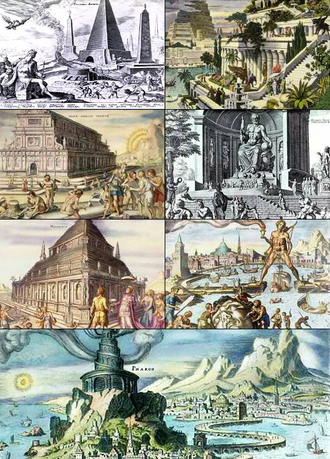
The Seven Wonders of the Ancient World, also known as the Seven Wonders of the World or simply the Seven Wonders, is a famous list of amazing buildings and structures from long ago. This list was first put together in the year 1572 in a book called Octo Mundi Miracula. It used old stories and writings to pick the most amazing places people had ever seen.
The seven wonders are the Great Pyramid of Giza, the Colossus of Rhodes, the Lighthouse of Alexandria, the Mausoleum at Halicarnassus, the Temple of Artemis, the Statue of Zeus at Olympia, and the Hanging Gardens of Babylon. These amazing places were spread across different lands—two were in Greece, two in Turkey, two in Egypt, and one in Iraq. Today, only the Great Pyramid of Giza still stands. The others were destroyed over many years, but we can still see pieces of the Lighthouse, the Temple of Artemis, and the Mausoleum in museums or where they were built. Some people even wonder if the Hanging Gardens of Babylon ever really existed.
Different lists of wonders existed long before the Octo Mundi Miracila. The very first list we know about was made hundreds of years ago, between the 2nd and 1st century BC. Many lists have been found, and some other wonderful places, like the Walls of Babylon, the Palace of Cyrus the Great, and the Pergamon Altar, were mentioned in more than one of them.
Background
Alexander the Great conquered much of the western world in the 4th century BC. This let Greek travelers visit the lands of the Egyptians, Persians, and Babylonians. These travelers were amazed by the sights they saw and began making lists to remember them.
The ancient Greeks called these sights "theamata" (θεάματα), meaning "sights" or "things to be seen." Later, they used the word "thaumata" (θαύματα), meaning "wonders." This list of wonders was like an ancient travel guidebook. It showed the most amazing places to visit.
Known lists
The idea of listing seven amazing monuments started with ancient writers. Diodorus Siculus talked about the Walls of Babylon and the Pyramids but did not make a full list. Later, Antipater of Sidon listed seven wonders. His list included most of the wonders we know today but used the Walls of Babylon instead of the Lighthouse of Alexandria.
Other ancient writers, like Philo of Byzantium, also made lists of wonderful sights. Some of these lists are incomplete. Over time, many different lists of wonders were created. These lists came from places like the Roman Empire and the Middle Ages. Sometimes they included new sites like the Colosseum or Noah's Ark. This shows how tastes and times changed.
| Complete | Incomplete | Number | |||||||||||||||||
|---|---|---|---|---|---|---|---|---|---|---|---|---|---|---|---|---|---|---|---|
Madrid(a) | Heraclitus(a) | Heraclitus(b) | Madrid(b) | ||||||||||||||||
| I. Babylon walls | 10 | ||||||||||||||||||
| II. Pyramids | 10 | ||||||||||||||||||
| III. Mausoleum | 9 | ||||||||||||||||||
| IV. Colossus | 11 | ||||||||||||||||||
| V. Artemis tem. | 8 | ||||||||||||||||||
| VI. Zeus sta. | 6 | ||||||||||||||||||
| VII. Cyrus' palace | 4 | ||||||||||||||||||
| VIII. Thebes (Eg) | 2 | ||||||||||||||||||
| IX. Cyzicus temple | 2 | ||||||||||||||||||
| X. Heraclea theatre | 1 | ||||||||||||||||||
| XI. Delos | 2 | ||||||||||||||||||
| XII. Thebes (Gr) | 2 | ||||||||||||||||||
| XIII. Hanging Gdns. | 5 | ||||||||||||||||||
| XIV. Capitoline | 2 | ||||||||||||||||||
| XV. Pergamon altar | 3 | ||||||||||||||||||
| XVI. Lighthouse | 3 | ||||||||||||||||||
| XVII. Chalke gate | 1 | ||||||||||||||||||
| XVIII. Zeus tem. | 1 | ||||||||||||||||||
| XIX. Myra thea. | 1 | ||||||||||||||||||
| XX. Asclepius San. | 1 | ||||||||||||||||||
| XXI. Parion altar | 1 | ||||||||||||||||||
| XXII. Athena statue | 1 | ||||||||||||||||||
| Number | 7 | 7 | 7 | 7 | 7 | 7 | 7 | 7 | 2 | 3 | 4 | 1 | 1 | 2 | 2 | 5 | 5 | 5 | |
Canonical seven wonders
Main article: Octo Mundi Miracula
The list of the Seven Wonders of the Ancient World was created in a book in 1572 called Octo Mundi Miracula. The wonders were from places around the Mediterranean Sea and Middle Eastern areas, which were the known world at that time. Most of these wonders were amazing buildings, except for the Pyramids of Giza and the Hanging Gardens of Babylon.
Only the Great Pyramid of Giza is still standing today. The others were destroyed by things like fires and earthquakes over many years. People have been very interested in these wonders for centuries. They have made art and traveled to see the remaining sites.
Images
Related articles


This article is a child-friendly adaptation of the Wikipedia article on Seven Wonders of the Ancient World, available under CC BY-SA 4.0.
Images from Wikimedia Commons. Tap any image to view credits and license.