 Safekipedia
Theories about Stonehenge
Adapted from Wikipedia · Adventurer experience
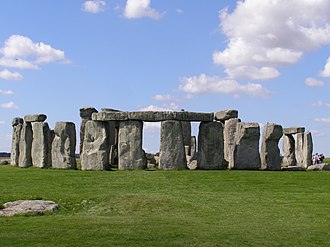
Stonehenge is one of the most famous ancient monuments in the world. It is located in England and is made up of large standing stones. People have wondered for centuries how it was built and why it is there.
Theories about Stonehenge come from many different areas. Scholars in archaeology study the stones and the land around them to learn about its history and purpose. Others look to mythology for explanations, finding stories and legends that might explain its creation. Some people even explore ideas from the paranormal, suggesting mysterious or supernatural causes.
Because of its age and mystery, Stonehenge continues to capture the imagination of people around the world. It reminds us of how much we still have to learn about the past.
Early theories
Many early historians used stories to explain Stonehenge. Some tales said the wizard Merlin had magic stones brought from Ireland. Others thought the Devil was responsible.
In the 1100s, writers like Henry of Huntingdon and Geoffrey of Monmouth shared stories about Stonehenge. Later, in 1655, some believed it was a Roman temple. For a long time, people thought groups like the Danes might have built it.
Druids and scientific evidence
The first person to study Stonehenge was John Aubrey around 1640. He thought the Druids built it. Another person, William Stukeley, shared this idea later. In 1740, John Wood, the Elder measured the site very carefully.
We now know from radiocarbon dating that Stonehenge was built between 3100 BC and 1600 BC. This helps us know who could not have built it. The Druids lived much later, around 300 BC. The Romans came to the British Isles in 55 BC, so Stonehenge was not a Roman temple as Inigo Jones thought.
Early references to Stonehenge
The ancient Greek writer Diodorus Siculus may have talked about Stonehenge in his work called Bibliotheca historica. He wrote about a faraway island named Hyperborea, where people honored Apollo. Some think this island might have been Great Britain, and the temple he described could be an early mention of Stonehenge.
Experts such as Christopher Chippindale and Aubrey Burl believe this description does not fit Stonehenge well. They note that Diodorus said the Sun and Moon looked very low in the sky, which is not how it looks where Stonehenge stands.
The bluestones
Main article: Bluestone
Many ideas exist about the bluestones at Stonehenge. Some believe they came from places like the Preseli Hills. Others think natural forces like glaciers may have helped carry some stones before people brought them to the site.
Recent studies suggest the bluestones came from specific areas in Wales. Researchers found evidence that people used these stones to build a smaller circle before moving them to Stonehenge. This shows that the stones had special meaning.
Stonehenge as part of a ritual landscape
Many people think Stonehenge was built to replace wooden buildings nearby, like those at Durrington Walls. They believe Stonehenge was part of a special journey for treating the dead. This journey started at sunrise in the east and ended at sunset in the west. Moving from wood to stone might have shown a change from life to death.
The site may have also had special astrological or spiritual meaning. Some ideas say the stones were placed to show important family lines or meeting places. The way hills nearby line up with the sunrise and sunset may have made the site even more special.
Construction techniques and design
The stones at Stonehenge match each other in shape and point toward the sun during the solstices. This shows the builders had a clear plan before they started.
People have many ideas about how the stones were moved and put in place. Some think the smaller stones came from Wales and were pulled on wooden paths using rope. Tests show this would have been very hard to do. Other ideas include using wooden tracks with round logs, floating the stones in water, or using wooden frames and ropes to lift them up. All these methods would have needed a lot of hard work and teamwork, taking many years to complete.
Ley lines
British author John Michell thought that ley lines straight lines linking special places might match up with Stonehenge and other important sacred sites in Britain. He noticed that Stonehenge and Llantwit Major are almost the same distance from Glastonbury, making neat patterns on a map. But many experts doubt these ideas because Glastonbury Abbey was built much later than Stonehenge. Some also think the old tales Michell talked about might really mean a nearby village called Amesbury not Stonehenge.
Images
Related articles


This article is a child-friendly adaptation of the Wikipedia article on Theories about Stonehenge, available under CC BY-SA 4.0.
Images from Wikimedia Commons. Tap any image to view credits and license.