 Safekipedia
Timeline of the Catholic Church
Adapted from Wikipedia · Adventurer experience
The history of the Catholic Church is a big part of the history of Christianity. It is also, according to church historian Mark A. Noll, the "world's oldest continuously functioning international institution." This article looks at almost two thousand years of this important history.
Over time, some big disagreements have split Christianity apart. The Catholic Church says these big splits happened around 144 with Marcionism, 318 with Arianism, 451 with the Oriental Orthodox, and between 1054 and 1449 during the East–West Schism. During this time, the churches in the East and West disagreed about important beliefs and leadership. Then in 1517 came the Protestant Reformation, which led to many new Christian groups.
The Catholic Church has been important in many major events in world history. It helped spread Christianity to Western, Central Europe, and Latin America. It also helped start universities, hospitals, and made big impacts on art, music, and literature. The Church has been involved in many global events, like the Reconquista, the Crusades, and even helped in the Fall of Communism in Eastern Europe near the end of the 20th century.
Ministry of Jesus and founding
Main article: Chronology of Jesus
-
4 BC: Nativity of Jesus. According to the Gospel of Luke, Jesus was born in the town of Bethlehem during the time of King Herod the Great and the Roman Emperor Augustus. His mother was the Virgin Mary, and Christians believe he was the Son of God.
-
Around 28–29 AD: Jesus began his teachings after being baptized. He chose special followers called Apostles, including Peter, James, and John. They saw Jesus do amazing things and heard his important messages.
-
30-33 AD: Jesus' followers believed he was the Messiah. He entered Jerusalem and was later crucified there. But after three days, his followers said he came back to life. Later, he told his disciples to share his teachings with everyone. Shortly after, Peter spoke to many people, and about 3,000 decided to join as followers.
First millennium
Apostolic Catholic Church
Main article: History of early Christianity
The early years of the Catholic Church had many important events. In 34 AD, Stephen became the first Christian martyr. Around 40 AD, Mary, known as Our Lady of the Pillar, appeared to James the Great in Spain. In 46 AD, Paul started his journeys to share Christianity with Barnabas. The Council of Jerusalem in 50 AD decided that new followers did not need to follow Jewish laws, helping Christianity grow.
Many leaders helped shape the early Church. In 64 AD, hard times began for Christians under Nero after a fire in Rome. Peter was martyred during this time. Paul was martyred in 67 AD, and Pope Linus became the next pope. In 70 AD, Jerusalem and its temple were destroyed. The Gospels of Matthew, Luke, and Acts were finished in the 80s AD. By 100 AD, the Gospel of John was completed, and John, the last of the apostles, passed away in Ephesus.
313–476
Changes continued as the Church grew. In 313 AD, the Edict of Milan let Christians practice their faith openly. In 325 AD, the First Ecumenical Council of Nicaea was held to solve problems among Christians and created the Nicene Creed. Constantine started building Constantinople in 324 AD, which later became an important Church center.
Christmas was first celebrated in Rome in 336 AD, and December 25 was chosen as the date in 345 AD. In 380 AD, Emperor Theodosius I made Christianity the official religion of the Roman Empire. The Council of Rome in 382 AD decided which books are part of the Bible. In 431 AD, the Council of Ephesus taught that Jesus was both fully God and fully human. The Council of Chalcedon in 451 AD explained more about Jesus and called Mary the Mother of God.
477–799
During this time, the Church kept growing and organizing. In 480 AD, Benedict wrote rules for monasteries that helped guide monastic life. In 496 AD, Clovis I, king of the Franks, became Catholic. Pope Gregory the Great, who became pope in 590 AD, changed Church structures and began Gregorian chant. In 596 AD, Augustine of Canterbury was sent to share Christianity with people in England.
Muslim armies took over Jerusalem and Syria in 638 AD, and Egypt and North Africa later. In 664 AD, the Synod of Whitby joined the Celtic Church in England with the Catholic Church. In 711 AD, Muslim armies invaded Spain. In 732 AD, Charles Martel stopped them at Poitiers in France. In 756 AD, the Popes were given control of Rome by King Pepin the Short of the Franks, starting the Papal States.
800–1001
In 800 AD, Charlemagne was crowned Holy Roman Emperor by Pope Leo III, an important moment for the Church and the Holy Roman Empire. Missionary work continued, with Ansgar starting work in Sweden around 829 AD. In 863 AD, Cyril and Methodius translated the Bible into Slavonic to help share Christianity with Slavic peoples. In 962 AD, Otto the Great was crowned Holy Roman Emperor by Pope John XII.
Poland began becoming Catholic in 966 AD with Mieszko I, and Kievan Rus' followed in 988 AD under Vladimir I the Great. In 1000/1001 AD, Stephen I of Hungary became king and later turned to Catholicism, starting the Catholic Church in Hungary.
Second millennium
1001–1453
In 1012, a book called Decretum about church rules was finished. In 1054, a big split happened between two parts of the Christian church. In 1095, a leader asked people to help protect Christians in faraway lands. Monasteries grew, and new groups of religious people formed. Important church meetings made new rules, and churches were built in a special style called Gothic.
The church grew in power, and new universities were started. In 1215, a big meeting made important decisions for the church. New groups like the Franciscans and Dominicans began. In 1274, the churches briefly reunited. By the end of this time, the church faced challenges from new ideas and leaders.
1454–1599
In the years that followed, explorers like Christopher Columbus reached new lands. The church faced changes, like the start of the Protestant Reformation when Martin Luther questioned church practices in 1517. New churches were started in different parts of the world, and important artists like Michelangelo created famous works. The church also dealt with new ideas and scientific discoveries, like those by Copernicus.
1600–1699
The next years saw more changes. New religious groups and schools were started. In Japan, Christianity was banned. Battles happened, and new leaders shaped the church. In Europe, important political events affected the church. Artists and writers who were Catholic created famous works during this time.
1700–1799
In this period, the church continued to change. New seminaries were founded, and religious orders grew. The church faced challenges from new ideas and political changes, like the French Revolution. Important musical works were created, and the church expanded into new areas.
19th century
The 1800s brought more changes. Napoleon changed the church in France. In the United Kingdom, laws changed to allow more Catholics. New universities were founded, and the church spoke out against slavery. Important church meetings happened, and new areas of the world became part of the Catholic Church. Artists and writers continued to create works that reflected their faith.
20th century
The 1900s were a time of big changes. Wars affected the church, and new leaders brought new ideas. The church grew in many parts of the world. Important events like the Second Vatican Council in the 1960s brought many changes to how the church worked and how people practiced their faith. New movements started, and the church continued to face challenges and opportunities in a changing world.
Third millennium
21st century
See also: History of the Catholic Church since 1962
- March 5, 2000: Pedro Calungsod was honored by Pope John Paul II at the Vatican. He is a martyr from the Philippines.
- April 30, 2000: Pope John Paul II named Faustina Kowalska a saint and set the Sunday after Easter as Divine Mercy Sunday.
- January 1, 2001: The 21st century and the new millennium began. The church celebrated the start of the third Christian millennium.
- January 6, 2001: Pope John Paul II shared a plan for the church in the new millennium in Novo Millennio Ineunte. He said that prayer was very important.
- January 25, to 26, 2003: The 4th World Meeting of Families was held at Rizal Park in Manila, Philippines.
- 2004: Cambridge University Press published The Cambridge Companion to Hans Urs von Balthasar, about his writings.
- April 2, 2005: Pope John Paul II died at the age of 84. Many people around the world watched his funeral.
- April 19, 2005: Cardinal Joseph Alois Ratzinger was chosen as Pope Benedict XVI. He was the first pope chosen in the 21st century and the 3rd millennium.
- August 18, 2005: Pope Benedict XVI went to Cologne, Germany for the World Youth Day. It was his first trip outside Italy.
- January 9, 2006: The 400th Year Anniversary of the Translation of the Black Nazarene was celebrated at Minor Basilica of the Black Nazarene in Quiapo, Manila, Philippines. It came from Acapulco, Mexico in 1606.
- September 12, 2006: Pope Benedict XVI spoke at the University of Regensburg about faith and reason. His words caused some reactions from Muslims around the world.
- June 11, 2007: Pope Benedict XVI changed a rule about choosing popes. He brought back the old way of needing two-thirds of votes.
- July 7, 2007: Pope Benedict XVI allowed priests of the Latin Church to use the 1962 Roman Missal in private and sometimes in public.
- October 28, 2007: Pope Benedict XVI held a big ceremony to honor 498 Spanish Martyrs who died during the Civil War in Spain.
- 2007: The Fifth Episcopal Conference of Latin America was held at Aparecida, Brazil. Cardinal Jorge Bergoglio – later Pope Francis – helped write the final document.
- August 13, 2007: TV Maria began broadcasting in Manila, Philippines.
- May 2008: Pope Benedict XVI and some Muslim leaders agreed that true religion is peaceful and that violence is never right.
- July 2008: Pope Benedict XVI went to Sydney, Australia for the World Youth Day and said that Spain would host the next one.
- January 2009: The Holy See removed the excommunication of some bishops of the Society of St. Pius X.
- October 11, 2009: Father Damien, a Belgian priest who helped people with a serious illness, was named a saint.
- November 20, to 27, 2009: The 5th Asian Youth Day was held in Imus City, Cavite, Philippines.
- April 19, to 22, 2010: The 1st Philippine Apostolic Congress on Mercy was held in the Philippines.
- October 17, 2010: Mary MacKillop, an Australian nun, was named a saint. Also named a saint was Andre Bessette from Montreal, Canada.
- October 21, 2012: Kateri Tekakwitha, a laywoman from the Algonquin-Mohawk people, was named a saint by Pope Benedict XVI.
- October 21, 2012: Pedro Calungsod, a young person from the Archdiocese of Cebu, Philippines, was named a saint by Pope Benedict XVI.
- 2012: Hildegard of Bingen was named a Doctor of the Church.
- February 2013: Pope Benedict XVI stepped down as pope.
- March 2013: Jorge Bergoglio of Argentina was chosen as Pope Francis. He was the first Latin American and the first Jesuit to be pope.
- May 12, 2013: Pope Francis named over 800 people as saints. They were killed by Turks in Otranto in 1480.
- October 13, 2013: José María of Manila was honored by Cardinal Angelo Amato in Tarragona, Spain. He became a Spanish-Filipino Martyr.
- October 16–18, 2013: The First Philippine Conference of New Evangelization was held in Manila by Archbishop Cardinal Luis Antonio Tagle at the University of Santo Tomas in Manila.
- January 15–19, 2015: Pope Francis visited the Philippines. It was the fourth time a pope had visited.
- February 2015: Charles Maung Bo and Soane Patita Mafi became the first cardinals from Myanmar and Tonga.
- May 2015: In his teaching letter Laudato si', Pope Francis talked about taking care of the environment.
- May 23, 2015: Oscar Romero, the Archbishop of San Salvador, was honored by Pope Francis.
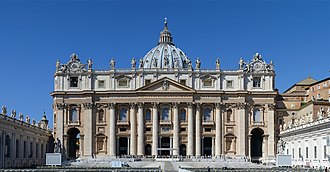
- April 12, 2015: Pope Francis named Gregory of Narek a Doctor of the Church during a service at St. Peter's Basilica in Rome.
- December 8, 2015 to November 20, 2016: Pope Francis asked Catholics to take part in a special year of mercy.
- January 24–31, 2016: The 51st International Eucharistic Congress was held in Cebu City, Philippines.
- February 12, 2016: Patriarch Kirill of Moscow and Pope Francis met near Havana, Cuba and signed a statement about working together.
- January 16, to 20, 2017: The 4th World Apostolic Congress on Mercy was held in Manila, Philippines.
- November 2, 2017: Pope Francis talked about letting married men become priests in some places where there are not enough priests.
- May 13, 2017: Pope Francis named Francisco and Jacinta Marto as saints. They saw visions in Fatima, Portugal.
- December 18, 2017: Pope Francis named priest-communicator Patrick Peyton venerable.
- March 19, 2018: In a letter, Pope Francis talked about the importance of being good and kind.
- May 18, 2018: Bishops of Chile offered to step down because of problems with some clerics. Pope Francis accepted their offers.
- August 2, 2018: Pope Francis said that the death penalty is wrong.
- December 17, 2018: The Holy See recognized the Orthodox Church of Ukraine.
- July 1, 2019: The date was set for the naming of John Henry Newman as a saint.
- July 2, 2019: Pope Francis gave nine bone fragments of St. Peter to Orthodox Ecumenical Patriarch Bartholomew of Constantinople.
- July 5, 2019: Pope Francis said that the Russian Orthodox Church was trying to influence other religions in Ukraine.
- September 17, 2019: Pope Francis had a meal with Ecumenical Patriarch Bartholomew I at Domus Sanctae Marthae.
- October 5, 2019: Pope Francis named 13 new cardinals.
- October 6, 2019: The Synod of Bishops for the Pan-Amazon region began.
- October 10, 2019: The Episcopal Conference of Poland agreed to start the process to name the parents of John Paul II as saints.
- December 15, 2019: Pope Francis held the first Papal Celebration of Simbang Gabi at Vatican City.
- May 1, 2020: Luis Antonio Tagle became the first Filipino Cardinal-Bishop.
- 2021: The Philippines celebrated 500 years since Christianity came to the country in 1521.
- December 31, 2022: Pope Benedict XVI died at the age of 95.
- April 21, 2025: Pope Francis died at the age of 88 after being ill.
- May 9, 2025: Pope Leo XIV was chosen as the new pope.
- November 28, 2025: Pope Leo XIV and Bartholomew I celebrated the 1,700th year anniversary of a very old meeting about faith.
Images
Related articles



This article is a child-friendly adaptation of the Wikipedia article on Timeline of the Catholic Church, available under CC BY-SA 4.0.
Images from Wikimedia Commons. Tap any image to view credits and license.