 Safekipedia
Vatican City
Adapted from Wikipedia · Adventurer experience
Vatican City, officially called the Vatican City State, is the smallest country in the world. It covers just 48.99 hectares (121 acres) and has a population of about 882 people. This tiny city-state is located inside Rome, Italy, and is ruled by the pope, who is also the leader of the Catholic Church.
The Vatican became an independent country in 1929 through an agreement called the Lateran Treaty between the Holy See and the Kingdom of Italy. It serves as the main center for the Catholic Church, which has over a billion members worldwide.
Inside Vatican City are important religious and cultural sites like St Peter's Basilica, the Sistine Chapel, the Vatican Apostolic Library, and the Vatican Museums. These places hold some of the world's most famous artworks. The Vatican does not collect taxes and gets its money from gifts from believers, selling stamps and souvenirs, and charging admission to its museums.
Name
The name Vatican City started with the Lateran Treaty in 1929. This treaty made the city-state, named after Vatican Hill where it is inside Rome. The word "Vatican" comes from an old Etruscan place called Vatica or Vaticum, in an area the Romans called Ager Vaticanus (‘Vatican territory’).
In Italian-language, the city is called Città del Vaticano, or formally Stato della Città del Vaticano, meaning 'State of Vatican City'. Its Latin name is Status Civitatis Vaticanae, used in official documents by the Holy See and the pope.
History
Further information: History of the Papacy and Holy See § History
Early history
The name "Vatican" comes from ancient Roman times. It was an area near Rome called Ager Vaticanus. This place was marshy and often flooded. Romans thought it felt unlucky because it was near their enemy, the city of Veii, and because of the floods.
Over time, many rich people built homes there. A famous ruler, Caligula, built a place for races called the Circus of Nero. A tall stone tower, called the Vatican obelisk, still stands today. This area also became important for early Christians, who believed Saint Peter, one of Jesus' followers, was buried there.
Papal States
Main article: Papal States
See also: History of the Papacy
For many years, the leaders of the Catholic Church, called popes, ruled a large area of land in Italy known as the Papal States. They did not always live in the Vatican. For a long time, they lived in a palace called the Lateran Palace in Rome. Later, they moved to the Vatican, and then to another palace called the Quirinal Palace.
Under Italian rule (1871–1929)
Main article: Roman Question
In 1870, when Italy was being united into one country, Rome became part of Italy. The popes were not allowed to leave the Vatican, which caused a disagreement that lasted until 1929.
Lateran treaties
Main article: Lateran Treaty
In 1929, an agreement called the Lateran Treaty was signed. This treaty created Vatican City as its own small country and ended the disagreement between the popes and Italy.
World War II
During World War II, the Vatican stayed neutral. Even when German troops occupied Rome, they respected the Vatican's neutral status. The leader of the Vatican at the time worked to keep Rome from being bombed.
Post-war history
After the war, changes continued to be made within the Vatican. In later years, new buildings were added, sometimes causing discussions with nearby countries.
Geography
Main article: Geography of Vatican City
Vatican City is a tiny country inside the city of Rome, Italy. It is built on Vatican Hill and has important places like St Peter's Basilica, the Apostolic Palace, the Sistine Chapel, and museums. This area was once part of Rome but became its own country in 1929.
The weather in Vatican City is like Rome's, with mild winters and hot summers. The city has gardens that cover about half of its land, with fountains and sculptures.
Governance
Main article: Politics of Vatican City
The politics of Vatican City happens because it is an absolute elective monarchy and is governed by the Holy See. The head of the Catholic Church, the pope, holds power here. The pope has main control over making laws, running the government, and making judgments in Vatican City. This makes it a rare example of a non-hereditary monarchy.
The Vatican City State was created in 1929 by the Lateran Pacts. It gives the Holy See a small area of land and independence. It is different from the Holy See. The state helps the Holy See but is not needed for it to work. The Holy See has existed since Roman times and is recognized as an independent country.
Vatican City is one of the few well-known independent countries that is not a member of the United Nations. The Holy See is different from Vatican City State and has permanent observer status. This means it has all the rights of a full member except voting in the UN General Assembly.
The government of Vatican City has a special structure. The pope is the leader, but he gets help from different groups. The Pontifical Commission for Vatican City State makes laws in the pope's name. This group has cardinals chosen by the pope for five years. The president of this commission runs the government and is also the president of the governorate. He gets help from the general secretary and the deputy general secretary. The Holy See's Secretariat of State handles foreign relations.
The pope has full power over the government, laws, and courts in Vatican City. He is the only absolute monarch in Europe.
Vatican City has departments that handle health, security, telecommunications and other areas.
The pope is the ex officio head of state because he is the bishop of the diocese of Rome and head of the Catholic Church. The term "Holy See" means the pope's spiritual leadership, mostly done through the Roman Curia. His official title for Vatican City is Sovereign of the State of Vatican City.
Pope Leo XIV, born Robert Francis Prevost in Chicago, United States, was elected on 8 May 2025. The main helper for the pope in Vatican City is the president of the Pontifical Commission for Vatican City State. Since 2001, this president is also the president of the Governorate of Vatican City. The current president is the Italian sister Raffaella Petrini, appointed by Pope Francis on 1 March 2025 and reconfirmed by Pope Leo XIV on 9 May 2025.
Laws are made by the pope and given to the Pontifical Commission for Vatican City State. The members are cardinals chosen by the pope for five years. The commission's actions need the pope's approval through the Holy See's Secretariat of State, and they are published in a special part of the Acta Apostolicae Sedis.
Running the government is done by the president of the Governorate of Vatican City. The Governorate has two main helpers: the general secretary and the deputy general secretary. They are chosen by the pope for five years. Important actions need approval from the Pontifical Commission and the pope through the Secretariat of State.
The Pontifical Commission and the president of the Governorate can get help from councilors in making laws and other big decisions. The president can call together members of the Council of Directors with outside experts and people. The Governorate runs government work through several departments and offices. Their leaders are chosen by the pope for five years.
The Governorate has central offices for law and personnel, and directorates for:
- Infrastructure and services
- Telecommunications and information systems
- Security and civil protection services
- Economy
- Health and hygiene
- Museums and cultural heritage
- Pontifical villas
There are also groups for money, rules, workers, and hiring.
The pope's name, four groups handle court work: a Supreme Court, a Court of Appeal, a Tribunal and a Sole Judge. Their jobs are set by Vatican rules. If needed, sentences can be served in Italy (see the section on crime below).
Because Vatican City is small, many offices of the Holy See are in Italy. They have the same protection as diplomatic missions thanks to the Lateran Treaty.
Vatican City is inside Italy, so its defence is handled by the Italian Armed Forces. There is no special defence agreement because Vatican City is a neutral state. It has no army, but the Swiss Guard protects the pope and people in the state. The Swiss Guard are soldiers with Vatican City State passports.
The Pontifical Swiss Guard was started by Pope Julius II in 1506 to protect the pope. Members must be Catholic, unmarried Swiss men who finished training with the Swiss Armed Forces, be between 19 and 30 years old, and at least 174 cm tall. They carry small arms and halberds, and are trained in protecting people. With the Corps of Gendarmerie of Vatican City, they help with Italy-Vatican border control. The Palatine Guard and the Noble Guard were stopped by Pope Paul VI in 1970.
All of Vatican City is listed as important cultural property and is a World Heritage Site. This gives it protection under international law during armed conflicts. Many old documents are kept in the "Bunker", a strong room under the Cortile della Pigna, with systems for fire protection, climate and humidity control, and security.
The Corps of Firefighters of the Vatican City State handles fire and civil defence. It started in the early 1800s and was made formal in 1941. It deals with fires, floods, natural disasters, and other big events. It reports to the Directorate for Security Services and Civil Defence, which also runs the Gendarmerie.
The Gendarmerie Corps is the police force for Vatican City and the extraterritorial properties of the Holy See. It handles security, public order, border control, traffic, investigations, and other police work. It has 130 people and is part of the Directorate for Security Services and Civil Defence.
Even though St Peter's Square is part of Vatican City, it is usually watched by Italian police forces.
Crime in Vatican City mostly includes stealing and shoplifting by visitors. Pickpockets often work in St Peter's Square. If crimes happen there, Italian police may arrest and try the people.
Under the Lateran Treaty, Italy will punish crimes done in Vatican City if asked by the Holy See. If someone accused of a crime in both Italy and Vatican City runs to Vatican City or a protected building, Italy can arrest them.
Vatican City does not have prisons, except small cells for people waiting for trial. People found guilty serve their time in Italian prisons, with the Vatican paying the costs.
Vatican City State is a country under international law. The Holy See handles diplomacy for it, along with its own work. Vatican City does not have its own diplomatic service.
Because it is small, Vatican City cannot host embassies. Embassies to the Holy See are in Rome. Only during World War II were some embassy staff allowed to stay in Vatican City because Rome was controlled by Axis powers.
Vatican City State joins some international groups that relate to it as a place, not just the Holy See. These groups are fewer than those the Holy See joins. They include:
- European Conference of Postal and Telecommunications Administrations (CEPT)
- European Telecommunications Satellite Organization (Eutelsat IGO)
- International Grains Council (IGC)
- International Institute of Administrative Sciences (IIAS)
- International Telecommunication Union (ITU)
- International Telecommunications Satellite Organization (ITSO)
- Interpol
- Universal Postal Union (UPU)
It also works with:
Vatican City State is not a member of the United Nations (UN), but the Holy See has observer status in the United Nations General Assembly since 1968. Since it is not a UN member, Vatican City is not under the International Court of Justice. It works with UN groups through this status.
Vatican City State is not a member of the International Criminal Court. In Europe, only Belarus is also not a member. Ukraine and Monaco signed but did not approve, and Russia left in 2016.
Vatican City State is not a member of the Council of Europe or part of the European Convention on Human Rights, so it is not under the European Court of Human Rights. In Europe, Belarus is also not a member, while Russia was kicked out after the 2022 Russian invasion of Ukraine.
The OECD's "Common Reporting Standard" (CRS) to stop tax evasion and money laundering has not been signed. Vatican City has been criticized for money laundering in the past. The only other European country not to sign the CRS is Belarus.
Vatican City State is one of few countries that do not share financial data with the International Monetary Fund.
Economy
Main article: Economy of Vatican City
Vatican City makes money from its museums, post office, and by selling stamps, coins, medals, and gifts. People who visit the museums also help its economy. Workers in Vatican City earn about the same as workers in Rome. The Vatican has its own bank, called the Vatican Bank, which handles money matters around the world. It has ATMs that show instructions in Latin, which is unusual.
Vatican City makes its own coins and stamps and uses the Euro as its money. It started using the Euro in 2002. Before that, it had its own money called the Vatican lira.
In 2014, the Vatican created a special office to manage its money. It also brought together its news, radio, and media services under one group.
In 2022, the Vatican planned to release digital collectibles called NFTs from its museum collection.
Transport
Main article: Transport in Vatican City
Vatican City has walkways and a main square for people to move around. It is very small, about the size of a short walk, and does not have airports or highways. There is a small heliport for flying in. The closest big airports are in Rome. There is a small railway that moves goods and connects to Rome’s train system. The nearest subway station is in Rome, close to the Vatican museums.
Telecommunications and mass media
Vatican City has its own modern telephone system. It controls its own web address ending in .va. It also has radio services and a website called Vatican News. These services are managed by a special group. Vatican Radio broadcasts on different frequencies and online. The Vatican also has its own newspaper and printing press.
Postal service
Vatican City started its own postal service in 1929 and began issuing its own stamps soon after. It is known for having an efficient postal system. The postal code for Vatican City is SCV-00120.
Healthcare
See also: Vatican Pharmacy and Bambino Gesù Hospital
Sustainability
The Vatican has taken steps to help the environment. It uses solar power with panels on buildings like the Paul VI Audience Hall. It has added charging stations for electric cars and plans to replace its cars with electric ones. The Vatican stopped using single-use plastics in 2019, before the European Union’s rule. It recycles about 55% of its waste and aims to reach 70–75% recycling. It also uses energy-saving lights and digital documents to save energy and paper.
Demographics
See also: Demographics of Vatican City and Women in Vatican City
Vatican City is a very small place with only 882 people living there as of 2024. These people include religious workers, guards, and their families. Many more people visit each day as tourists. Everyone living there follows the Catholic faith.
Vatican City does not have an official language, but Italian is used for most everyday matters. The Swiss Guard, who protect the city, use Swiss German for commands but take their promises in their own languages.
Citizenship in Vatican City is special. It is given to people who work for the religious leaders, and it ends if they stop working there. Their families can also become citizens. If someone loses Vatican citizenship, they become an Italian citizen.
Languages
Further information: Languages of Vatican City
Citizenship
Citizenship in Vatican City is different from other countries. It is given to people who work for the religious leaders. It ends if they stop working there. Their families can also become citizens. If someone loses Vatican citizenship, they become an Italian citizen.
The Holy See issues only diplomatic and service passports, whereas Vatican City issues ordinary passports for its citizens.
Statistical oddities
Vatican City is often unusual in statistics because it is very small. For example, there are more men than women because most jobs are for men. The city also has a high number of petty crimes against tourists and uses a lot of wine for religious reasons.
A 360-degree view from the dome of St. Peter's Basilica, looking over the Vatican's Saint Peter's Square (centre) and out into Rome, showing Vatican City in all directions
| Citizenship | Vatican | other | |
|---|---|---|---|
| Residency | other | Vatican City | |
| Pope | 1 | ||
| Cardinals | 56 | 10 | |
| Diplomats | 316 | ||
| Swiss Guard | 104 | ||
| Others | 131 | 636 | |
| Total | 618 | 636 | |
| 372 | 246 | ||
| 882 | |||
| 1,254 | |||
| Sex | all | male | female | ||||||
|---|---|---|---|---|---|---|---|---|---|
| Citizenship | Vatican | other | Vatican | other | Vatican | other | |||
| Residency | other | Vatican City | other | Vatican City | Vatican City | ||||
| Pope | 1 | 1 | |||||||
| Cardinals | 43 | 30 | 43 | 30 | |||||
| Diplomats | 306 | 306 | |||||||
| Swiss Guard | 86 | 86 | |||||||
| Other religious | 50 | 197 | 49 | 102 | 1 | 95 | |||
| Other lay | 56 | 24 | 25 | 3 | 31 | 21 | |||
| Total | 572 | 221 | 540 | 105 | 32 | 116 | |||
| 349 | 223 | 349 | 191 | 32 | |||||
| 444 | 296 | 148 | |||||||
| 793 | 645 | 148 | |||||||
Culture
See also: Music of Vatican City
See also: Architecture of Vatican City and Vatican Museums
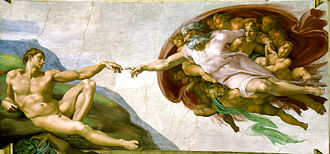
Vatican City has some of the world's most famous art. St Peter's Basilica, made by many great artists, shows beautiful Renaissance architecture. The Sistine Chapel is known for its lovely paintings, including work by Michelangelo.
The Vatican Apostolic Library and the Vatican Museums hold important historical and cultural items. In 1984, UNESCO named Vatican City a World Heritage Site, making it the only place in the world with this honor.
Pope Pius XI started the Pontifical Academy of Sciences in 1936. This group brings together scientists to study math, physics, natural sciences, and medicine. The Vatican Observatory, begun in the 1500s, studies the stars and teaches others about space with help from the University of Arizona.
Main article: Sport in Vatican City
Vatican City does not join the Olympic Games, but it takes part in other international sports events. It has its own sports group, called Athletica Vaticana.
Football in Vatican City is managed by the Vatican Amateur Sports Association. This group runs a small championship with eight teams and organizes other football competitions. It also supports the Vatican City national football team.
Images
Related articles




This article is a child-friendly adaptation of the Wikipedia article on Vatican City, available under CC BY-SA 4.0.
Images from Wikimedia Commons. Tap any image to view credits and license.