 Safekipedia
City-state
Adapted from Wikipedia · Adventurer experience
A city-state is an independent sovereign city. It is the main place for government, trade, and culture in its area. Unlike bigger countries with many cities and countryside, a city-state is just one city that runs itself.
Many important city-states existed long ago, such as Rome, Athens, and Venice.
Today, only a few city-states remain. Singapore is the largest and most well-known. It has its own currency, military, and strong influence in the world. Other places like Monaco and Vatican City are also often called city-states.
Some cities, such as Hong Kong and Dubai, are very independent but are not fully separate countries. They still belong to larger nations but have many powers usually found in a city-state.
Historical background
Ancient and medieval world
Further information: List of ancient Greek cities, List of Phoenician cities, Cities of the ancient Near East, Italian city-states, Maya city, Polis, and Altepetl
Historical city-states included Sumerian cities such as Uruk, Ur and Nippur; Ancient Egyptian cities like Thebes and Memphis; the Phoenician cities such as Tyre and Sidon; the five Philistine city-states; the Berber cities of the Garamantes; the cities of ancient Greece (the poleis such as Athens, Sparta, Thebes, and Corinth); the Roman Republic (which grew from a city-state into a large empire); the Italian city-states from the Middle Ages, such as Florence, Siena, Ferrara, Milan, and Venice; the Mayan cities in Mesoamerica such as Chichen Itza, Tikal, Copán and Monte Albán; the central Asian cities along the Silk Road; the cities of the Swahili coast; Ragusa and Poljica in Croatia; Tbilisi in Georgia; the Russian cities of Novgorod and Pskov; the free imperial cities of German-speaking Europe; mueang of Indochina; barangay states of the Philippines; and many others. The Viking cities in medieval Ireland, such as the Kingdom of Dublin, were also city-states.
In Cyprus, the Phoenician city of Kition was a city-state from around 800 BC until the 4th century BC.
The ancient Greek city-states and the merchant cities of Renaissance Italy are some of the best-known examples. These small political groups often worked together but sometimes could not join larger countries. Because they were small, they were sometimes taken over by bigger countries like Rome. Over time, they became part of larger groups like empires and nations.
Central Europe
In the Holy Roman Empire (962–1806) more than 80 Free Imperial Cities had the right to make their own rules. Some, like Bremen, Hamburg and Lübeck, worked together on trade. Cities sometimes made agreements to protect each other, like the Hanseatic League, the Swabian League of Cities, the Décapole, or the Old Swiss Confederacy. The Swiss cantons such as Zürich, Bern, Lucerne, Fribourg, Solothurn, Basel, Schaffhausen, and Geneva began as city-states.
After the Holy Roman Empire ended in 1806, some cities became independent, like the Free Hanseatic City of Bremen, the Free City of Frankfurt upon Main, the Free and Hanseatic City of Hamburg, the Free and Hanseatic City of Lübeck, and the Free City of Kraków. The city of Fiume also had special status under Habsburg rule.
Italy
Main article: Italian city-states
See also: Medieval commune, Lombard League, Maritime republics, and Signoria
In Northern and Central Italy during the Middle Ages and Renaissance, city-states with land around them were common. Some were part of the Holy Roman Empire but ruled themselves. This time saw strong growth in trade and cities, with influence across Europe and the Mediterranean. Many were ruled by one leader or a family, like the House of Gonzaga and the House of Sforza.
Examples of Italian city-states during the Middle Ages and the Renaissance
- Republic of Florence, Duchy of Milan, Duchy of Ferrara, San Marino, Duchy of Modena and Reggio, Duchy of Urbino, Duchy of Mantua and the Republic of Lucca.
- The powerful maritime republics: Republic of Venice, Republic of Genoa, Republic of Amalfi, Republic of Pisa, Republic of Ancona and Duchy of Gaeta
Southeast Asia
In Mainland Southeast Asia, leaders organized towns into independent groups called mueang. These towns sometimes paid respect to bigger towns, forming a system where smaller towns followed larger ones. This continued until the 19th century when European powers arrived. Siam changed to a nation-state, bringing towns like Lan Xang and Cambodia into its lands.
In early Philippine history, groups called barangays were important. These were sometimes called barangay states, but they were really their own small countries, ruled by Datus, Rajahs and Sultans. They came from the word balangay, a type of boat used by Filipinos before Europeans arrived.
20th-century cities under international supervision
Danzig
Main article: Free City of Danzig
The Free City of Danzig was a semi-autonomous city-state from 1920 to 1939. It included the port of Danzig (now Gdańsk, Poland) and nearby towns. It was created in 1920 after World War I.
Fiume
Main article: Free State of Fiume
After having special status under Habsburg rule, the Free State of Fiume became an independent state from 1920 to 1924. It covered 28 km2 (11 sq mi) including the city of Fiume (now Rijeka in Croatia) and nearby areas.
Jerusalem
Main article: Corpus separatum (Jerusalem)
The United Nations Partition Plan for Palestine in 1947 suggested making Jerusalem a special city-state managed by the United Nations Trusteeship Council. This did not happen because war began soon after. Jerusalem was divided, and later Israel took control of all of it.
Memel
Main article: Klaipėda Region
The Klaipėda Region or Memel Territory was put under the League of Nations in 1920 after World War I. It was to stay there until the people voted on joining Germany. In 1923, Lithuania took control of it.
Ottoman
Some ideas for splitting the Ottoman Empire suggested special zones in Istanbul or the Turkish straits, and possibly İzmir/Smyrna. After World War I, allies of World War I occupied these places, but Turkey remained in control of Istanbul, while Smyrna was taken by Greece but later returned to Turkey.
Shanghai
Main article: Shanghai International Settlement
The Shanghai International Settlement (1845–1943) was a special area with its own rules, post office, and money.
Tangier
Main article: Tangier International Zone
The city of Tangier had an international zone about 373 km2 (144 sq mi). It was first managed by France, Spain, and the United Kingdom, and later by other countries too. It was part of Morocco but became its own area from 1923 to 1956, when it joined Morocco.
Trieste
Main article: Free Territory of Trieste
The Free Territory of Trieste was an independent area between Italy and Yugoslavia from 1947 to 1954. It was managed by the United Nations Security Council after World War II.
West Berlin
In the 20th century West Berlin acted as a separate area from 1948 to 1990. It was not part of any country but was controlled by the Western Allies. It was closely linked to West Germany but was not officially part of it.
Contemporary sovereign city-states
Vatican City
Main article: Vatican City
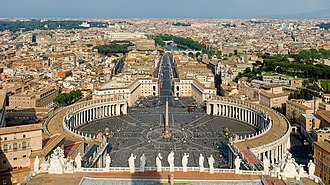
Vatican City is a very small independent country. It became its own state in 1929 through an agreement between Italy and the Pope. Today, it has its own leaders, citizens, flag, and stamps. It is the smallest country in the world.
Monaco
Main article: Monaco
Monaco is a tiny independent city-state next to France. It is famous for its casino, royal family, and beautiful harbor. Monaco has its own leaders and governs the same area, though it relies on France for protection.
Singapore
Main article: Singapore
Singapore is an island city-state in Southeast Asia. It has about 6 million people living in an area of 728 square kilometres. Singapore became independent in 1965 after leaving Malaysia. It has its own money, a big airport, busy ports, and a strong army to protect itself.
Contemporary non-sovereign city-states
Some cities are not independent countries, but they have a lot of self-rule within a larger country. They act like small independent cities even though they belong to a bigger nation. These places are often called "city-states" because they manage many of their own affairs.
Some cities with strong self-rule include:
- Spain: Ceuta and Melilla (as autonomous cities)
- Armenia: Yerevan (as an autonomous city)
- China: Hong Kong and Macau (as special administrative regions)
- South Korea: Sejong (as a self governing city)
- United Kingdom: Gibraltar (as a British Overseas Territory)
- United States: Washington, D.C. (as a federal district)
Other cities that are part of a group of states but have a lot of self-rule include:
- Argentina: Buenos Aires
- Austria: Vienna
- Belgium: Brussels
- Brazil: Brasília
- Germany: Bremen, Berlin and Hamburg
- Nigeria: Lagos
- Mexico: Mexico City
- Malaysia: Malacca, Penang
- Russia: Moscow, Saint Petersburg, and Sevastopol (disputed)
- Switzerland: Basel-Stadt and Geneva
States with similar characteristics
Some small countries today are like city-states. Places like Djibouti, Qatar, Brunei, Kuwait, Bahrain, and Malta focus on one big city. For example, Luxembourg City is so important that the whole country is named after it. But these places also have smaller towns and rural areas, unlike true city-states like Singapore.
Tiny countries where many people live close together, such as San Marino, are sometimes called city-states even if they do not have one large city.
Proposed city-states
Main article: Urban secession
London
Main article: London independence
Some people think London should be its own city-state, separate from the United Kingdom.
Jerusalem
There are ideas about Jerusalem becoming an independent city-state protected by the United Nations or international groups. Jerusalem is important to three major religions—Judaism, Christianity, and Islam—which causes some disagreements. Both Israel and Palestine see Jerusalem as their capital, especially about East Jerusalem. The UN partition plan for Palestine suggested a special setup for Jerusalem called Corpus separatum, but this was not accepted.
Hong Kong
Sovereign State of the Bektashi Order
Main article: Sovereign State of the Bektashi Order
There is a proposal for a new city-state in Tirana, Albania's capital, called the Sovereign State of the Bektashi Order. If approved by the Albanian Parliament and a vote by the people, this small state would be led by the Bektashi Order and be like Vatican City. The idea came from Albania’s Prime Minister Edi Rama and the leader of the Bektashi Order Baba Mondi. They think this could help promote peaceful Muslim values. If created, it would be very small, surrounded by eastern Tirana, and could become the smallest nation in the world.
Images
Related articles


This article is a child-friendly adaptation of the Wikipedia article on City-state, available under CC BY-SA 4.0.
Images from Wikimedia Commons. Tap any image to view credits and license.