Etruscan civilization
The Etruscans built a civilization in Etruria, in ancient Italy. They shared one language and culture and joined together as a group of city-states. After they took over nearby lands, their territory at its largest covered much of what is now Tuscany, western Umbria and northern Lazio. It also included what are now the Po Valley, Emilia-Romagna, south-eastern Lombardy, southern Veneto and western Campania.
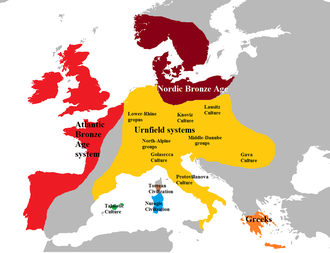
Many writers have wondered where the Etruscans came from. Most modern scholars agree that they were an indigenous people, meaning they had lived in the area for a very long time. The earliest signs of a culture that we can recognize as Etruscan date from about 900 BC. This was the Iron Age Villanovan culture, which is seen as the earliest stage of Etruscan civilization. It grew out of the earlier Proto-Villanovan culture of the late Bronze Age, in the same region. That earlier culture was part of the Urnfield culture system in central Europe.
The Etruscan civilization was at its largest around 500 BC, shortly after the Roman Kingdom became the Roman Republic. Starting in the late 4th century BC, the Etruscans lost power to the expanding Rome during the Roman–Etruscan Wars. In 90 BC, Etruscans were given Roman citizenship. By 27 BC, all of Etruscan land had become part of the newly formed Roman Empire.
Etruscan culture grew strong in three groups of cities that worked together: Etruria (Tuscany, Latium and Umbria), the Po Valley, including the eastern Alps, and Campania. The group in northern Italy is mentioned by Livy in his Ab Urbe Condita. Power in the Etruscan political system belonged to each city and probably to individual families. When Etruscan power was at its height, wealthy families became very rich by trading with the Celts to the north and the Greeks to the south. They filled their large family tombs with luxury goods from other places.
The earliest known Etruscan writing is found in inscriptions from southern Etruria that date to around 700 BC. The Etruscans developed a system of writing based on the Euboean alphabet, which was used in the coastal areas of Magna Graecia in Southern Italy. The Etruscan language is still only partly understood. Because of this, what we know about their society and culture relies heavily on later Roman and Greek sources, which generally viewed the Etruscans unfavorably.
Legend and history
Main article: Etruscan history
The Etruscans called themselves Rasenna. According to Dionysius of Halicarnassus, this word comes from an Etruscan word meaning "the people." The ancient Greeks called them Tyrrhenians, and the Tyrrhenian Sea got its name from this word. The Romans called them Tusci or Etruscī. The Roman name is where Toscana gets its name. Toscana is their heartland. Etruria is a name for their wider region. One idea is that Turs-, the root of Tusci, means "tower." So the Etruscans may have been called "tower builders," because they often built their towns on high cliffs with walls. However, no one knows where the name Tyrrhenian comes from.
Ancient Greek and Roman writers did not agree on where the Etruscans came from. Some said they came from Greece or Lydia. Others said they were native to Italy. Dionysius of Halicarnassus said they had always lived in the land. Today, most scholars agree that the Etruscans were already living in Italy. Archaeologists believe their civilization grew out of the earlier Villanovan culture in Italy. Over time, the Etruscans became rich by trading metals such as copper and iron. Their influence spread across Italy and the western Mediterranean Sea. Later, their power became weaker. Rome took control of Etruria in the 3rd century BC.
Main article: Etruscan origins
Main articles: Proto-Villanovan culture and Villanovan culture
Main article: Villanovan culture
Main articles: Etruria Padana and Etruria Campana
Main article: Etruscan cities
Main article: Founding of Rome
| Etruscan civilization (900–27 BC) | Villanovan period (900–720 BC) | Villanovan I | 900–800 BC |
| Villanovan II | 800–720 BC | ||
| Villanovan III (Bologna area) | 720–680 BC | ||
| Villanovan IV (Bologna area) | 680–540 BC | ||
| Orientalizing period (720–580 BC) | Early Orientalizing | 720–680 BC | |
| Middle Orientalizing | 680–625 BC | ||
| Late Orientalizing | 625–580 BC | ||
| Archaic period (580–480 BC) | Archaic | 580–480 BC | |
| Classical period (480–320 BC) | Classical | 480–320 BC | |
| Hellenistic period (320–27 BC) | Hellenistic | 320–27 BC | |
Society
Main articles: Etruscan society and Daily life of the Etruscans
Main article: Etruscan governance
Main articles: Etruscan society: Rise of the family and Women in Etruscan society
Main article: Etruscan military history
See also: Padanian Etruria
Main article: Etruscan cities
The Etruscans had a system of government led by the state. It is believed that their government changed from rule by one king to a republic run by a small group of leaders in the 6th century BC. Religion was closely tied to government. The king was seen as the highest leader and a link between the gods and the people. Kings and officials worked to keep peace with the gods through rituals and by reading signs. They used haruspices, who studied animal organs and the sky. Twelve city-states formed a league that met each year at the shrine of Voltuma to make decisions about politics and religion.
Wealthy families became an important part of Etruscan society, and married couples were at its center. The Etruscans also had a strong military tradition. Fighting brought them wealth, so they raided nearby areas and fought piracy to gain land, goods, and other resources. Over time, their cities came under the control of other peoples, including Italic, Celtic, and Roman groups. Their names survive in inscriptions, and their ruins are still of interest in central Italy.
Economy
The Etruscan economy was based on farming, mining, metalworking, and trade across the Mediterranean. Their home on the Tyrrhenian coast helped their trade. Land was seen as the main source of wealth. However, metal ores under the ground and the metal trade made the coastal cities very rich. This attracted Greek and Phoenician merchants to Etruria. Roman writers praised the region's fertile land, its grain (especially spelt), vineyards, olive groves and figs. Cities such as Cerveteri, Roselle, Volterra, Chiusi, Perugia and Arezzo supplied grain to Rome and to the army of Scipio during the Punic Wars. Etruscan engineers were skilled at irrigation and drainage. They dug underground channels, as in the territory of Veii. The Romans later continued this work. The region also had valuable metals, especially copper and iron from the Colline Metallifere and iron from the island of Elba. Populonia became a major centre for iron smelting, and Etruscan bronzes were valued in other lands.
The Etruscan cities traded widely around the Mediterranean. They sent out metals, wine and oil, and bought large amounts of Greek pottery. Trade passed through coastal emporia, which were protected by sanctuaries. Examples include Gravisca, the port of Tarquinia, and Pyrgi, a port of Caere. Competition for these trade routes led the Etruscans to ally with Carthage against the Phocaean Greeks, as at the Battle of Alalia. The earliest Etruscan coins, mostly made at Populonia, date from around the fifth century BC, but they were used only a little. For a long time, trade relied on bronze weighed out by value, including the so-called ramo secco ingots.
Culture
Main article: Etruscan religion
Main article: Etruscan architecture
Main article: Etruscan art
Main articles: Etruscan language and Tyrsenian languages
The Etruscans followed an immanent polytheism. They believed that everything they could see showed divine power, and that this power was shared among many deities. These gods were active in the world and could be asked for help with everyday matters. Two figures, Tages and Vegoia, were said to have taught the Etruscans how to understand the gods, and their teachings were kept in sacred books. Among the gods were local ones such as Tinia, who ruled the sky, and Fufluns, who may have been the god of the people. Some gods were inspired by Greek and Roman gods, such as Artemis and Minerva.
Little is known about Etruscan architecture. The Etruscans adapted styles from the native peoples of Italy and were influenced by Greek architecture. Later, ancient Roman architecture began with Etruscan styles.
Their art was made from about the 9th to the 2nd century BC. It included sarcophagi, wall paintings, and engraved bronze mirrors. Most surviving art comes from tombs. The Etruscans played pipes and drums, and later stringed instruments such as the lyre.
The Etruscans left about 13,000 inscriptions, but only a few are long. They wrote in the Etruscan alphabet, which came from a Euboean Greek alphabet. They learned it through contact with Greek colonies such as Cumae in the 8th century BC. Most scholars think Etruscan is related only to other members of the Tyrsenian language family, which is not clearly connected to other known language groups. Etruscan texts were written for about seven centuries, and the oldest written records date from around 700 BC. Most surviving texts are about funerals or religion, and many are epitaphs. Some important ones are the Liber Linteus, a ritual text, and the Tablet of Cortona, a contract. Most of what we know about Etruscan literature comes from references by later Roman writers. The Romans adopted the Etruscan alphabet in the middle of the 7th century BC, and it also influenced the Oscan script, Umbrian, Faliscan, and Venetic writing.
| Euboean alphabet | ||||||||||||||||||||||||||
|---|---|---|---|---|---|---|---|---|---|---|---|---|---|---|---|---|---|---|---|---|---|---|---|---|---|---|
| Letter |  |  |  |  |  |  |  |  |  |  |  |  |  |  |  |  |  |  |  |  |  |  |  |  |  |  |
| Transcription | A | B | G | D | E | V | Z | H | TH | I | K | L | M | N | X | O | P | Ś | Q | R | S | T | U | X | PH | CH |
| Early Etruscan alphabet | ||||||||||||||||||||||||||
|---|---|---|---|---|---|---|---|---|---|---|---|---|---|---|---|---|---|---|---|---|---|---|---|---|---|---|
| Letter |  |  |  |  |  |  |  |  |  |  |  |  |  |  | | |  |  |  |  |  |  |  |  |  |  |
| Transcription | A | B | C | D | E | F | Z | H | TH | I | K | L | M | N | S | O | P | SH | Q | R | S | T | U | X | PH | KH |

Quiz time!
4 questions about Etruscan civilization
What did the Etruscans call themselves?
Pictures
Keep exploring




This article is a child-friendly adaptation of the Wikipedia article on Etruscan civilization, available under CC BY-SA 4.0.
Images from Wikimedia Commons. Tap any image to view credits and license.