 Safekipedia
Transport in London
Adapted from Wikipedia · Adventurer experience
London has a big and well-organized transport system. It includes both public and private services. In 2017, 37% of trips in London were made using its integrated transport network. Private services made up 36% of trips, while walking accounted for 24% and cycling for 2%.
Public transport in London is mostly managed by Transport for London (TfL). TfL runs most public transport, including the Underground, Buses, Tramlink, the Docklands Light Railway, London River Services, Elizabeth line and the London Overground.
Other train services are run by different train operating companies or by the Department for Transport (DfT). Some, like Eurostar and Heathrow Express, operate on an open-access basis. TfL also manages most major roads in London, but not smaller roads. There are also several independent airports serving London, with Heathrow being the busiest airport in Europe.
History
Further information: History of transport in London
London's public transport started with horse-drawn buses in 1829. These buses were later replaced by motor buses in 1902. Over time, private companies joined together to form one bus service. The first underground railways were unified in 1902, and by 1913, they also took over the city's trams. In 1933, these services became part of the London Passenger Transport Board, operating under the name London Transport.
The management of London's transport changed many times. In 2000, a new authority called Transport for London took over most services, making public transport easier to manage for the whole city.
| Dates | Organisation | Overseen by |
|---|---|---|
| 1933–1947 | London Passenger Transport Board | London County Council |
| 1948–1962 | London Transport Executive | British Transport Commission |
| 1963–1969 | London Transport Board | Minister of Transport |
| 1970–1984 | London Transport Executive (Greater London only) | Greater London Council |
| 1970–1986 | London Country Bus Services (Green Line only) | National Bus Company |
| 1984–2000 | London Regional Transport | Secretary of State for Transport |
| 2000(2003)–present | Transport for London | Mayor of London |
Metro and light rail
Transport for London (TfL) runs three main railway systems in London. The biggest is the London Underground, also called the Tube. It was the world's first underground railway and started in 1863. Every day, many people use it. It has 11 lines that connect different parts of the city.
TfL also runs the Docklands Light Railway (DLR) in east London. This is an automatic light rail system that helps people travel around the Docklands area. The DLR is very important for East London.
Another system is the Tramlink, which serves areas like Croydon and the surrounding boroughs. The Tramlink connects with the London Underground and other rail services.
Heavy rail
Main articles: London station group and Rail transport in Great Britain
London is the heart of Britain's railway network. It has 18 major stations with many services. Parts of the city not covered by the Underground or DLR use suburban heavy rail services to reach these stations. These services are run by private rail companies and use the Oyster card system.
The main stations include Cannon Street, Charing Cross, Euston, Fenchurch Street, King's Cross, Liverpool Street, Marylebone, Moorgate, Paddington, Victoria and Waterloo. Paddington and Liverpool Street also have services on the Elizabeth line.
Other stations include Waterloo East, City Thameslink, Old Street and Vauxhall. London connects to Europe through the Channel Tunnel Rail Link. High-speed Eurostar trains go to Paris, Brussels and Amsterdam, starting from St Pancras International. The route also goes through Stratford International and two stations in Kent, Ashford International and Ebbsfleet International.
Suburban and regional
Main article: Urban rail in the United Kingdom
London has a large network of trains for people traveling into the city from nearby areas. This network has 368 railway stations in the London fare zones, serving Greater London and nearby places. Most people get to central London either by the Underground or by these train services.
Historically, London's train network spreads out from the center. Most trains end at stations around the edge of the city center. Two important lines cross London: the Thameslink route between Bedford and Brighton, and the Elizabeth line from Reading to Shenfield. A big project called Crossrail created the Elizabeth line, which opened in May 2022, adding a new way to travel across London.
While many central London stations are endpoints, some have lines going through to other parts of the city. London Bridge connects to Cannon Street and Charing Cross, and also has services on the Thameslink route.
London Overground
Main article: London Overground
In addition to lines going into and across London, there are also train routes that circle around the outer parts of the city. These are managed by Transport for London and are called the London Overground. This helps people travel across London without going into the very center.
The London Overground uses old railway lines to create a circular route with branches. It includes the oldest part of the Underground, the Thames Tunnel under the River Thames, finished in 1843. The services include routes to places like Richmond, Clapham Junction, Highbury and Islington, Surrey Quays, New Cross, Sydenham, Crystal Palace, and West Croydon.
Airport services
Heathrow, Gatwick and Stansted airports have special train services. The Heathrow Express starts from Paddington and is run by the airport. The Gatwick Express starts from Victoria and the Stansted Express starts from Liverpool Street.
Operators
National Rail lines around London are run by different train companies. This started when British Rail was split up in the 1990s. These companies now work under contracts with the government.
Some of these companies are owned by governments or big companies from other countries. London Overground and Docklands Light Railway are run by private companies working for Transport for London. Heathrow Express is run separately.
National InterCity
Long-distance trains leave from several London stations to different parts of the UK:
- London Euston for the West Midlands, Wales, North West England and Scotland
- London King's Cross for the East Midlands, Yorkshire and the Humber, North East England and Scotland
- London Paddington for South West England, the West Midlands and Wales
- London St Pancras for the East Midlands, Yorkshire and the Humber and Kent
- London Liverpool Street for East of England
- London Waterloo for the south coast and South West England.
International
St Pancras has trains to cities in Europe like Paris, Brussels, Lyon and Marseille. Trips to Paris take about 2 hours and 15 minutes, and to Brussels about 1 hour and 50 minutes. Trains also go to Amsterdam.
You can also buy tickets to travel by train and ferry to the Netherlands or the Republic of Ireland.
| Airport | Train operator | Central London station |
|---|---|---|
| City | DLR | Bank/Tower Gateway |
| Gatwick | Gatwick Express | Victoria |
| Southern | Victoria | |
| Thameslink | St Pancras/Farringdon/City Thameslink/Blackfriars/London Bridge | |
| Heathrow | Heathrow Express | Paddington |
| London Underground | Several including Earl's Court and King's Cross St Pancras | |
| Elizabeth line | Paddington, Bond Street, Tottenham Court Road, Farringdon, Liverpool Street | |
| Luton | Thameslink | St Pancras/Farringdon/City Thameslink/Blackfriars/London Bridge/Elephant & Castle |
| East Midlands Railway | St Pancras International | |
| Stansted | Stansted Express | Liverpool Street |
| Southend | Greater Anglia | Liverpool Street |
| Train operator | Franchise/services | Parent company/owner |
|---|---|---|
| Arriva Rail London | London Overground metro service across London | Arriva |
| c2c | Essex Thameside – local and regional/commuter services from Fenchurch Street to East London and South Essex | DfT Operator |
| Chiltern Railways | London to Aylesbury Line – local and regional/commuter services from Marylebone to North West London, Buckinghamshire | Arriva |
| MTR Elizabeth line | Elizabeth line cross-London regional / commuter service from Reading and Heathrow Airport in the west, through the centre of the city to Stratford and Shenfield in the east | MTR Corporation |
| Govia Thameslink Railway | Thameslink Southern & Great Northern franchise – operate under the Gatwick Express, Great Northern, Southern, and Thameslink brands from King's Cross, Moorgate, Blackfriars, London Bridge and Victoria to North London, South London, Hertfordshire, Cambridgeshire, Bedfordshire, Kent and Sussex, also operate cross city services via the Thameslink route | Govia |
| Great Western Railway | Greater Western franchise – local and regional/commuter services from Paddington to West London and the Thames Valley Heathrow Express Non-stop service from Paddington to Heathrow Airport (infrastructure owned by Heathrow Airport Holdings) | FirstGroup |
| Greater Anglia | East Anglia franchise – local and regional/commuter services from Liverpool Street to Essex, Hertfordshire and Cambridgeshire, also operate the Stansted Express | DfT Operator |
| London Northwestern Railway | Local and regional/commuter services from Euston to Hertfordshire, Buckinghamshire and Northamptonshire, Warwickshire, Staffordshire and Birmingham | DfT Operator |
| South Western Railway | South Western franchise – local services from Waterloo to South West London and regional/commuter services to Surrey, Hampshire, Dorset & Berkshire | DfT Operator |
| Southeastern | South Eastern franchise – local metro services across South East London and commuter and regional services from Victoria, Charing Cross, Cannon Street, Blackfriars and high speed services from St Pancras to Kent | DfT Operator on behalf of Department for Transport |
Ticketing
Main article: Oyster card
London commuters mostly use special tickets to travel on public transport. The Oyster card is a small electronic ticket that works on many buses and trains in London. It lets people travel as much as they want on these services. There is also a paper ticket called the Travelcard. The London Pass is a special ticket for tourists that includes travel and entry to some popular places.
Roads
London has many types of roads, from big motorways to small side streets. The biggest roads are motorways and dual carriageways, designed to help cars move faster. There are also smaller roads for local traffic.
Many of London's streets were built before cars existed, so the roads can get very busy. People have tried to solve this problem for a long time. In the past, new wide roads were built, but many plans were stopped because of costs and protests. Today, there is a focus on improving public transport instead.
Main articles: London congestion charge and Ultra Low Emission Zone
Because of the busy city centre, there are not many big roads that go straight into the middle of London. Some of the main roads include the A40, A12, A13, and A2. These roads help connect London to places far away, like airports and other cities.
There are also ring roads that go around London. The innermost one is called the Inner Ring Road, and there are two others that circle the suburbs. The biggest ring road is the M25, which goes around most of the city and is very busy, especially near Heathrow Airport.
None of these roads charge a fee to drive on them, except for the Dartford Crossing, which has a toll. Some other tunnels will start charging fees soon.
The big roads are helped by many smaller roads that connect different parts of the city. These smaller roads are used by local traffic and are managed by local authorities.
In 2003, a charge was introduced for cars entering central London during busy times. This helped reduce traffic congestion. The charge was later increased, and the area it covers has grown over time.
In 2019, a zone was created where cars must meet certain clean air standards to enter central London. This zone has since been expanded to cover more of the city.
Work has been done to make London's roads safer, such as lowering speed limits and improving road designs. There are also special rules for bigger vehicles to ensure they can see better. Education and training programs help keep everyone safe on the roads.
Cycling
Main article: Cycling in London
Cycling is very popular in London for getting around and for fun. Many people in London own bicycles.
A bike hire system started by Transport for London made cycling even more popular. There are many bikes available at stations all over London.
Buses
Main article: Buses in London
London has a big bus network with many trips every day. Millions of people use the buses on many different routes. These buses help people travel around the city and carry more passengers than the Underground.
There are special night buses that run all night on many routes. Many of the buses in London are battery electric or hydrogen fuel cell buses, which helps keep the air clean.
The bus services are run by many different companies, but the city decides the routes, how often buses come, and the fares. Some of these companies are from other countries.
Many of the buses are the famous red double-deckers, and they are easy to get on and off. Since the year 2000, there has been work to make the bus system better, with more routes and more frequent buses.
| Operator | Routes | TfL routes | Parent company |
|---|---|---|---|
| Arriva London | London | Yes | Arriva |
| Carousel Buses | Buckinghamshire | No | Go-Ahead Group |
| First Beeline | Berkshire | No | FirstGroup |
| First Bus London | London | Yes | |
| Go-Ahead London | London | Yes | Go-Ahead Group |
| Green Line Coaches | Express services to Berkshire & Hertfordshire | No | Arriva |
| London Sovereign | North London | Yes | FirstGroup |
| London Transit | North, West & Central London | Yes | |
| London United | West & Central London | Yes | |
| Metrobus | South and South-east London, and parts of Surrey, Kent, West and East Sussex | No | Go-Ahead Group |
| Metroline | North & West London | Yes | ComfortDelGro |
| Stagecoach London | South and East London | Yes | Stagecoach Group |
| Sullivan Buses | Hertfordshire & North London | Yes | - |
| Transport UK London Bus | London | Yes | Transport UK Group |
| Uno | Hertfordshire & North London | Yes | University of Hertfordshire |
Taxis
Black cabs and hire cars
The famous black cab is often seen around the city. These drivers must learn all the streets for years to get a special license called "The Knowledge". All taxis in London are checked by the Public Carriage Office to make sure they are safe and fair. You can find black cabs on the street or at train stations and busy areas. The price depends on how far and how long the trip is, shown by a machine in the car called a taximeter.
Private cars that people call before getting in, known as PHVs or minicabs, cannot pick people up on the street. Since January 2023, new private hire cars must be cleaner and follow strict rules.
Bicycle taxis and pedicabs
Pedicabs are bikes with seats for passengers and are popular with visitors in central London. The first company to bring them to London came from Cambridge in 1998. Today, there are several companies offering these services. There have been plans to make sure these bike taxis follow the right rules too.
Airports
Main article: Airports of London
London has many busy airports. The six main airports are Heathrow, Gatwick, Stansted, Luton, London City, and Southend.
Heathrow and Gatwick handle flights both far and near. Southend mostly serves flights in Europe. Stansted and Luton focus on budget flights in Europe and around the UK. London City is popular with business travelers for short trips. It is the closest airport to central London, about 10 km away and connected by train.
Heathrow, about 20–25 km from central London, is the busiest airport in Europe. Gatwick, located about 40 km south of London, is the world's busiest single-runway airport.
Southend, east of London, grew to support the 2012 Summer Olympics and now connects to London through roads and trains. Stansted, the farthest airport at about 50 km north, mainly serves budget travelers. Luton Airport, about 45 km northwest, also focuses on budget flights and connects to London by road and train.
Other airports like Biggin Hill and RAF Northolt serve private planes and helicopters. Croydon Airport was London's first major airport but closed in 1959.
Water transport
River Thames
See also: London River Services
The River Thames used to be one of London's main ways to travel. Today, more people use boats for fun and to go to work. This is thanks to an organization called London River Services that started in 1999. This group helps manage and promote boat trips and leisure rides on the river. Some boats are run by private companies, and London River Services looks after five important stops in central London.
Canals
See also: Canals of the United Kingdom
London has several canals, like the Regent's Canal, which connects to other waterways across England. These canals were built a long time ago to carry things like coal and food. Today, they are mostly used for fun, with people enjoying boat rides, especially in the summer.
Cargo
Some large goods are still moved on the Thames. London's port used to be very busy, but most of it moved to a place called Tilbury in Essex outside of London. Today, the port is still important and is the second busiest in the UK for moving goods. The Port of London Authority looks after most of the port and helps ships travel safely on the river.
Cable Car
Main article: London Cable Car
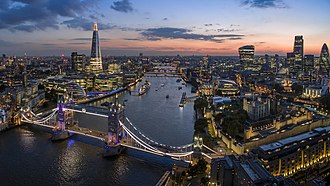
The London Cable Car is a special cable car that crosses the River Thames. It started on 28 June 2012 and is run by Transport for London. It helps people travel across the river and gives riders a beautiful view of London.
The cable car line is 0.62 miles long and goes from the Greenwich Peninsula to the Royal Victoria Dock, near ExCeL London. It uses a special kind of technology called monocable detachable gondola, which is cheaper and faster to build than other systems.
Accessibility
Main article: Accessibility of transport in London
Public transport in London has been made better for everyone, including people who use wheelchairs. Many train stations, including the Underground and Overground, were built a long time ago. But now, more stations have ramps and lifts to help all people travel.
Buses, trams, and taxis in London are easy for everyone to use. London was one of the first big cities to have buses that are easy for everyone to get on and off.
Public transport statistics
People in London spend about 84 minutes each weekday using public transport, like buses or trains, to get to work or school. Many riders wait about 10 minutes at a stop before their bus or train arrives.
In 2018, London had more places to charge electric vehicles than anywhere else in the UK. That year, people in England took many trips on local buses and trains. Light rail and tram travel also grew, reaching the highest number of trips since 1983.
Images
Related articles




This article is a child-friendly adaptation of the Wikipedia article on Transport in London, available under CC BY-SA 4.0.
Images from Wikimedia Commons. Tap any image to view credits and license.