Visual arts
"Visual Arts" redirects here. For the company with a similar name, see Visual Arts (company).
The visual arts are art forms that we look at. They include painting, drawing, printmaking, sculpture, ceramics, photography, video, image, filmmaking, design, crafts, and architecture. Many other art forms, such as performing arts, conceptual art, and textile arts, also include parts of the visual arts. The visual arts also include the applied arts, such as industrial design, graphic design, fashion design, interior design, and decorative art.
Today, "visual arts" includes fine art, as well as applied or decorative arts and crafts. This was not always true. Before the Arts and Crafts Movement began in Britain and other places around 1900, the word 'artist' was often used only for people who made fine art, such as paintings, sculptures, or prints. It was not used for people who made decorative arts or crafts. Artists in the Arts and Crafts Movement pointed out this difference, and they valued folk art as much as other kinds of art. Art schools also kept fine art separate from crafts. They believed that a craftsperson could not be called an artist in the arts.
In both Western art and East Asian art, painting was often seen as more important than other arts, and sculpture was seen this way to a smaller degree. People felt painting depended most on the artist's imagination and was furthest from hard physical work. In Chinese painting, the most respected style was "scholar-painting," which, in theory, was done by educated people who painted for enjoyment. The Western hierarchy of genres showed similar ideas.
Education and training
Visual arts education and training have changed over time. They also differ around the world and between cultures. Long ago, people learned visual arts through apprentice and workshop systems. These often lasted 2 to 6 years.
Different regions have taken different paths. In many European and North American countries, art academies grew into universities and institutes. Under the influence of industrialization, they focused more on applied arts than on fine arts. Several Sub-Saharan African countries have put less focus on art in primary schools. They often chose vocational or STEM subjects instead. In Asia, programs often followed the goals of the state or nobility. Singapore, however, has focused on digital visual arts as part of its creative economy. In the Middle East, education moved away from 19th-century European models. It now connects more with tourism and cultural heritage preservation. In several Latin American countries, art education was once limited under colonial rule. Today it focuses more on modern art to help build national identity. Mexico's system has tried to combine indigenous artistic heritage with Western academic structures. Museums and art galleries also teach people about art in informal ways. They offer historical background and aesthetic experiences.
Drawing
Main article: Drawing
Drawing is a way of making a flat image, illustration, or picture. Artists use many kinds of tools and methods, both old-fashioned and digital. They make marks by pressing a tool onto a surface or moving it across it. Some common tools are graphite pencils, pen and ink, inked brushes, wax color pencils, crayons, charcoals, pastels, and markers. Digital stylus pens can copy these effects. Common ways to draw include making lines, hatching, crosshatching, random hatching, shading, scribbling, stippling, and blending. Chinese artists value the Four Treasures of the Study: the brush, ink, inkstone, and paper.
Drawing is very old and has been found in cultures all over the world. Art of the Upper Paleolithic includes figurative art from at least 40,000 years ago. Even older are non-figurative cave paintings made of hand stencils and simple shapes. Ancient cave representations of animals have been found in places such as Lascaux, France, Altamira, Spain, Maros, Sulawesi in Asia, and Gabarnmung in Australia. In ancient Egypt, people used ostraca, which were pieces of pottery and limestone, for ink drawings. Drawing on Greek vases began with geometric designs. Later, it showed people in black-figure pottery during the 6th century BC. Indian palm-leaf manuscript drawings date back to the 5th and 6th centuries. Drawing on paper spread to the Middle East and Europe in the 14th century, helped by Islamic traders who traveled from China. European artists such as Raphael, Michelangelo, and Leonardo da Vinci took up drawing as an art in its own right, not just as preparation for painting or sculpture.
Painting
Main article: Painting
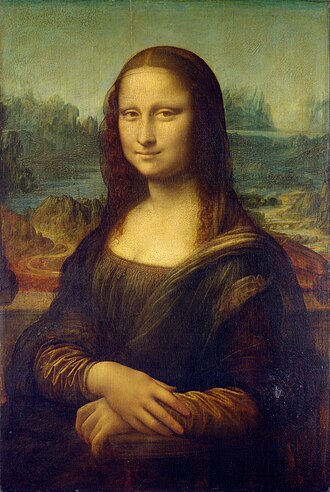
Painting means putting pigments (color) mixed with a binding agent (a kind of glue) onto surfaces like walls, canvas, or paper. Painters use drawing and arrangement to show their ideas and feelings. Paintings have been made for many reasons, including body painting, religious icons, decoration, and advertising. The earliest paintings used natural colors made from ochre, chalk, and charcoal on stone. Tools for body painting are about 200,000 years old in places like Zambia. Cave paintings made with twigs, fingers, feathers, and animal hair are at least 50,000 years old. As people built homes and made pottery, painters developed fresco and frieze techniques in the Mediterranean and ancient India. New binders like tempera and encaustic also appeared. Ink wash painting became an important tradition in East Asia.
Later, artists mixed pigments into drying oils to make paintings that looked more realistic. At first, artists liked wood panels, but stretched canvas became popular because it was easier to carry. Oil paint dries slowly, which let painters use chiaroscuro. This technique shows depth using light and shadow. In the 1800s, the box easel and the paint tube let artists paint outdoors, which is called plein air painting. These tools also made it possible to use new man-made colors. Watercolors were painted on paper, and gouache is used in commercial arts. In the 1900s, acrylic binders gave artists a quick-drying choice instead of oil paint. Modern and contemporary artists have used materials like house paint, found objects, and newspaper collage. More recently, digital painting lets artists use computer programs to create images with pixels instead of physical paint.
Printmaking
Main article: Printmaking
Printmaking is making an image for art. The artist creates the image on a matrix. The image is then pressed onto a flat surface using ink or another form of colour. Except for a monotype, the same matrix can be used to make many copies. The main techniques are woodcut, line engraving, etching, lithography, and screen printing. There are many others too, including digital ones. The image is usually printed on paper or fabric. Other materials can be used too, from cloth and vellum to newer materials.
Prints in the Western tradition made before about 1830 are called old master prints. Main article: Old master print In Europe, woodcut was used to make prints on paper from around 1400 AD. The printing methods were first developed in the Byzantine and Islamic worlds. Albrecht Dürer made the Western woodcut so good that, at the end of the century, it had never been surpassed. In China, printmaking began about 1,100 years ago. Pictures were printed next to text that had been cut into woodblocks. Main article: Woodblock printing Over time, artists in the Song dynasty began cutting landscapes. The technique was improved during the Ming and Qing dynasties. In Japan, woodblock printing is best known for the ukiyo-e style. It was widely used to print illustrated books during the Edo period. Main article: Woodblock printing in Japan
Japanese woodblock printing, called mokuhanga, uses water-based inks. These inks allow for bright colours and see-through layers of colour. In the early 20th century, shin-hanga became popular. It mixed ukiyo-e with Western painting techniques.
Photography
Main article: Photography
Photography is the process of making pictures using light. Light bounces off objects or comes from them, and it is recorded onto a special surface or a storage chip. This takes a set amount of time, called an exposure. Cameras use mechanical shutters or electronic timing to let in photons (tiny bits of light). The light is then processed with chemicals or digitizing devices inside cameras.
The word comes from two Greek words meaning "light" and "drawing" or "writing," so it means "drawing with light." The result of photography has long been called a photograph. Many people call them a "photo" or "picture," and the word "image" is now used more and more.
Architecture
See also: Architecture
Architecture is the process and the product of planning, designing, and constructing buildings or other structures. Many people see buildings as cultural symbols and works of art. Long ago, people built shelters for safety, protection, and worship, using the building materials and skills they had. As cultures grew, building became a craft. The most formal version of that craft is called "architecture."
The oldest surviving written work about architecture is De architectura, by the Roman architect Vitruvius, from the early 1st century AD. Vitruvius said a good building has three qualities, often described as firmness, commodity, and delight. A building should be durable and stand up well over time. It should also suit its purpose. And it should be pleasant to look at.
Filmmaking
Main article: Filmmaking
Filmmaking is the process of making a motion picture. It usually starts with an idea and some research. Next comes writing the script, then filming and recording. Animation, special effects, editing, and sound and music come after that. The last step is sharing the film with an audience. Filmmaking includes many kinds of films, such as documentaries, films about theatre and books, and poetic or experimental works. People also often use the word to describe video-based work.
Computer art
Main article: Computer art
See also: Digital art
Visual artists are no longer limited to traditional arts media. Computers have been used in the visual arts since the 1960s. Artists use them to capture or create images and shapes, and to edit those images. They can try out many compositions quickly. Computers also help make the final rendering or printing, including 3D printing. Many traditional art forms now use digital technology, so it can be hard to tell traditional artworks apart from new media works made with computers. Computers have also blurred the lines between illustrators, photographers, photo editors, 3D modelers, and craft artists. A photographer may become a digital artist.
Computer art is any art where computers play a role in making or showing it. It can be an image, sound, animation, video, CD-ROM, DVD, video game, website, algorithm, performance or gallery installation. An artist may mix traditional painting with algorithmic art and other digital methods, so it can be hard to define computer art by its final product. Computer art appears in art museums, but it is often seen more as a tool than a form, unlike painting. Some computer-based works belong to a new conceptual and postdigital style, which studies technology and its effects on society.
Plastic arts
Main article: Plastic arts
Plastic arts are art forms where a soft material is shaped by moulding or modelling, such as ceramics or sculpture. The term has also been used for all the visual arts, which are not writing or music. Materials that can be carved or shaped, such as stone, wood, concrete, or steel, are also included in the narrower meaning, because good tools can shape them. Piet Mondrian and his movement used the word "plastic" in a different way. They called their style "Neoplasticism."
Main article: Sculpture
Sculpture is three-dimensional artwork made by shaping or joining hard or soft material, sound, text, or light. It is often made from stone (rock or marble), clay, metal, glass, or wood. Some sculptures are made by carving. Others are built together and fired, welded, molded, or cast. Sculptures are often painted. The oldest sculptures we are sure of come from the Aurignacian culture. This culture lived in Europe and southwest Asia at the start of the Upper Paleolithic. They also made some of the earliest known cave art. Because sculpture uses materials that can be shaped, it is part of the plastic arts. Most public art is sculpture, and a group of sculptures together in a garden is called a sculpture garden. In the 20th century, many sculptors began using art fabricators to make their works. This happened as conceptual art became popular and technology improved. Sculptures can also be made with 3D printing. Some artists use the natural landscape itself, as in land art and hill figures. One example is the Litlington White Horse in East Sussex, England. It was made in the 20th century by removing grass to show the white chalk underneath. It needs regular care to stay bright against the green hills.
US copyright definition of visual art
In the United States, copyright law uses a strict definition of "visual art." A visual art work is a painting, drawing, print, or sculpture. It must exist as a single copy, or as a limited edition of 200 copies or fewer that the artist signs and numbers. A still photo made only for display also counts if it follows the same rules.
Many things are not counted as visual art under this law. These include posters, maps, globes, charts, technical drawing, diagrams, models, applied art, films and other audiovisual works, books, magazines, newspapers, and similar publications. Merchandise, advertising, packaging, and parts of these items are also not counted. A work made for hire is not counted either, and neither is any work that copyright law does not protect.

Quiz time!
4 questions about Visual arts
What do painters mix with pigment (colour) to make paint stick to a surface?
Pictures
Keep exploring




This article is a child-friendly adaptation of the Wikipedia article on Visual arts, available under CC BY-SA 4.0.
Images from Wikimedia Commons. Tap any image to view credits and license.