
Aerospace
Aerospace refers to the technology and industry involved with the atmosphere and outer space collectively. It includes many different kinds of work, such as commercial, industrial, and military uses. People who study aerospace engineering learn about both aeronautics, which deals with flying in the air, and astronautics, which deals with traveling beyond Earth.
Aerospace organizations do many important jobs. They research new ideas, design new machines, build aircraft and spacecraft, operate them, keep them working, and fix them when needed. All of this helps us travel safely in the sky and explore far away in space.
One way scientists decide where space begins is by using a line called the Kármán line. This line is about 100 kilometres or 62 miles above the ground. Above this line, the air is so thin that it is very hard for airplanes to fly without moving as fast as objects in orbit.
Overview
In most countries, the aerospace industry works together with both government and private companies. Many countries have their own space programs, like the National Aeronautics and Space Administration in the United States, the European Space Agency in Europe, and others around the world.
Besides government programs, many companies help make tools and parts for space, such as spacecraft and satellites. Well-known companies include Boeing, Airbus, SpaceX, and Lockheed Martin. These companies also build airplanes and other aircraft.
History
Main articles: History of aviation and Timeline of space exploration
Aerospace began with an engineer named George Cayley in 1799. He described what a modern airplane looks like, with wings and tails.
In the 1800s, groups formed to study flying, and people like Otto Lilienthal tested gliders. The Wright brothers used these ideas to create the first powered airplane flight in 1903.
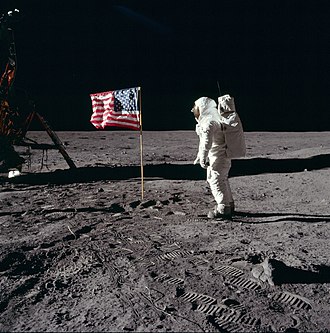
Later, wars and stories about space inspired new inventions. In 1957, the world’s first artificial satellite, Sputnik 1, was launched. In 1969, people landed on the Moon for the first time. Today, people can travel to space as tourists, and there are always new discoveries being made.
Manufacturing
Aerospace manufacturing is a special kind of industry that makes things like airplanes, missiles, space vehicles, and their parts. Most of this work is done for governments. Each company that makes these things has a special code given by the government to help track them.
In the United States, two big groups, the Department of Defense and NASA, buy a lot of these products. Many people work in this industry, especially in Washington state and California. Some important companies are Boeing, United Technologies Corporation, SpaceX, Northrop Grumman, and Lockheed Martin. These companies work with schools and training programs to help new workers learn the skills they need.
Important places for making airplanes and other aerospace products are found in many countries. In North America, cities like Washington, California, and Montreal are key spots. In Europe, Toulouse in France and Hamburg in Germany are important. Other places include São José dos Campos in Brazil, Querétaro and Mexicali in Mexico, and Bangalore in India. Each of these places has companies that help build and test new airplanes, missiles, and space vehicles.
Technology
Aerospace uses many technologies and ideas, especially ones created during World War II. For example, some airplanes have folding wings to save space on ships. Others use special high-lift devices to help them take off and land better.
Scientists also made big improvements to airplane engines. They created ways to make planes fly higher and faster. Some planes even have special pressurized cabins so people can fly comfortably at very high altitudes.
New ideas like radio detection and ranging helped planes find their way and avoid enemies. Pilots also got special suits to help them when flying very fast or high. All these inventions helped make aerospace what it is today.
Functional safety
Main article: AS9100
Functional safety is about making sure that machines and tools can be used safely without causing harm or damage. This is very important in the aerospace industry, where everything must work perfectly to keep people safe. Groups like the European Aviation Safety Agency create strict rules to help make sure airplanes and space vehicles are safe. Different places have their own rules, such as AS 9100 in America, EN 9100 in Europe, and JISQ 9100 in Asia, all designed to keep aerospace vehicles safe. Some companies focus on checking and testing these vehicles to make sure they follow the safety rules.
Spinoffs
Spinoffs are new technologies created by NASA that are used for other purposes. These ideas help many areas like medicine, transportation, and everyday products. For example, NASA’s work has helped make better medical tools. These inventions show how money for space work helps many parts of life. NASA shares these stories every year in a report called "Spinoffs."
These new technologies help companies grow and create new industries, like machines that can land on the Moon.
Pictures
Keep exploring



This article is a child-friendly adaptation of the Wikipedia article on Aerospace, available under CC BY-SA 4.0.
Images from Wikimedia Commons. Tap any image to view credits and license.