 Safekipedia
COVID-19 pandemic
Adapted from Wikipedia · Discoverer experience
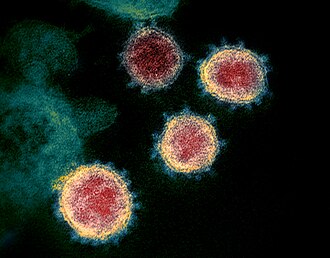
The COVID-19 pandemic, also known as the coronavirus pandemic, was caused by a virus called SARS-CoV-2. It began in Wuhan, China, in December 2019 and quickly spread around the world. By March 2020, the World Health Organization declared it a pandemic, meaning it was a serious worldwide health problem. The pandemic continued until May 2023, when the World Health Organization said the emergency was over.
Most people with COVID-19 had symptoms like fever, sore throat, cough, and feeling tired. Some people did not show any symptoms at all, while others became very sick. The virus spread mainly through tiny particles in the air when infected people talked, coughed, or sneezed. Scientists developed vaccines quickly, and they became available to everyone starting in December 2020. These vaccines helped protect people from getting very sick.
The pandemic changed daily life for many people. Governments around the world put in place measures like lockdowns, mask mandates, and closing schools and businesses to stop the virus from spreading. Many people started working from home, and travel became limited. The pandemic also caused big problems for the world’s economy, with many businesses struggling and people losing jobs. It also led to shortages of things like food and medical supplies. Even though the pandemic is considered over, COVID-19 continues to affect people, and it remains one of the deadliest health crises in history.
Terminology
Further information: COVID-19 naming
Pandemic
In epidemiology, a pandemic means a disease that spreads over a very wide area, crossing many countries, and affects many people. During the COVID-19 pandemic, some people debated what this term really means.
The end of a pandemic doesn’t always mean the disease completely disappears. Different groups and places have different ways of deciding when a pandemic ends. Some see the end of a pandemic as more of a social idea than just a medical fact.
Time reported in March 2024 that experts have different ideas about whether COVID-19 is still a pandemic or just common in the community. The World Health Organization (WHO) still called it a pandemic on their website.
Virus names
During the initial outbreak in Wuhan, people often called the virus and the disease “coronavirus” or “Wuhan coronavirus.” In January 2020, the WHO suggested using 2019-nCoV and 2019-nCoV acute respiratory disease as temporary names. This was to avoid using place names, animal names, or group names, which can cause unfair treatment of people. On 11 February 2020, WHO chose the official names COVID-19 and SARS-CoV-2. WHO explained that CO stands for corona, VI for virus, D for disease, and 19 for the year the outbreak started (31 December 2019). WHO also uses “the COVID-19 virus” and “the virus that causes COVID-19” in messages to the public.
WHO named special versions of the virus, called variants of concern and variants of interest, using Greek letters. At first, these versions were named after where they were found (for example, Delta was called the “Indian variant”), but this is not common anymore. Now, a more organized naming system is used that shows the variant’s PANGO lineage (for example, Omicron’s lineage is B.1.1.529).
Epidemiology
Background
SARS-CoV-2 is a virus that is related to viruses found in bats and pangolins. The first known outbreak began in Wuhan, China, in December 2019. Many early cases were linked to people who had visited a local market, but it is possible that the virus could spread between people earlier than that. Scientists think the virus likely came from bats or another similar animal.
Cases
Official counts of cases refer to the number of people who were tested for COVID-19 and tested positive. Because not everyone was tested, especially early in the pandemic, the actual number of infections was likely much higher. Children and adults were equally likely to be infected, according to studies.
In December 2021, the number of cases continued to rise due to new variants. By April 2022, over 500 million cases were confirmed worldwide.
Test positivity rate
One way health officials watched the pandemic was by looking at the test positivity rate, or the percent of tests that were positive. In 2020, a rate above 5% was considered too high.
Deaths
Further information: List of deaths due to COVID-19
As of March 2023, more than 6.88 million deaths had been reported worldwide from COVID-19. The first death was in Wuhan on January 9, 2020. The numbers vary by region and over time.
Multiple ways are used to measure how many people died. Official counts usually include people who died after testing positive. These counts can miss some deaths because not everyone was tested. Some studies suggest the actual number of deaths may be much higher than reported.
In May 2022, a study estimated that there were about 14.9 million more deaths than usual by the end of 2021. Most of these extra deaths were likely because of the virus.
The time between when someone gets sick and when they die can range from 6 to 41 days, usually about 14 days. Older people and those with health problems were at higher risk of dying.
Infection fatality ratio (IFR)
See also: List of human disease case fatality rates
The infection fatality ratio (IFR) is the number of deaths from the disease divided by the total number of people who were infected, including those who didn’t show symptoms. It is shown as a percentage.
In November 2020, a review found IFRs ranging from 0.24% to 1.49% in different countries. The risk of death increases with age. For example, it is 0.002% at age 10, 0.4% at age 55, and 15% at age 85.
Case fatality ratio (CFR)
Another way to look at death rates is the case fatality ratio (CFR), which is the number of deaths divided by the number of diagnosed cases. This number can be tricky because of delays between when people get sick and when they die, and because testing focused on people with symptoms.
Based on data from Johns Hopkins University, the global CFR was 1.02 percent as of March 2023. This number changes by region and has generally gone down over time.
Disease
Main article: COVID-19
Variants
Main article: Variants of SARS-CoV-2
Several types of the virus that causes COVID-19 have been found. Some of these types can spread more easily than others. By May 2023, most of these types were no longer causing new infections. As of September 2024, two specific types, BA.2.86 and JN.1, are being watched closely.
Signs and symptoms
Main article: Symptoms of COVID-19
COVID-19 can cause different signs and symptoms in different people. Some people might have only a few mild symptoms, while others might get very sick. Common symptoms include headache, trouble smelling or tasting, a runny or stuffy nose, cough, muscle aches, sore throat, fever, diarrhea, and trouble breathing. Symptoms can change over time. Some people mainly have trouble breathing, while others have muscle aches or stomach problems.
Transmission
Main article: Transmission of COVID-19
COVID-19 mainly spreads when people breathe in tiny droplets or particles that come from someone who is sick. This can happen when an infected person talks, coughs, sneezes, or sings. People are more likely to get sick if they are close to someone who is infected, but it can also spread over longer distances, especially indoors.
Cause
Main article: Severe acute respiratory syndrome coronavirus 2
The virus that causes COVID-19 is part of a group of viruses called coronaviruses. It is a type of virus that can infect humans and some animals. Coronaviruses can cause illnesses ranging from the common cold to more serious diseases.
Diagnosis
Main article: COVID-19 § Diagnosis
Doctors can test for COVID-19 using a special test that looks for pieces of the virus’s genetic material. This test is usually done using a swab from the nose or back of the throat.
Prevention
Further information: COVID-19 § Prevention, Face masks during the COVID-19 pandemic, and Social distancing measures related to the COVID-19 pandemic
To help prevent getting COVID-19, people can get vaccinated, stay home when possible, avoid crowded places, keep distance from others, wear masks in public, wash hands often with soap for at least twenty seconds, and avoid touching their face with unwashed hands. People who think they might have COVID-19 should stay home, wear a mask, and wash their hands often.
Vaccines
Main article: COVID-19 vaccine
See also: History of COVID-19 vaccine development and Deployment of COVID-19 vaccines
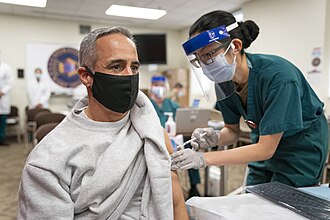
COVID-19 vaccines help protect people from the virus that causes COVID-19. These vaccines were developed quickly because scientists already knew a lot about similar viruses. Vaccines have helped reduce severe illness and deaths from COVID-19. By August 2024, more than 5.6 billion people had received at least one dose of a COVID-19 vaccine.
Treatment
Main article: Treatment and management of COVID-19
Most people with COVID-19 have only mild symptoms and can get better with rest, fluids, and medicines like paracetamol for fever or pain. People with more severe symptoms might need extra oxygen, special medicines, or care in a hospital. Some medicines that were tried early in the pandemic, like hydroxychloroquine and ivermectin, were not found to help.
Prognosis
Further information: COVID-19 § Prognosis, and Long COVID
COVID-19 can range from very mild to very severe. Most people recover within a couple of weeks, but some people, especially older adults, might need to stay in the hospital for weeks. Some people might continue to feel sick for months after recovering, a condition called long COVID. Common problems with long COVID include feeling very tired, having trouble remembering, and feeling short of breath.
Strategies
Main article: Public health mitigation of COVID-19
Many countries tried to slow the spread of COVID-19 by asking people to change their behavior. Some places used strict rules, while others just shared information. There were two main ways to handle the virus: stopping it completely and lessening its effects.
Stopping the virus completely, called "zero-COVID," tried to prevent the virus from spreading in the community. This included finding people who were sick, checking who they had been in touch with, and making sure they stayed away from others until they were no longer contagious. Places also used rules like closing schools, asking people to stay home, and testing many people.
When stopping the virus wasn’t possible, the focus was on slowing it down. This helped keep hospitals from getting too busy and gave more time to make vaccines and treatments. People changed how they lived, like working from home instead of going to an office.
Containment
Further information: Zero-COVID
To stop the virus from spreading to everyone, sick people were kept apart, and others they had been close to were checked and kept away until they were safe. Screening for symptoms helped find sick people early.
Mitigation
Further information: Flattening the curve
When stopping the virus wasn’t possible, the goal was to slow it down. This helped keep hospitals from getting crowded and gave more time to make vaccines and treatments. People worked from home, and many places closed schools and workplaces.
Non-pharmaceutical interventions
Ways to help stop the spread included wearing face masks, washing hands often, staying home when sick, and avoiding big groups. Places also closed schools and workplaces to keep people apart.
Other measures
Some places used very strict rules, like locking down whole areas and stopping people from traveling. Countries like China and Australia used many lockdowns. New Zealand stopped people from traveling a lot. South Korea tested many people and told them to stay home if they had been near someone sick. Singapore stopped people from moving around for a while and helped those who lost work.
Contact tracing
See also: Use and development of software for COVID-19 pandemic mitigation and Public health mitigation of COVID-19 § Information technology
Contact tracing tried to find people who had been close to someone sick and check if they were also sick. This was done by asking sick people who they had seen and then calling or visiting those people.
Health care
Further information: Flattening the curve, list of countries by hospital beds, and Shortages related to the COVID-19 pandemic
Health experts said it was important to make sure hospitals had enough space and supplies. They suggested focusing on testing, canceling non-urgent surgeries, and getting more equipment like machines to help people breathe.
Improvised manufacturing
Because it was hard to get enough supplies, some people used new ways to make things like swabs and parts for machines. They shared designs online so others could make them too. Many people made masks, face shields, and other protective gear at home.
Herd immunity
In July 2021, experts said it might be hard to stop the virus completely because a new version called Delta could still spread even among people who had vaccines. Health officials asked everyone, even those who were vaccinated, to keep wearing masks, staying apart, and staying home if they might have been exposed.
History
Further information: Pandemic prevention and Pandemic predictions and preparations prior to the COVID-19 pandemic
2019
Main article: Timeline of the COVID-19 pandemic in 2019
The outbreak started in Wuhan in November 2019. It might have been spreading between people before it was found. By the end of December, there were already hundreds of cases in the area. Health workers noticed people with a kind of pneumonia and told local officials. Scientists found a new type of virus and shared their findings.
2020
Timelines of the COVID-19 pandemic in 2020 by month: January, February, March, April, May, June, July, August, September, October, November, December
In January 2020, China shared the virus’s genetic code with the world. The number of cases grew quickly, and the virus spread to many parts of Asia and then to the whole world. By March, the World Health Organization said the outbreak was a pandemic. Many countries started taking steps to stop the spread.
By the end of 2020, a vaccine was being tested, and a new version of the virus was found in the United Kingdom.
2021
Timelines of the COVID-19 pandemic in 2021 by month: January, February, March, April, May, June, July, August, September, October, November, December
In 2021, more versions of the virus, called variants, appeared. Some were easier to spread. Vaccines were used to help protect people, but some variants made it harder for the vaccines to work as well.
2022
Timelines of the COVID-19 pandemic in 2022 by month: January, February, March, April, May, June, July, August, September, October, November, December
In 2022, the number of cases and deaths went down in many places because more people had immunity from vaccines or having the illness before. However, new versions of the virus kept appearing.
2023
Timeline of the COVID-19 pandemic in 2023
In 2023, the World Health Organization said COVID-19 was no longer a global emergency, but it was still something to watch. Some places stopped counting cases, but the virus was still moving around the world. Scientists kept learning about new changes in the virus to help doctors treat people who got sick.
Responses
Countries responded in different ways, from strict lockdowns to public education. Health experts suggested that curfews and lockdowns should be short-term measures to organize resources and protect healthcare systems. By March 2020, 1.7 billion people worldwide were under some form of lockdown. This number rose to 3.9 billion by early April—more than half the world's population.
In several nations, protests rose against restrictions. A study from February 2021 found that protests against these rules could increase the spread of the virus.
Asia
By the end of 2021, Asia's peak matched the world's peak in May 2021. However, Asia had only half the global average in total cases.
China used strict lockdowns to stop the virus. Vaccines used in China included the BIBP, WIBP, and CoronaVac. By December 2021, China had vaccinated 1.162 billion people, or 82.5% of its population. China’s focus on a zero-COVID strategy contained early waves, but later waves from the Omicron variant challenged this approach. In November 2022, protests occurred over strict measures, and China eased its zero-COVID policy in December. On 20 December 2022, China changed how it counted COVID-19 deaths.
The first case in India was reported on 30 January 2020. India began a nationwide lockdown on 24 March 2020. The government introduced a contact tracking app called Aarogya Setu. India’s vaccination program was very successful, with over 90% of people getting the first dose and 65% getting the second dose. A second wave hit India in April 2021, putting pressure on healthcare services. By 21 October 2021, India had surpassed 1 billion vaccinations.
Iran reported its first cases on 19 February 2020, in Qom. Early measures included closing schools and cancelling events. Iran became a center of the pandemic in February 2020. By August 2021, the fifth wave peaked, with over 400 deaths in one day.
South Korea reported COVID-19 on 20 January 2020. South Korea set up a large screening program, including drive-through testing and tracking contacts. Despite some early criticism, South Korea’s program was successful in controlling the outbreak.
Europe
COVID-19 reached Europe in Bordeaux, France, on 24 January 2020. By 17 March 2020, every European country had reported a case. Italy was the first European nation to introduce a national lockdown. By 13 March 2020, the World Health Organization declared Europe the epicenter of the pandemic. By 18 March 2020, over 250 million people in Europe were in lockdown. Europe became the epicenter again in late 2021.
The Italian outbreak began on 31 January 2020. The government closed schools, suspended flights, and declared a state of emergency. By March 2020, nearly all commercial activity was closed except supermarkets and pharmacies. Italy’s second wave led to hospitals stopping accept patients in November 2020.
Spain reported COVID-19 on 31 January 2020. Non-essential workers were ordered to stay home starting 30 March 2020. By September 2021, Spain had one of the highest vaccination rates in the world.
Sweden chose to keep most activities open. The Public Health Agency of Sweden focused on longer-term measures. By June 2020, Sweden no longer had excess deaths.
Devolution in the United Kingdom meant each country set its own rules. England had shorter restrictions. The UK government began social distancing and quarantine measures on 18 March 2020. By December 2020, the UK became the first country to approve a COVID-19 vaccine.
North America
The virus reached the United States on 13 January 2020. All North American countries reported cases by April 2020.
The United States had the most cases and deaths from COVID-19. COVID-19 became a leading cause of death in the U.S. in 2020. Vaccines became available in December 2020. By November 2022, new virus variants were spreading in the U.S.
Canada declared states of emergency in March 2020. Provinces closed schools, limited gatherings, and restricted travel. Vaccine passports were used across Canada. By November 2022, Canada saw a rise in flu cases.
South America
COVID-19 reached South America on 26 February 2020, in Brazil. By May 2020, all South American countries had cases. By July 2021, South America had over 34 million cases and 1 million deaths. Brazil had the third-most cases and second-most deaths worldwide.
Africa
COVID-19 reached Africa on 14 February 2020, in Egypt. By May 2020, all African countries had cases. Africa had lower death rates than other regions. In June 2021, Africa faced a third wave with many new cases. By October 2022, most African countries were not able to reach a 70% vaccination goal.
Oceania
COVID-19 reached Oceania on 25 January 2020, in Melbourne, Australia. Australia and New Zealand were praised for their response. By 2022, these countries opened their borders, leading to more cases. Restrictions were lifted by September 2022 due to high immunity levels.
Antarctica
Due to its remoteness, Antarctica was the last continent to report COVID-19 cases, in December 2020. Outbreaks occurred in 2021 and 2022.
United Nations
Main article: United Nations response to the COVID-19 pandemic
The United Nations was criticized for its slow response. On 23 March 2020, the United Nations Secretary-General called for a global ceasefire. In July 2020, the UN Security Council passed a resolution supporting this idea.
WHO
Main article: World Health Organization's response to the COVID-19 pandemic
The WHO started several programs to raise money, support supply chains, and test treatments. The COVAX program, led by the WHO, aimed to ensure fair access to vaccines worldwide.
Restrictions
Further information: Timeline of the COVID-19 pandemic and International aid related to the COVID-19 pandemic
The pandemic caused big changes in the world's economy, especially in the United States, Europe, and Latin America. It also led to arguments and disagreements in many places about the best ways to handle the situation. International trade faced problems as some areas closed their borders to protect their people.
Travel restrictions
Main article: Travel restrictions related to the COVID-19 pandemic
Because of the pandemic, many countries put rules in place to stop people from traveling. These rules included asking people to stay home, not allowing visitors from certain places, or stopping all travel. This hurt the travel industry a lot. Some people wondered if these travel rules really helped stop the spread of the illness, especially if they were not used together with other ways to stay healthy. Studies showed that travel rules worked best at the very start or end of an outbreak. The European Union decided not to close its open travel area known as the Schengen zone.
Repatriation of foreign citizens
Main article: Evacuations related to the COVID-19 pandemic
Several countries brought their citizens and workers home from Wuhan and nearby areas, mostly using special flights. Countries like Canada, the United States, Japan, India, Sri Lanka, Australia, France, Argentina, Germany, and Thailand were among the first to do this. Brazil and New Zealand also helped their own people and others. South Africa brought back 112 of its citizens who did not have the illness, but kept four who showed signs of it. Pakistan chose not to bring its citizens home.
The United States said it would bring Americans home from the Diamond Princess cruise ship on February 15, and Canada brought 129 Canadians from the ship on February 21. In early March, India started bringing its citizens back from Iran. On March 20, the United States began taking some of its soldiers out of Iraq.
Impact
Main article: Impact of the COVID-19 pandemic
Further information: Social impact of the COVID-19 pandemic
The COVID-19 pandemic had big effects on the world. It hurt the economy, changed how people worked and lived, and affected many parts of life.
Economics
Main article: Economic impact of the COVID-19 pandemic
See also: Impact of the COVID-19 pandemic on aviation, on science and technology, on financial markets, 2020 stock market crash, and COVID-19 recession
The pandemic and the ways people tried to stop it caused big problems for the world’s economy. On 27 February 2020, worries about the outbreak caused big drops in US stock prices, the worst since 2008.
Travel and tourism almost stopped because of rules against traveling and closing down places like museums and parks. Airlines cut flights, and some airlines even stopped working. Cruise ships had many problems, and train stations and ferry ports closed. Mail between countries stopped or was very slow.
Shops had trouble staying open, with some closing for days or weeks. Stores in Europe and Latin America saw 40% fewer people coming in, while places in North America and the Middle East had 50–60% fewer visitors. Shopping malls lost 33–43% of their usual customers in March compared to February. Mall owners tried to keep people safe by cleaning more, checking temperatures, and stopping events.
Millions of people lost their jobs, including more than 40 million in the US. According to a report by Yelp, about 60% of US businesses that closed during this time will not open again. The International Labour Organization (ILO) said that the money people made from working dropped by 10.7%, or $3.5 trillion, in the first nine months of 2020.
Supply shortages
Main article: Shortages related to the COVID-19 pandemic
People bought a lot of things very quickly, emptying out stores of things like food, toilet paper, and water. This happened because people were worried and didn’t know what would happen.
There were not enough things because factories and places where things are stored were closed or had problems. This made it hard to get things like computer chips for cars and other products.
The World Health Organization said that there was suddenly a lot more need for things to help keep people safe, like masks and gloves, which made prices go up a lot. Some places ran out of these things.
In September 2021, the World Bank said that food prices stayed about the same, but the poorest countries saw food prices go up a lot. Some countries had more food than they needed, but others did not.
There was too much oil and gas at the start because people were not traveling as much. But when things started to get better, there was not enough energy to meet the need.
Arts and cultural heritage
Main article: Impact of the COVID-19 pandemic on the arts and cultural heritage
The arts and places like museums and theaters were hit hard by the pandemic. Many places closed for a while, and events were cancelled or put off. About ten million jobs in these areas were lost around the world. Some people were still able to enjoy art through things like watching concerts online or going to art festivals on the computer.
Politics
Main article: Impact of the COVID-19 pandemic on politics
See also: Impact of the COVID-19 pandemic on international relations
The pandemic caused changes in governments and how they worked. Some leaders had to stop doing things for a while, and some elections were delayed. Some rules to stop the virus were not liked by everyone.
Brazil
The pandemic caused a lot of problems in Brazil. The president, Jair Bolsonaro, did not follow the advice of health experts and even spread wrong information. This made it hard for the country to fight the virus. Many people got very sick, and the president lost an election because of how he handled things.
China
Some leaders in China lost their jobs because of how they handled the virus. Some people said the government did not tell the whole truth. Journalists who reported on the pandemic were stopped by the government.
Italy
In early March 2020, Italy asked for help because they were struggling. Russia sent doctors and medical supplies. Other countries like Norway and some in Europe also sent help.
United States
Some people in the United States did not like the rules to stop the virus, like closing businesses or staying home. Workers who had to keep working said their jobs were unsafe and they were not paid enough. Some people thought the pandemic helped a candidate win an election.
People in the United States wanted better health care, help for children who needed care, time off work when sick, and more money for health programs. There were also debates about whether people should be required to get vaccines.
Other countries
More journalists were put in prison or detained around the world, with some of these cases related to the pandemic. A big military exercise planned by NATO in Germany, Poland, and the Baltic states was done on a smaller scale.
The government of Iran got very sick with the virus, including many leaders. The president of Iran asked other countries for help. Saudi Arabia said they would stop fighting in Yemen for a while.
The relationship between Japan and South Korea got worse. Some people in South Korea wanted their president to leave office because of how they handled the pandemic.
Some countries made new laws that gave the government more power. In Hungary, the leader could make decisions without the parliament. In some other countries, people who spoke against the government were arrested.
Food systems
Further information: Food security during the COVID-19 pandemic
The pandemic made it hard to get food in many places. People did not have as much money, and it was hard to move food from where it was made to where it was needed. In some places, food became more expensive. The World Health Organization said that in 2020, 811 million people did not have enough to eat, partly because of the pandemic.
Education
Main article: Impact of the COVID-19 pandemic on education
Schools and colleges in many countries closed for a while. Some places used computers and the internet for learning instead. About one billion students were affected. Closing schools caused many problems, like children not having enough to eat, not having a place to stay, and not having the things they needed to learn. It was harder for children who were already struggling. Some countries let students move ahead without taking tests. Many students said their mental health got worse during this time.
Health
Main articles: Impact of the COVID-19 pandemic on other health issues and Mental health during the COVID-19 pandemic
The pandemic affected health in many ways. People did not go to the hospital as much for things like heart attacks or appendicitis because they were scared. There were not enough medical supplies for some people. The pandemic also made mental health harder for many, including healthcare workers, patients, and people who were isolated.
In late 2022, there was a big increase in illnesses like flu, RSV, and COVID-19 in North America and Europe, especially among children. This caused many children to need care in hospitals. In the United Kingdom, there were also more cases of a bacterial infection called Strep A.
One type of flu virus might have disappeared because of measures taken during the pandemic.
Environment
Main article: Impact of the COVID-19 pandemic on the environment
The pandemic helped the environment in some ways because there was less travel and fewer people using things that pollute. In China, using coal went down by 26%, and a type of air pollution went down by 50%.
Animals changed their behavior during this time. Some animals were less active when people were around, while others, especially in places with more people, were more active. This showed that animals may see people as a protection from other animals.
Some animals, like mink on farms and white-tailed deer, got very sick from the virus that causes COVID-19. Deer seem to carry the virus without getting very sick.
Discrimination and prejudice
Main article: Xenophobia and racism related to the COVID-19 pandemic
Some people faced unfair treatment because of their background during the pandemic. People of Chinese and East Asian descent were treated badly in many places because of racist ideas. Some leaders used names that made people think badly of others. Older people were also treated badly because people thought they were more likely to get very sick.
Some people worried that treating people who did not get vaccines unfairly was not right. Others said it was important to talk about people who did not get vaccinated because it affected everyone.
In early 2022, a group working on human rights asked Italy to change some rules about vaccines to make sure everyone’s rights were protected.
Lifestyle changes
The pandemic changed many things about daily life. People bought more things online, and restaurants lost business. Some people started working from home. This change continued even after the pandemic, with many people choosing to work from home. This caused some cities to lose value in their office spaces. Some companies started hiring people from other countries to work from home.
Historiography
A 2021 study noted that the COVID-19 pandemic had increased interest in epidemics and infectious diseases among both historians and the general public. Prior to the pandemic, these topics were usually overlooked by “general” history and only received attention in the history of medicine. Many comparisons were made between the COVID-19 and 1918 influenza pandemics, including the development of anti-mask movements, the widespread promotion of misinformation and the impact of socioeconomic disparities.
Religion
Main article: Impact of the COVID-19 pandemic on religion
In some places, religious groups made the virus spread more because of big gatherings and sharing wrong information. Some religious leaders said they were not allowed to do what they believed was right. In other places, being part of a religion helped people follow health rules and feel better when they were alone.
Information dissemination
Further information: Media coverage of the COVID-19 pandemic, Impact of the COVID-19 pandemic on social media, and Impact of the COVID-19 pandemic on journalism
During the pandemic, many news websites let people read their articles for free. Scientists also shared their research papers online for everyone to see. This made it easier for people to learn about the pandemic.
A special kind of technology helped show updates about the pandemic. Johns Hopkins University created a dashboard that many governments used to share important information with the public.
Misinformation
Main article: COVID-19 misinformation
There was a lot of wrong information about the pandemic shared on the internet and in messages. The World Health Organization called this an "infodemic." Some people were unsure about getting vaccines because of these false ideas.
Culture and society
The COVID-19 pandemic changed many things in popular culture. It appeared in TV shows that were already being made before the pandemic, and it also became a big part of new shows. Some people thought it was funny to make jokes about the pandemic, while others were not sure if it was the right time to laugh.
Because of the pandemic, many people wanted to escape into stories, like movies about zombies or other made-up diseases. They also noticed themes about getting sick, feeling lonely, and losing control in stories. Some people compared what was happening to a movie called Contagion from 2011, saying it was close to real life but not exactly the same.
Music also changed during this time. More people listened to classical music, calm music, and music for children, while the amount of pop, country, and dance music stayed about the same.
Transition to later phases
Main article: Endemic COVID-19
Experts in March 2022 said that COVID-19 would eventually become common in communities, like the cold and flu. By May 2023, the World Health Organization said the emergency phase of the pandemic had ended, but they also said the pandemic itself was not over. Some experts thought it might take years or even decades before COVID-19 would settle into a predictable pattern.
Even after the emergency phase ended, COVID-19 continued to spread and cause illness. By 2025, many experts agreed that COVID-19 had become common in communities, though it still caused many cases and deaths each year.
Long-term effects
After the first lockdowns in early 2020, many countries felt the lasting effects of the pandemic. Some places faced high prices for goods, and problems with getting products from one place to another became more common.
Travel took off again quickly, with airlines making money for the first time since before the pandemic. However, business trips by plane were still not as common as before.
The pandemic also caused delays in health care, leading to more deaths from other illnesses. Many children missed out on important vaccinations because the focus was on fighting COVID-19. Efforts to catch up on these vaccinations were made, but some areas still struggle to get back to normal levels.
Images
Related articles




This article is a child-friendly adaptation of the Wikipedia article on COVID-19 pandemic, available under CC BY-SA 4.0.
Images from Wikimedia Commons. Tap any image to view credits and license.