 Safekipedia
Variants of SARS-CoV-2
Adapted from Wikipedia · Discoverer experience
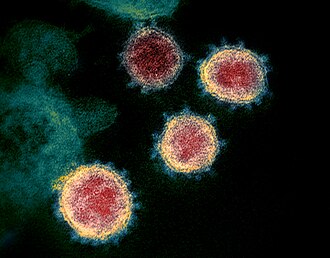
Variants of severe acute respiratory syndrome coronavirus 2 (SARS-CoV-2) are versions of the virus that causes coronavirus disease 2019 (COVID-19). While these variants look similar to the original virus, they have small genetic changes that make them different enough to be studied separately by scientists.
Some of these variants are important because they might spread more easily, make people sicker, or make vaccines less effective. This is why health experts keep watching them closely.
As of June 25, 2025, the World Health Organization listed certain variants as ones they are especially interested in, like JN.1, and others they are monitoring, including KP.3, KP.3.1.1, and several more. These variants help the virus continue to spread among people.
Overview
SARS-CoV-2, the virus that causes COVID-19, has changed over time through natural mutations. Scientists first noticed the virus in December 2019 and have been studying its changes ever since. Early on, there were fewer changes because there were not many infections. But as more people got sick, the virus changed more often.
Some of these changes made certain versions of the virus spread more easily. For example, the Alpha and Delta versions were found to spread faster than earlier versions. Some versions also had changes that helped them infect people even if many had already been sick or vaccinated. These special versions are watched closely by health experts around the world.
Definitions
The term variant of concern (VOC) for SARS-CoV-2, which causes COVID-19, describes a type of the virus that has changes in its spike protein. These changes can make the virus spread more easily among people.
Before a variant becomes a VOC, it might be called a variant of interest (VOI) or a variant under investigation (VUI). When fully studied, these variants are grouped into categories using systems like Pango, Nextstrain, and GISAID.
The World Health Organization updates its rules for naming these variants. As of October 2023, it also uses terms like variants under monitoring (VUM) for variants that might be spreading more quickly in different countries.
Different groups, like the CDC in the United States, may have slightly different rules for naming these variants.
Notability criteria
Viruses change over time by picking up small differences, which can create new versions called variants. When a new variant starts to spread in a group of people, it may be called an "emerging variant". For the virus that causes COVID-19, these new versions often differ by just a few tiny pieces.
Some new variants might have special traits, such as spreading more easily, making people sicker, or not being caught by tests that look for the virus. They might also not be stopped by treatments or by the immunity people get from being sick before or from vaccines. These special variants might affect certain groups more, like children or people whose immune systems don’t work well. If a variant shows it can cause more cases or special outbreaks, and it’s not yet widespread, it might be called a "variant of interest". If it later proves to make vaccines or treatments less effective, it could become a "variant of concern".
Nomenclature
See also: Colloquial names of SARS-CoV-2 variants
SARS-CoV-2 variants are groups of the virus that have small changes in their genetic makeup. At first, many groups and news reports named these variants after the countries where they were first found. This led to some problems, so in May 2021, the World Health Organization decided to use Greek letters like Alpha, Beta, and Gamma to name important variants. This made it easier to talk about them without causing any country to feel bad. Later, when they reached the letter Mu, they skipped Nu and Xi to avoid confusion or offense, choosing Omicron instead. If all Greek letters are used, they might start using names of constellations.
Lineages and clades
There are many variants of SARS-CoV-2, but scientists group them into larger families called lineages or clades. Different groups have different ways to name these families:
- As of January 2021, GISAID had identified eight main groups, called clades.
- Nextstrain, a tool for tracking how viruses change, had identified 13 main groups by June 2021.
- The Phylogenetic Assignment of Named Global Outbreak Lineages (PANGOLIN) team had named 1,340 different lineages by August 2021.
Countries also have their own systems for naming variants. For example, Public Health England used to name variants by the year, month, and a number, like [2021] [01]/[01]. They have since changed this system.
National public health institutes may create their own naming systems to track variants in their area.
| PANGO lineages | Notes to PANGO lineages | Nextstrain clades, 2021 | GISAID clades | Notable variants |
|---|---|---|---|---|
| A.1–A.6 | 19B | S | Contains "reference sequence" WIV04/2019 | |
| B.3–B.7, B.9, B.10, B.13–B.16 | 19A | L | ||
| O | ||||
| B.2 | V | |||
| B.1 | B.1.5–B.1.72 | 20A | G | Lineage B.1 in the PANGO Lineages nomenclature system; includes Delta/B.1.617 |
| B.1.9, B.1.13, B.1.22, B.1.26, B.1.37 | GH | |||
| B.1.3–B.1.66 | 20C | Includes Epsilon/B.1.427/B.1.429/CAL.20C and Eta/B.1.525 | ||
| 20G | Predominant in US generally, Feb '21 | |||
| 20H | Includes Beta/B.1.351 aka 20H/501Y.V2 or 501.V2 lineage | |||
| B.1.1 | 20B | GR | Includes B.1.1.207 and Lambda (lineage C.37) | |
| 20D | ||||
| 20J | Includes Gamma/P.1 and Zeta/P.2 | |||
| 20F | ||||
| 20I | Includes Alpha/B.1.1.7 aka VOC-202012/01, VOC-20DEC-01 or 20I/501Y.V1 | |||
| B.1.177 | 20E (EU1) | GV | Derived from 20A | |
Reference sequence
Scientists study a virus by comparing it to a reference sample. Because we don't know exactly when the first person got sick, choosing this reference sample can vary between studies.
One early sample, called Wuhan-1, was collected on December 24, 2019. Another group uses a sample collected on December 26, 2019, from the NCBI reference genome. Yet another sample, called WIV04/2019, was taken from a sick patient on December 30, 2019 and is often used as a reference, especially by researchers working with GISAID.
The virus sample first found in Wuhan, China differs from the original virus by three changes. Since then, many different versions of the virus have developed.
Overview of historical variants of concern or under monitoring
The following table shows information and risk levels for different versions of the virus that causes COVID-19, as known in 2021. These versions are called variants of concern. The data used to estimate risks were approximations because there wasn’t enough information available for detailed studies. For four main variants — Alpha, Beta, Gamma, and Delta — tests still worked well, and some treatments remained effective. PCR tests could also detect the Omicron variant.
Previously circulating and formerly monitored variants (WHO)
The World Health Organization (WHO) says a previously circulating variant doesn't pose a major added risk to global public health compared to other circulating SARS-CoV-2 variants, but it should still be monitored.
On 15 March 2023, the WHO updated its tracking system for variants of concern, announcing that only variants of concern will be assigned Greek letters.
Previously circulating variants of concern (VOC)
The variants listed below had previously been designated as variants of concern but were replaced by other variants. As of May 2022, the WHO lists the following under "previously circulating variants of concern":
Alpha (lineage B.1.1.7)
Main article: SARS-CoV-2 Alpha variant
First detected in October 2020 during the COVID-19 pandemic in the United Kingdom from a sample taken the previous month in Kent, lineage B.1.1.7, labelled Alpha variant by the WHO, was previously known as the first Variant Under Investigation in December 2020 (VUI – 202012/01) and later notated as VOC-202012/01. It is also known as 20I (V1), 20I/501Y.V1 (formerly 20B/501Y.V1), or 501Y.V1. From October to December 2020, its prevalence doubled every 6.5 days. It is linked with a significant increase in the rate of COVID-19 infection in United Kingdom, partly because of the N501Y mutation. There was some evidence that this variant had increased transmissibility, and early analyses suggested an increase in severity, though later work found no evidence of increased severity. As of May 2021, the Alpha variant had been detected in some 120 countries.
On 16 March 2022, the WHO de-escalated the Alpha variant and its subvariants to "previously circulating variants of concern".
B.1.1.7 with E484K
Variant of Concern 21FEB-02 (previously written as VOC-202102/02), described by Public Health England (PHE) as "B.1.1.7 with E484K" is of the same lineage in the Pango nomenclature system, but has an additional E484K mutation. As of 17 March 2021, there were 39 confirmed cases of VOC-21FEB-02 in the UK. On 4 March 2021, scientists reported B.1.1.7 with E484K mutations in the state of Oregon. In 13 test samples analysed, one had this combination, which appeared to have arisen spontaneously and locally, rather than being imported. Other names for this variant include B.1.1.7+E484K and B.1.1.7 Lineage with S:E484K.
Beta (lineage B.1.351)
Main article: SARS-CoV-2 Beta variant
On 18 December 2020, the 501.V2 variant, also known as 501.V2, 20H (V2), 20H/501Y.V2 (formerly 20C/501Y.V2), 501Y.V2, VOC-20DEC-02 (formerly VOC-202012/02), or lineage B.1.351, was first detected in South Africa and reported by the country's health department. It has been labelled as Beta variant by WHO. Researchers and officials reported that the prevalence of the variant was higher among young people with no underlying health conditions, and by comparison with other variants it more frequently resulted in serious illness in those cases. The South African health department also indicated that the variant may be driving the second wave of the COVID-19 epidemic in the country due to the variant spreading at a more rapid pace than other earlier variants of the virus.
Scientists noted that the variant contains several mutations that allow it to attach more easily to human cells because of the following three mutations in the receptor-binding domain (RBD) in the spike glycoprotein of the virus: N501Y, K417N, and E484K. The N501Y mutation has also been detected in the United Kingdom.
On 16 March 2022, the WHO has de-escalated the Beta variant and its subvariants to "previously circulating variants of concern".
Gamma (lineage P.1)
Main article: SARS-CoV-2 Gamma variant
The Gamma variant or lineage P.1, termed Variant of Concern 21JAN-02 (formerly VOC-202101/02) by Public Health England, 20J (V3) or 20J/501Y.V3 by Nextstrain, or just 501Y.V3, was detected in Tokyo on 6 January 2021 by the National Institute of Infectious Diseases (NIID). It has been labelled as Gamma variant by WHO. The new variant was first identified in four people who arrived in Tokyo having travelled from the Brazilian Amazonas state on 2 January 2021. On 12 January 2021, the Brazil-UK CADDE Centre Archived confirmed 13 local cases of the new Gamma variant in the Amazon rainforest. This variant of SARS-CoV-2 has been named lineage P.1 (although it is a descendant of B.1.1.28, the name B.1.1.28.1 is not permitted and thus the resultant name is P.1), and has 17 unique amino acid changes, 10 of which in its spike protein, including the three concerning mutations: N501Y, E484K and K417T.: Figure 5
The N501Y and E484K mutations favour the formation of a stable RBD-hACE2 complex, thus, enhancing the binding affinity of RBD to hACE2. However, the K417T mutation disfavours complex formation between RBD and hACE2, which has been demonstrated to reduce the binding affinity.
The new variant was absent in samples collected from March to November 2020 in Manaus, Amazonas state, but it was detected for the same city in 42% of the samples from 15 to 23 December 2020, followed by 52.2% during 15–31 December and 85.4% during 1–9 January 2021. A study found that infections by Gamma can produce nearly ten times more viral load compared to persons infected by one of the other lineages identified in Brazil (B.1.1.28 or B.1.195). Gamma also showed 2.2 times higher transmissibility with the same ability to infect both adults and older persons, suggesting P.1 and P.1-like lineages are more successful at infecting younger humans irrespective of sex.
A study of samples collected in Manaus between November 2020 and January 2021, indicated that the Gamma variant is 1.4–2.2 times more transmissible and was shown to be capable of evading 25–61% of inherited immunity from previous coronavirus diseases, leading to the possibility of reinfection after recovery from an earlier COVID-19 infection.
A study found that people fully vaccinated with Pfizer or Moderna have significantly decreased neutralisation effect against Gamma, although the actual impact on the course of the disease is uncertain.
Preliminary data from two studies indicate that the Oxford–AstraZeneca vaccine is effective against the Gamma variant, although the exact level of efficacy has not yet been released. Preliminary data from a study conducted by Instituto Butantan suggest that CoronaVac is effective against the Gamma variant as well, and as of July 2021 has yet to be expanded to obtain definitive data.
On 16 March 2022, the WHO has de-escalated the Gamma variant and its subvariants to "previously circulating variants of concern".
Delta (lineage B.1.617.2)
Main article: SARS-CoV-2 Delta variant
The Delta variant, also known as B.1.617.2, G/452R.V3, 21A or 21A/S:478K, was a globally dominant variant that spread to at least 185 countries. It was first discovered in India. Descendant of lineage B.1.617, which also includes the Kappa variant under investigation, it was first discovered in October 2020 and has since spread internationally. On 6 May 2021, British scientists declared B.1.617.2 (which notably lacks mutation at E484Q) as a "variant of concern", labelling it VOC-21APR-02, after they flagged evidence that it spreads more quickly than the original version of the virus and could spread quicker or as quickly as Alpha. It carries L452R and P681R mutations in Spike; unlike Kappa it carries T478K but not E484Q.
On 3 June 2021, Public Health England reported that twelve of the 42 deaths from the Delta variant in England were among the fully vaccinated, and that it was spreading almost twice as fast as the Alpha variant. Also on 11 June, Foothills Medical Centre in Calgary, Canada reported that half of their 22 cases of the Delta variant occurred among the fully vaccinated.
In June 2021, reports began to appear of a variant of Delta with the K417N mutation. The mutation, also present in the Beta and Gamma variants, raised concerns about the possibility of reduced effectiveness of vaccines and antibody treatments and increased risk of reinfection. The variant, called "Delta with K417N" by Public Health England, includes two clades corresponding to the Pango lineages AY.1 and AY.2. It has been nicknamed "Delta plus" from "Delta plus K417N". The name of the mutation, K417N, refers to an exchange whereby lysine (K) is replaced by asparagine (N) at position 417. On 22 June, India's Ministry of Health and Family Welfare declared the "Delta plus" variant of COVID-19 a variant of concern, after 22 cases of the variant were reported in India. After the announcement, leading virologists said there was insufficient data to support labelling the variant as a distinct variant of concern, pointing to the small number of patients studied. In the UK in July 2021, AY.4.2 was identified. Alongside those previously mentioned it also gained the nickname 'Delta Plus', on the strength of its extra mutations, Y145H and A222V. These are not unique to it, but distinguish it from the original Delta variant.
On 7 June 2022, the WHO has de-escalated the Delta variant and its subvariants to "previously circulating variants of concern".
Previously circulating variants of interest (VOI)
Epsilon (lineages B.1.429, B.1.427, CAL.20C)
Main article: SARS-CoV-2 Epsilon variant
The Epsilon variant or lineage B.1.429, also known as CAL.20C or CA VUI1, 21C or 20C/S:452R, is defined by five distinct mutations (I4205V and D1183Y in the ORF1ab gene, and S13I, W152C, L452R in the spike protein's S-gene), of which the L452R (previously also detected in other unrelated lineages) was of particular concern. From 17 March to 29 June 2021, the CDC listed B.1.429 and the related B.1.427 as "variants of concern". As of July 2021, Epsilon is no longer considered a variant of interest by the WHO, as it was overtaken by Alpha.
From September 2020 to January 2021, it was 19% to 24% more transmissible than earlier variants in California. Neutralisation against it by antibodies from natural infections and vaccinations was moderately reduced, but it remained detectable in most diagnostic tests.
Epsilon (CAL.20C) was first observed in July 2020 by researchers at the Cedars-Sinai Medical Center, California, in one of 1,230 virus samples collected in Los Angeles County since the start of the COVID-19 epidemic. It was not detected again until September when it reappeared among samples in California, but numbers remained very low until November. In November 2020, the Epsilon variant accounted for 36 per cent of samples collected at Cedars-Sinai Medical Center, and by January 2021, the Epsilon variant accounted for 50 per cent of samples. In a joint press release by University of California, San Francisco, California Department of Public Health, and Santa Clara County Public Health Department, the variant was also detected in multiple counties in Northern California. From November to December 2020, the frequency of the variant in sequenced cases from Northern California rose from 3% to 25%. In a preprint, CAL.20C is described as belonging to clade 20C and contributing approximately 36% of samples, while an emerging variant from the 20G clade accounts for some 24% of the samples in a study focused on Southern California. Note, however, that in the US as a whole, the 20G clade predominates, as of January 2021. Following the increasing numbers of Epsilon in California, the variant has been detected at varying frequencies in most US states. Small numbers have been detected in other countries in North America, and in Europe, Asia and Australia. After an initial increase, its frequency rapidly dropped from February 2021 as it was being outcompeted by the more transmissible Alpha. In April, Epsilon remained relatively frequent in parts of northern California, but it had virtually disappeared from the south of the state and had never been able to establish a foothold elsewhere; only 3.2% of all cases in the United States were Epsilon, whereas more than two-thirds were Alpha.
Zeta (lineage P.2)
Eta (lineage B.1.525)
Main article: SARS-CoV-2 Eta variant
The Eta variant or lineage B.1.525, also called VUI-21FEB-03 (previously VUI-202102/03) by Public Health England (PHE) and formerly known as UK1188, 21D or 20A/S:484K, does not carry the same N501Y mutation found in Alpha, Beta and Gamma, but carries the same E484K-mutation as found in the Gamma, Zeta, and Beta variants, and also carries the same ΔH69/ΔV70 deletion (a deletion of the amino acids histidine and valine in positions 69 and 70) as found in Alpha, N439K variant (B.1.141 and B.1.258) and Y453F variant (Cluster 5). Eta differs from all other variants by having both the E484K-mutation and a new F888L mutation (a substitution of phenylalanine (F) with leucine (L) in the S2 domain of the spike protein). As of 5 March 2021, it had been detected in 23 countries. It has also been reported in Mayotte, the overseas department/region of France. The first cases were detected in December 2020 in the UK and Nigeria, and as of 15 February 2021, it had occurred in the highest frequency among samples in the latter country. As of 24 February 56 cases were found in the UK. Denmark, which sequences all its COVID-19 cases, found 113 cases of this variant from 14 January to 21 February 2021, of which seven were directly related to foreign travel to Nigeria.
As of July 2021, UK experts are studying it to ascertain how much of a risk it could be. It was then regarded as a "variant under investigation", but pending further study, it was anticipated to possibly become a "variant of concern". Ravi Gupta, from the University of Cambridge said in a BBC interview that lineage B.1.525 appeared to have "significant mutations" already seen in some of the other newer variants, which means their likely effect is to some extent more predictable.
Theta (lineage P.3)
Main article: SARS-CoV-2 Theta variant
On 18 February 2021, the Department of Health of the Philippines confirmed the detection of two mutations of COVID-19 in Central Visayas after samples from patients were sent to undergo genome sequencing. The mutations were later named as E484K and N501Y, which were detected in 37 out of 50 samples, with both mutations co-occurrent in 29 out of these.
On 13 March, the Department of Health confirmed the mutations constitutes a variant which was designated as lineage P.3. On the same day, it also confirmed the first COVID-19 case caused by the Gamma variant in the country. The Philippines had 98 cases of the Theta variant on 13 March. On 12 March it was announced that Theta had also been detected in Japan. On 17 March, the United Kingdom confirmed its first two cases, where PHE termed it VUI-21MAR-02. On 30 April 2021, Malaysia detected 8 cases of the Theta variant in Sarawak.
As of July 2021, Theta is no longer considered a variant of interest by the WHO.
Iota (lineage B.1.526)
The proportion of USA cases represented by the Iota variant had declined sharply by the end of July 2021 as the Delta variant became dominant.
Kappa (lineage B.1.617.1)
Lambda (lineage C.37)
Mu (lineage B.1.621)
Formerly monitored variants (WHO)
The variants listed below were once listed under variants under monitoring, but were reclassified due to either no longer circulating at a significant level, not having had a significant impact on the situation, or scientific evidence of the variant not having concerning properties.
| Pango lineage | GISAID clade | Nextstrain clade | Earliest samples | Date of VOI | Date of designation |
|---|---|---|---|---|---|
| P.2 | GR/484K.V2 | 20B/S.484K | 2020-04 | 2021-07-06 | 2021-08-17 |
| P.3 | GR/1092K.V1 | 21E | 2021-01 | 2021-07-06 | 2021-08-17 |
| B.1.427 B.1.429 | GH/452R.V1 | 21C | 2020-03 | 2021-07-06 | 2021-11-09 |
| B.1.617.1 | G/452R.V3 | 21B | 2020-10 | 2021-09-20 | |
| B.1.526 | GH/253G.V1 | 21F | 2020-11 | 2021-09-20 | |
| B.1.525 | G/484K.V3 | 21D | 2020-12 | 2021-09-20 | |
| C.37 | GR/452Q.V1 | 21G | 2020-12 | 2021-06-14 | 2022-03-09 |
| B.1.621 | GH | 21H | 2021-01 | 2021-08-30 | 2022-03-09 |
| Pango lineage | GISAID clade | Nextstrain clade | Earliest samples | Date of VUM | Date of designation | Country of sampling |
|---|---|---|---|---|---|---|
| AV.1 | GR | 2021-03 | 2021-05-26 | 2021-07-21 |  UK UK | |
| AT.1 | GR | 2021-01 | 2021-06-09 | 2021-07-21 |  Russia Russia | |
| R.1 | GR | 2021-01 | 2021-04-07 | 2021-11-09 |  Japan Japan | |
| B.1.466.2 | GH | 2020-11 | 2021-04-28 | 2021-11-09 |  Indonesia Indonesia | |
| B.1.1.519 | GR | 20B/S.732A | 2020-11 | 2021-06-02 | 2021-11-09 | Multiple countries |
| C.36.3 | GR | 2021-01 | 2021-06-16 | 2021-11-09 | Multiple countries | |
| B.1.214.2 | G | 2020-11 | 2021-06-30 | 2021-11-09 | Multiple countries | |
| B.1.1.523 | GR | 2020-05 | 2021-07-14 | 2021-11-09 | Multiple countries | |
| B.1.619 | G | 2020-05 | 2021-07-14 | 2021-11-09 | Multiple countries | |
| B.1.620 | G | 20A/S.126A | 2020-11 | 2021-07-14 | 2021-11-09 |  Lithuania Lithuania |
| B.1.1.318 AZ.5 | GR | 2021-01 | 2021-06-02 |  England England | ||
| C.1.2 | GR | 2021-05 | 2021-09-01 |  South Africa South Africa | ||
| B.1.630 | GH | 2021-03 | 2021-10-12 |  Dominican Republic Dominican Republic | ||
| B.1.640 | GH/490R | 2021-09 | 2021-11-22 |  Republic of Congo Republic of Congo | ||
| XD | 2022-01 | 2022-03-09 |  France France |
Omicron
Further information: SARS-CoV-2 Omicron variant
The Omicron variant, also called lineage B.1.1.529, was named a serious variant by the World Health Organization on November 26, 2021.
This variant has many changes in its genetic makeup, some of which are concerning. There is some proof that this variant may increase the chance of getting infected again. Scientists are studying how it affects how easily the virus spreads, severe illness, and other factors.
Omicron was first found in November 2021 in Botswana and South Africa. Cases were also found in Hong Kong, Israel, and Europe. By early 2022, it was spreading widely in many places, including India.
As time went on, new versions of Omicron appeared. By February 2022, BA.1, BA.1.1, and BA.2 were the most common types worldwide. BA.2 was easier to spread than BA.1 and became the main type in many countries by spring 2022.
In 2022, more new versions called XBB types appeared. One of these, XBB.1.5, became the most common type in the United States by late 2022. Another type, EG.5 (sometimes called “Eris”), started spreading in early 2023.
In July 2023, a new type called BA.2.86 was found. A version of this, called JN.1 (sometimes “Pirola”), started spreading in late 2023. By early 2024, JN.1 was the most common type worldwide.
In 2024 and 2025, even more new versions appeared, such as KP.2, KP.3 (called “FLuQE”), XEC, XFG (called “Stratus”), and NB.1.8.1 (called “Nimbus”). These continued to change and spread around the world.
Omicron variants under monitoring (WHO, 2022/2023)
In May 2022, the World Health Organization started a new way to watch closely related versions of the main Omicron variant. This was because most of the virus samples being studied were from the Omicron family. By February 2023, this group was called "Omicron variants under monitoring."
| Pango lineage | GISAID clade | Nextstrain clade | Relation to circulating VOCs | First documented | Notable features |
|---|---|---|---|---|---|
| BF.7 | GRA | 22B | BA.5 sublineage | 2022-01-24 | BA.5 + S:R346T |
| BQ.1 | GRA | 22E | BA.5 sublineage | 2022-02-07 | BQ.1 and BQ.1.1: BA.5 + S:R346T, S:K444T, S:N460K |
| BA.2.75 | GRA | 22D | BA.2 sublineage | 2021-12-31 | BA.2.75: BA.2 + S:K147E, S:W152R, S:F157L, S:I210V, S:G257S, S:D339H, S:G446S, S:N460K, S:Q493R reversion |
| CH.1.1 | GRA | 22D | BA.2 sublineage | 2022-07-20 | BA.2.75 + S:L452R, S:F486S |
| XBB | GRA | 22F | Recombinant of BA.2.10.1 and BA.2.75 sublineages, i.e. BJ1 and BM.1.1.1, with a breakpoint in S1 | 2022-08-13 | BA.2+ S:V83A, S:Y144-, S:H146Q, S:Q183E, S:V213E, S:G252V, S:G339H, S:R346T, S:L368I, S:V445P, S:G446S, S:N460K, S:F486S, S:F490S |
| XBB.1.5 | GRA | 23A | Recombinant of BA.2.10.1 and BA.2.75 sublineages, i.e. BJ1 and BM.1.1.1, with a breakpoint in S1 | 2022-01-05 | XBB + S:F486P |
| XBF | GRA | Recombinant of BA.5.2.3 and CJ.1 (BA.2.75.3 sublineage) | 2022-07-20 | BA.5 + S:K147E, S:W152R, S:F157L, S:I210V, S:G257S, S:G339H, S:R346T, S:G446S, S:N460K, S:F486P, S:F490S | |
| JN.1 | GRA | 24A | BA.2.86 sublineage; genetic features include S:L455S | 2023-08-25 | As of 28 June 2024, classified as a VOI; "Omicron VOC" category no longer declared |
Other notable variants
Lineage B.1.1.207 was first found in August 2020 in Nigeria. Scientists are still learning about how it spreads and how sick it might make people. It has a change called P681H, which it shares with the Alpha variant. As of late December 2020, this variant made up about 1% of virus samples in Nigeria, but its numbers might grow. By May 2021, it had been found in 10 countries.
Other variants like B.1.1.317 made health officials in Queensland Health add extra quarantine time for two people in Brisbane, Australia. Lineage B.1.616, found in Brittany, France in January 2021, was hard to detect with normal tests. Lineage B.1.618, first found in October 2020, spread in West Bengal, India in April 2021.
In July 2021, scientists found unusual virus strains in New York City wastewater. They thought these might come from people who were not tested or from animals.
The B.1.640.2 variant, also called the IHU variant, was found in October 2021 in a traveler to France from Cameroon. It infected 12 people but spread more slowly than the Omicron variant. In March 2022, a mix of Delta and Omicron called Deltacron was reported. In July 2023, a highly changed Delta variant with many mutations was announced.
Between November 2023 and July 2024, a very unusual variant was found in New Jersey. It bound much more strongly to human cells than any other variant and resisted antibodies, but it disappeared by mid-2024.
Recombinant variants
In 2022, the British government told us about some mixed versions of the SARS-CoV-2 virus. These mixed versions are called recombinant variants and have special names: XD, XE, and XF.
One of these, called XE, is a mix of two other versions, BA.1 and BA.2. By March 2022, scientists thought XE might spread a little faster than BA.2.
Incubation theory for multiple mutated variants
See also: Antigenic escape and Escape mutation
Researchers have found that in people whose bodies don't fight infections well, the virus can change many times. These changes happen especially when special treatments are used, causing the virus to adapt and become different in similar ways across various patients.
Notable missense mutations
There have been many changes in the SARS-CoV-2 virus that scientists call missense mutations. These changes can affect how the virus spreads or how well vaccines work.
One important change is called D614G. This change happened early in the pandemic and became common around the world. It seems to help the virus spread more easily.
Another change, N501Y, was found in several variants and may help the virus connect better to cells in our bodies. There are also changes like L452R and E484K that might make it harder for vaccines to work as well. Scientists watch these changes closely to understand how the virus might behave differently.
Data and methods
Modern DNA sequencing can help find new versions of germs quickly during sickness outbreaks. Scientists use special computer programs to group similar germ sequences together, which helps them understand how the virus changes over time. By January 2021, scientists around the world had collected more than 330,000 sequences of the virus that causes COVID-19.
Countries worked together to share their tools for studying these virus versions. One method, called wastewater surveillance, can help find the virus in water and track how it spreads in a community. Testing can sometimes show if a virus version is present, but this depends on which versions are most common in an area.
| Mutation | Alpha | Beta | Gamma | Delta | Omicron |
|---|---|---|---|---|---|
| Δ69–70 |  |  | | | |
| ins214EPE | | | | | |
| S371L/S373P | | | | | |
| N501Y | | | | | |
| E484K | | | | | |
| E484A | | | | | |
| L452R | | | | | |
| nsp6:Δ106–108 | | | | | |
Cross-species transmission
Further information: Impact of the COVID-19 pandemic on animals and List of animals that can get SARS-CoV-2
There is a risk that COVID-19 could spread from humans to animals. This could mix with other animal viruses and create new types that are dangerous to humans. These changes might come back to affect people, especially those with weaker immune systems.
Cluster 5
Main article: Cluster 5
In November 2020, a special type of the virus called Cluster 5 was found in Northern Jutland, Denmark. It is believed to have come from minks to humans through mink farms. To stop this from spreading, Denmark decided to remove the mink population and put restrictions on travel in some areas. This was done to protect efforts to control the COVID-19 pandemic. Tests later showed that Cluster 5 was no longer spreading among people.
Vaccines
Main article: COVID-19 vaccine
During the COVID-19 pandemic, many vaccines were created to help protect people from the virus. These vaccines were given to many people, starting with those who were most at risk.
The way the virus works can change, and scientists watched closely to see if new versions of the virus could make the vaccines less effective. As of February 2021, experts in the United States believed that the approved vaccines still worked well against the versions of the virus that were spreading at that time.
See also: Oxford–AstraZeneca COVID-19 vaccine § Effectiveness, Pfizer–BioNTech COVID-19 vaccine § Effectiveness, Moderna COVID-19 vaccine § Effectiveness, Janssen COVID-19 vaccine § Efficacy, Novavax COVID-19 vaccine § Efficacy, Sinopharm BIBP COVID-19 vaccine § Effectiveness, Sputnik V COVID-19 vaccine § Effectiveness, CoronaVac § Effectiveness, Covaxin § Efficacy, ZF2001 § Efficacy, Abdala (vaccine) § Efficacy, SCB-2019 § Efficacy, and COVID-19 vaccine clinical research § Variants
Images
Related articles


This article is a child-friendly adaptation of the Wikipedia article on Variants of SARS-CoV-2, available under CC BY-SA 4.0.
Images from Wikimedia Commons. Tap any image to view credits and license.