 Safekipedia
England
Adapted from Wikipedia · Discoverer experience
England is a country that is part of the United Kingdom. It is located on the island of Great Britain, covering about 62% of it, and includes more than 100 smaller adjacent islands. England shares a land border with Scotland to the north and another land border with Wales to the west. It is surrounded by the North Sea to the east, the English Channel to the south, the Celtic Sea to the south-west, and the Irish Sea to the west. In the 2021 census, England had a population of 56,490,048, with London being both the largest city and the capital.
The area now called England was first inhabited by modern humans during the Upper Paleolithic period. The country takes its name from the Angles, a Germanic tribe who settled there during the 5th and 6th centuries. England became a unified state in the 10th century and has had extensive cultural and legal impact on the world since the Age of Discovery, beginning in the 15th century. The Kingdom of England joined with the Kingdom of Scotland in 1707 through the Acts of Union, forming the Kingdom of Great Britain.
England is the origin of the English language, the English legal system, association football, and the Anglican branch of Christianity. Its parliamentary system of government has been adopted by many nations. The Industrial Revolution began in 18th-century England, making it the world's first industrialised nation. England is home to the two oldest universities in the English-speaking world: the University of Oxford, founded in 1096, and the University of Cambridge, founded in 1209.
The landscape of England mainly consists of low hills and plains, especially in the centre and south. Upland and mountainous areas are mostly found in the north and west, including Dartmoor, the Lake District, the Pennines, and the Shropshire Hills. The London metropolitan area has a population of over 15 million as of 2025, making it the largest metropolitan area in the United Kingdom. England's population of 56.3 million makes up 84% of the United Kingdom's total population, with many people living around London, the South East, and industrial regions in the Midlands, the North West, the North East, and Yorkshire.
Toponymy
See also: Toponymy of England
The name "England" comes from an old name called Englaland, which means "land of the Angles." The Angles were a group of people from a place called Angeln in what is now Schleswig-Holstein, in Germany. They moved to the island of Great Britain a long time ago. The word "England" was first used in old writings that talk about the history of the English people.
Over time, the name stuck and was used for the whole country. Even today, some old stories and poems use special names like Loegria or Albion when they talk about England, giving it a poetic feel.
History
Main article: History of England
For a chronological guide, see Timeline of English history.
Prehistory
Main article: Prehistoric Britain
The earliest known evidence of human presence in the area now known as England dates back about 780,000 years. Modern humans lived there during ancient times, but permanent settlements only began within the last 6,000 years. After the last ice age, only large animals remained, but humans returned about 11,000 years ago from areas in northern Europe. Over time, sea levels rose, separating Britain from other lands. Farmers from Europe arrived around 4100 BC.
The Beaker culture brought new ways of making pots and tools around 2,500 BC. They built important stone structures like Stonehenge and Avebury. They made bronze by mixing tin and copper, and later created iron tools, which helped improve farming and weapons.
Ancient history
The Romans invaded Britain in 43 AD, bringing many new ideas and building structures like roads and baths. Native tribes tried to resist, but the Romans controlled much of the land. Later, a queen named Boudica led a rebellion but was defeated. This time brought many changes to daily life and culture.
Christianity began to spread during this period, though there is debate about exactly when it started. After the Romans left, Britain faced new challenges and changes in religion and leadership.
Middle Ages
After the Romans left, new groups from northern Europe arrived and settled in England. They brought their own languages and customs. Over time, these groups formed several small kingdoms that grew and changed. Battles and agreements shaped the land, and new leaders brought different ideas and rules.
Disputes over leadership led to big changes. One important moment was when William from Normandy became king after winning a battle in 1066. This brought new people to power and changed the language and culture of England.
Early modern period
During a time when exploration grew, England began to sail and discover new lands. Leaders made big decisions about religion, and the country expanded its influence around the world. Conflicts with other nations shaped England’s place in history.
Union with Scotland
Further information: Union of the Crowns and Treaty of Union
In 1603, the king of Scotland became the king of England, ruling both lands. This brought changes to how the countries were governed. Important books and ideas were shared, and new leaders brought different views on how things should be done.
Conflicts over power led to big struggles between leaders and the people they ruled. These fights changed the way England was governed forever. After a difficult time, new rules were made to balance power between the king and the people.
A big fire in London in 1666 destroyed much of the city, but it was rebuilt. New political groups formed, and the country grew in trade and wealth. The navy became strong, and England joined with Scotland to form a new kingdom.
Late modern and contemporary periods
England played a big role in shaping the world through inventions and trade. The Industrial Revolution brought huge changes, with factories and new ways of living. Cities grew as people moved for work, and new ideas changed how people thought about their country and the world.
England faced big wars in the early 1900s, which brought sadness and change. After the wars, the country worked to rebuild and adapt. New technologies and ways of living emerged, and England continued to evolve as part of a larger united kingdom.
Governance
Main article: Politics of England
Main article: English law
Main article: Subdivisions of England
See also: Regions of England, Combined authority, Counties of England, and Districts of England
England is part of the United Kingdom, which is a constitutional monarchy with a parliamentary system. Since 1707, England has not had its own separate government. Instead, it is governed directly by the Parliament of the United Kingdom. Other parts of the UK have their own governments, but England does not.
England's laws are made by judges in courts, using past decisions as guides. The highest court is the Supreme Court of the United Kingdom, which was created in 2009. England is divided into different areas for local government, including counties and districts. Some areas have their own local councils to help make decisions for their communities.
Geography
Main article: Geography of England
England is a country that is part of the United Kingdom. It covers most of the southern and central parts of the island of Great Britain. It shares land borders with Scotland to the north and Wales to the west. England is surrounded by the sea on all other sides, including the North Sea, the English Channel, and the Irish Sea.
England has many rivers and lakes. The longest river is the Thames, which flows through London. The landscape includes low hills and plains, with some higher, mountainous areas in the north and west. The highest point in England is Scafell Pike, which is 978 metres tall. The weather in England is generally mild but can change often, with rainfall spread throughout the year.
Main article: Climate of England
Main article: Fauna of England
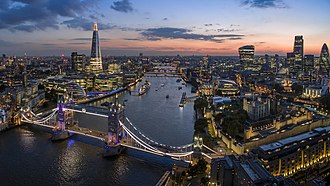
The biggest city in England is London, which is one of the busiest cities in the world. Other large cities include Birmingham, Manchester, Liverpool, and Leeds. Some smaller towns are also considered cities if they have special buildings called cathedrals.
Economy
Main article: Economy of England
England's economy is one of the largest and most active in the world. It has a strong mix of industries, including technology, science, and financial services. London is a major financial center and home to many important companies.
England is known for its advances in science and technology. Many famous inventors and scientists came from England, and the country continues to be a leader in areas like computing, medicine, and engineering. The country has a well-developed transportation system, including roads, railways, and airports, which helps connect its many cities and towns. England is also working to use cleaner energy sources, like wind power, to help protect the environment.
Healthcare
Main article: Healthcare in England
The National Health Service (NHS) is the public healthcare system in England. It started on 5 July 1948 and is funded mostly by taxes and National Insurance payments. The NHS provides most healthcare services free of charge, although some people pay for things like eye tests, dental care, and prescriptions.
The government department that oversees the NHS is called the Department of Health. It spends a lot of money each year to keep the NHS running. People in England generally live longer than in many other places, with men living about 77.5 years and women about 81.7 years on average.
Demography
Main article: Demographics of England
With over 56 million people, England is the most populous country in the United Kingdom, making up 84% of the total population. If England were its own country, it would be the 26th largest in the world by how many people live there.
The people of England are part of the larger group known as British people. Many people from England live in other parts of the world, especially in the United States, Canada, Australia, South Africa, and New Zealand. Since the late 1990s, many have also moved to Spain. Because of England's strong economy, especially in South East England, many people from other parts of the United Kingdom have moved there. There has also been a lot of movement from Ireland. Today, about 81.7% of people in England come from European backgrounds. Many people also have family roots in places like India, Pakistan, and Bangladesh. Smaller groups come from China, Arab countries, and Africa and the Caribbean.
English is the main language spoken in England. It began in what is now England and is used all over the world. Almost everyone in England speaks English well. Some people also speak other languages at home, like Punjabi or Urdu. Recently, Polish has become common as well. In schools, children often learn a second language such as French, Spanish, or German.
In terms of religion, the most common one in England is Christianity. The Church of England is the official church. There are also people who follow Islam, Hinduism, Sikhism, and Buddhism. Some people do not follow any religion at all. There are also small groups who practice other beliefs.
Education
Main article: Education in England
England has a well-organized system to help children learn from a young age. Kids start school around age 3 and go through primary school until they are about 11. After that, they move on to secondary school until they are 16. All state schools must teach important subjects like reading, writing, math, science, history, and art.
Students usually take important tests called GCSEs when they finish their required school years. After that, they can choose to keep learning in further education schools or colleges, where they might take exams called A-levels to help them get into university. England has many universities, including some of the best-known ones in the world, such as the University of Cambridge and the University of Oxford. Most of these universities are public, meaning anyone can attend if they meet the requirements.
Culture
Main article: Culture of England
Further information: English Renaissance
Architecture
Many ancient stone monuments were built during ancient times; well-known examples include Stonehenge, Devil's Arrows, Rudston Monolith and Castlerigg. With the Romans came buildings like basilicas, baths, amphitheaters, triumphal arches, villas, Roman temples, Roman roads, Roman forts, stockades and aqueducts. The Romans founded cities and towns such as London, Bath, York, Chester and St Albans. A famous example is Hadrian's Wall stretching across northern England.
Early medieval buildings were simple wooden structures with thatched roofs. Church buildings ranged from a mix of Hiberno-Saxon monastic styles to Early Christian basilicas. After the Norman conquest in 1066, many castles were built; famous ones include the Tower of London, Warwick Castle, Durham Castle and Windsor Castle.
During the Plantagenet era, English Gothic architecture flourished, with famous medieval cathedrals such as Canterbury Cathedral, Westminster Abbey and York Minster. The Tudor style followed, known for its four-centred arches. Later, the English Baroque style appeared, championed by architect Christopher Wren.
Georgian architecture brought a refined, simple style, with the Royal Crescent at Bath as a prime example. The Victorian era saw a Gothic Revival and the rise of industrial buildings like The Crystal Palace. Since the 1930s, modernist forms have appeared, sometimes controversial but supported in some areas.
Gardens
Landscape gardening, developed by Capability Brown, set an international trend for the English landscape garden. These gardens, often at large country houses, included lakes, rolling lawns, groves of trees, and structures like classical temples and Gothic ruins to create an ideal pastoral scene.
By the late 1700s, the English garden was being copied in places like Pavlovsk, Saint Petersburg and influenced public parks worldwide. Today, English Heritage and the National Trust protect many gardens and parks. The RHS Chelsea Flower Show is held yearly and is one of the world's largest gardening events.
Folklore
English folklore has developed over many centuries. Common folkloric beings include pixies, giants, elves, bogeymen, trolls, goblins and dwarves. Famous legends include tales of Offa of Angel and Wayland the Smith, and stories of Robin Hood and his Merry Men from Sherwood.
During the Middle Ages, tales from Brythonic traditions entered English folklore, leading to the Arthurian myth with characters like King Arthur, Camelot, Excalibur, Merlin and the Knights of the Round Table. People still celebrate Bonfire Night on November 5 to remember the failed Gunpowder Plot involving Guy Fawkes. Traditional activities include Morris dancing, Maypole dancing, and other local customs.
Cuisine
Since the early modern period, English food has been known for its simplicity and use of high-quality natural ingredients. Traditional dishes include the Sunday roast with roasted meat, Yorkshire pudding and gravy, fish and chips, and the full English breakfast. Other popular foods are meat pies like steak and kidney pie and the Cornish pasty.
Common sausages include bangers and mash and toad in the hole. Lancashire hotpot is a well-known stew. Popular cheeses are Cheddar, Red Leicester, Wensleydale, Double Gloucester and Blue Stilton. Many hybrid dishes like chicken tikka masala have been created. Traditional desserts include apple pie and spotted dick, often served with custard. Common drinks are tea, coffee, wine, ciders and English beers.
Visual arts
The earliest known examples are prehistoric rock and cave art pieces, found in places like North Yorkshire, Northumberland and Cumbria. With the Romans came statues, busts, glasswork and mosaics. During the Early Middle Ages, sculpted crosses, ivories, manuscript painting and gold and enamel jewellery were popular, with intricate designs like those in the Staffordshire Hoard.
The Tudor era saw prominent artists in portrait painting, with German Hans Holbein and English artists like Nicholas Hilliard. Under the Stuarts, Continental artists such as the Flemish Anthony van Dyck, Peter Lely, Godfrey Kneller and William Dobson were influential. The 18th century saw the founding of the Royal Academy, with a classicism based on the High Renaissance, led by Thomas Gainsborough and Joshua Reynolds.
In the 19th century, John Constable and J. M. W. Turner were major landscape artists. The Pre-Raphaelite Brotherhood, led by artists such as Holman Hunt, Dante Gabriel Rossetti and John Everett Millais, revived Early Renaissance styles. In the 20th century, Henry Moore was a leading figure in British sculpture and modernism.
Literature, poetry, and philosophy
Early authors such as Bede and Alcuin wrote in Latin. Old English literature includes the epic poem Beowulf and the Anglo-Saxon Chronicle, along with Christian writings. After the Norman conquest, Latin remained among the educated, and Anglo-Norman literature developed.
Middle English literature emerged with Geoffrey Chaucer, author of The Canterbury Tales, along with Gower, the Pearl Poet and Langland. Philosophers like William of Ockham and Roger Bacon were major figures in the Middle Ages. Julian of Norwich wrote Revelations of Divine Love.
With the English Renaissance, literature in Early Modern English appeared. William Shakespeare, with works like Hamlet, Romeo and Juliet, Macbeth, and A Midsummer Night's Dream, remains one of the most celebrated authors. Other Elizabethan authors include Christopher Marlowe, Edmund Spenser, Philip Sydney, Thomas Kyd, John Donne, and Ben Jonson.
Philosophers of the Enlightenment included John Locke, Thomas Paine, Samuel Johnson and Jeremy Bentham. The poet Alexander Pope was well regarded for his satirical verse. England played a key role in romanticism with figures like Samuel Taylor Coleridge, Lord Byron, John Keats, Mary Shelley, Percy Bysshe Shelley, William Blake and William Wordsworth.
In response to the Industrial Revolution, writers like William Cobbett, G. K. Chesterton and Hilaire Belloc sought a balance between liberty and tradition. Philosophers like John Stuart Mill and Bertrand Russell continued empiricism. Victorian authors include Charles Dickens, the Brontë sisters, Jane Austen, George Eliot, Rudyard Kipling, Thomas Hardy, H. G. Wells and Lewis Carroll. Later novelists include George Orwell, D. H. Lawrence, Virginia Woolf, C. S. Lewis, Enid Blyton, Aldous Huxley, Agatha Christie, Terry Pratchett, J. R. R. Tolkien, and J. K. Rowling.
Performing arts
The traditional folk music of England is centuries old and has influenced many genres, including sea shanties, jigs, hornpipes and dance music. Ballads featuring Robin Hood, printed by Wynkyn de Worde in the 16th century, are important artifacts. Collections by John Playford and Robert Harley preserve many songs. Well-known songs include Greensleeves, Pastime with Good Company, Maggie May and Spanish Ladies. Many nursery rhymes come from England, such as Mary, Mary, Quite Contrary, Roses Are Red, Jack and Jill, London Bridge Is Falling Down, The Grand Old Duke of York, Hey Diddle Diddle and Humpty Dumpty. Traditional English Christmas carols include "We Wish You a Merry Christmas", "The First Noel", "I Saw Three Ships" and "_God Rest Ye Merry, Gentlemen".
Early English composers include Thomas Tallis and William Byrd, followed by Henry Purcell from the Baroque period and Thomas Arne, known for Rule, Britannia!. German-born George Frideric Handel became a national icon, creating famous works like The Messiah, Solomon, Water Music, and Music for the Royal Fireworks.
Classical music gained attention in the 18th century with the Birmingham Triennial Music Festival. The English Musical Renaissance in the late 19th and early 20th century saw composers like Edward Elgar, Benjamin Britten, Frederick Delius, Gustav Holst, and Ralph Vaughan Williams. Present-day composers include Michael Nyman, known for The Piano, and Andrew Lloyd Webber, whose musicals have achieved worldwide success.
In popular music, many English bands and solo artists are among the most influential and best-selling musicians globally. Acts such as the Beatles, Led Zeppelin, Pink Floyd, Elton John, Queen, Rod Stewart, David Bowie, the Rolling Stones and Def Leppard are top-selling artists. England has origins in or strong ties to many music genres, including the British invasion, progressive rock, hard rock, glam rock, heavy metal, Britpop, indie rock, gothic rock, shoegazing, acid house, garage, trip hop, drum and bass, and dubstep.
Large outdoor music festivals in summer and autumn are popular, such as Glastonbury, V Festival, and the Reading and Leeds Festivals. England was at the forefront of the illegal, free rave movement from the late 1980s, which inspired the pan-European culture of teknivals. The Boishakhi Mela is a Bengali New Year festival celebrated by the British Bangladeshi community and is the largest open-air Asian festival in Europe. After the Notting Hill Carnival, it is the second-largest street festival in the UK, attracting over 80,000 visitors.
The most prominent opera house in England is the Royal Opera House at Covent Garden. The Proms is a major annual cultural event. The Royal Ballet is one of the world's leading classical ballet companies. The Royal Academy of Music is the oldest conservatoire in the UK, founded in 1822 and receiving its royal charter in 1830. England has many major orchestras, including the BBC Symphony Orchestra, the Royal Philharmonic Orchestra, the Philharmonia Orchestra, and the London Symphony Orchestra. Other forms of entertainment that originated in England include the circus and the pantomime.
Cinema
England has greatly influenced cinema, producing some of the greatest actors, directors and films. Directors like Alfred Hitchcock and David Lean are critically acclaimed. Hitchcock's The Lodger: A Story of the London Fog (1926) helped shape the thriller genre, and his 1929 Blackmail is often called the first British sound feature film.
Major film studios in England include Pinewood, Elstree and Shepperton. Some of the most commercially successful films come from England, including two of the highest-grossing film franchises (Harry Potter and James Bond). Ealing Studios in London claims to be the oldest continuously working film studio in the world. The London Symphony Orchestra first performed film music in 1935. The Hammer Horror films starring Christopher Lee produced the first gory horror films in color.
The BFI Top 100 British films includes Monty Python's Life of Brian (1979), often voted the funniest film in the UK. English producers are active in international co-productions and English talent appears regularly in American films. The UK film council named David Yates, Christopher Nolan, Mike Newell, Ridley Scott and Paul Greengrass the five most commercially successful English directors since 2001. Other contemporary directors include Sam Mendes, Guy Ritchie and Richard Curtis. Current actors include Tom Hardy, Daniel Craig, Benedict Cumberbatch, Lena Headey, Felicity Jones, Emilia Clarke, Lashana Lynch, and Emma Watson. Acclaimed for motion capture work, Andy Serkis opened The Imaginarium Studios in London in 2011. The visual effects company Framestore in London has created some of the most acclaimed special effects in modern film. Many successful Hollywood films are based on English people, stories or events. The 'English Cycle' of Disney animated films includes Alice in Wonderland, The Jungle Book and Winnie the Pooh.
Sites and institutions
English Heritage manages historic sites, artifacts and environments in England, sponsored by the Department for Culture, Media and Sport. The National Trust focuses on landscapes and country houses. 17 of the 25 United Kingdom UNESCO World Heritage Sites are in England, including Hadrian's Wall, Stonehenge, Avebury and Associated Sites, the Tower of London, the Jurassic Coast, Saltaire, Ironbridge Gorge, Blenheim Palace and the Lake District.
London's British Museum holds over seven million objects, one of the world's largest and most comprehensive collections. The British Library in London is the national library, holding over 150 million items in many languages and formats. The National Gallery in Trafalgar Square has over 2,300 paintings from the mid-13th century to 1900. The Tate galleries hold British and international modern art and host the Turner Prize.
The Secretary of State for Culture, Media and Sport oversees cultural property and heritage. A blue plaque, the oldest historical marker scheme in the world, commemorates famous people or events in England. In 2011, there were around 1,600 museums in England, most of which are free to enter. London is one of the world's most visited cities, often ranking in the top five most visited cities in Europe. It is considered a global center of finance, art and culture.
Media
The BBC, founded in 1922, is the UK's publicly funded broadcasting corporation and the oldest and largest in the world. It operates TV and radio stations in the UK and abroad, funded by the television licence. The BBC World Service is an international broadcaster in over 40 languages.
London leads the media sector in England, with national newspapers and TV and radio based there, though Manchester is also a key media center. The UK publishing sector has a turnover of around £20 billion and employs about 167,000 people. National newspapers from England include The Times, The Guardian, The Daily Telegraph and the Financial Times.
Magazines and journals from England with worldwide circulation include Nature, New Scientist, The Spectator, Prospect, NME and The Economist. The Secretary of State for Culture, Media and Sport is responsible for media and broadcasting in England.
Sport
England has a strong sports history and developed many popular sports in the 19th century, including association football, cricket, rugby union, rugby league, tennis, boxing, badminton, squash, rounders, hockey, snooker, billiards, darts, table tennis, bowls, netball, thoroughbred horseracing, greyhound racing and fox hunting. England also helped develop golf, sailing and Formula One.
Football is the most popular sport. The England national football team, based at Wembley Stadium, played Scotland in the first international football match in 1872. England hosted and won the 1966 FIFA World Cup, with the final being the most-watched TV event ever in the UK. Sheffield F.C., founded in 1857, is the world's oldest football club. The England women's national football team won the UEFA Women's Euro 2022, hosted by England, and the UEFA Women's Euro 2025, winning the final against Spain.
Cricket likely developed in the early medieval period among farming and metalworking communities in the Weald. The England cricket team competes with Wales. A major rivalry is The Ashes series between England and Australia, played since 1882. Lord's Cricket Ground in London is often called the "Mecca of Cricket". After winning the 2019 Cricket World Cup, England became the first country to win World Cups in football, rugby union, and cricket.
William Penny Brookes helped organize the modern Olympic Games. London has hosted the Summer Olympic Games three times: in 1908, 1948, and 2012. England competes in the Commonwealth Games, held every four years. Sport England is the governing body for sports funding and strategy.
Rugby union began at Rugby School in Warwickshire in the early 19th century. The top club league is the English Premiership. England's Red Roses won the 2025 Women's Rugby World Cup. Rugby league started in Huddersfield in 1895. Since 2008, the England national rugby league team has been a full test nation, replacing the Great Britain national rugby league team, which won three World Cups. Club sides play in Super League, the modern form of the Rugby Football League Championship. Rugby League is most popular in northern counties like Lancashire, Yorkshire and Cumbria.
Golf is prominent in England, partly due to ties with Scotland. Professional tours for men and women include the PGA and the European Tour. The world's oldest golf tournament, The Open Championship, is played in both England and Scotland. The Ryder Cup, a biennial competition, is named after English businessman Samuel Ryder.
Tennis was created in Birmingham in the late 19th century, and the Wimbledon Championships is the oldest tennis tournament in the world and is considered the most prestigious. Wimbledon is a major event in the English cultural calendar.
In boxing, under the Marquess of Queensberry Rules, England has produced many world champions across weight divisions recognized internationally.
The thoroughbred horse breed, originating in 17th and 18th-century England, is best known for horse racing. The National Hunt race Grand National is held annually at Aintree Racecourse in early April and is the most watched horse race in the UK. Red Rum is the most successful horse in the race's history.
The 1950 British Grand Prix at Silverstone was the first race in the newly created Formula One World Championship. England has built some of the most advanced racing cars, and many racing companies base operations there. England also has a strong heritage in Grand Prix motorcycle racing, producing several world champions.
Darts is a popular sport in England, both professionally and as a traditional pub game. Another popular pub game is snooker, and England has produced several world champions.
The English enjoy competitive sailing, founding and winning many international tournaments, including the match race, regattas, and the America's Cup.
National symbols
Main article: National symbols of England
The St George's Cross has been the national flag of England since the 13th century. It features a red cross and is linked to Saint George, who is England's patron saint. The flag is also part of the Union Flag, which represents the whole United Kingdom.
Other important symbols of England include the Tudor rose, which combines red and white roses to represent peace, and the three lions shown on the Royal Arms of England. England celebrates its National Day on April 23, known as Saint George's Day, in honor of its patron saint. While the United Kingdom uses God Save the King as its anthem, songs like Jerusalem and Land of Hope and Glory are often used to represent England in special events.
Images
Related articles


This article is a child-friendly adaptation of the Wikipedia article on England, available under CC BY-SA 4.0.
Images from Wikimedia Commons. Tap any image to view credits and license.