 Safekipedia
City-state
Adapted from Wikipedia · Discoverer experience
A city-state is an independent sovereign city that serves as the main center for government, trade, and culture in its area. Unlike larger countries, which have many cities and countryside, a city-state is just one city that runs itself. Many important city-states existed long ago, such as Rome, Athens, and Venice.
Today, only a few city-states remain. Singapore is the largest and most well-known, with its own currency, military, and strong influence in the world. Other places like Monaco and Vatican City are also often called city-states.
Some cities, such as Hong Kong and Dubai, are very independent but are not fully separate countries. They still belong to larger nations but have many powers usually found in a city-state.
Historical background
Ancient and medieval world
Further information: List of ancient Greek cities, List of Phoenician cities, Cities of the ancient Near East, Italian city-states, Maya city, Polis, and Altepetl
Historical city-states included Sumerian cities such as Uruk, Ur and Nippur; Ancient Egyptian city-states, such as Thebes and Memphis; the Phoenician cities (such as Tyre and Sidon); the five Philistine city-states; the Berber city-states of the Garamantes; the city-states of ancient Greece (the poleis such as Athens, Sparta, Thebes, and Corinth); the Roman Republic (which grew from a city-state into a vast empire); the Italian city-states from the Middle Ages to the early modern period, such as Florence, Siena, Ferrara, Milan (which as they grew in power began to dominate neighboring cities) and Genoa and Venice, which became powerful thalassocracies; the Mayan and other cultures of pre-Columbian Mesoamerica (including cities such as Chichen Itza, Tikal, Copán and Monte Albán); the central Asian cities along the Silk Road; the city-states of the Swahili coast; Ragusa and Poljica in Croatia; Tbilisi in Georgia; the medieval Russian city-states of Novgorod and Pskov; the free imperial cities of German-speaking Europe; mueang of Indochina; barangay states of the Philippines; and many others. Danish historian Poul Holm has classed the Viking colonial cities in medieval Ireland, most importantly the Kingdom of Dublin, as city-states.
In Cyprus, the Phoenician settlement of Kition (in present-day Larnaca) was a city-state that existed from around 800 BC until the end of the 4th century BC.
Some of the most well-known examples of city-state culture in human history are the ancient Greek city-states and the merchant city-states of Renaissance Italy, which organised themselves as independent centers. The success of regional units coexisting as autonomous actors in loose geographical and cultural unity, as in Italy and Greece, often prevented their amalgamation into larger national units. However, such small political entities often survived only for short periods because they lacked the resources to defend themselves against incursions by larger states (such as Roman conquest of Greece). Thus they inevitably gave way to larger organisations of society, including the empire and the nation-state.
Central Europe
In the Holy Roman Empire (962–1806) more than 80 Free Imperial Cities came to enjoy considerable autonomy in the Middle Ages and in early modern times, buttressed legally by international law following the Peace of Westphalia of 1648. Some, like three of the earlier Hanseatic cities – Bremen, Hamburg and Lübeck – pooled their economic relations with foreign powers and were able to wield considerable diplomatic clout. Individual cities often made protective alliances with other cities or with neighbouring regions, including the Hanseatic League (1358 – 17th century), the Swabian League of Cities (1331–1389), the Décapole (1354–1679) in the Alsace, or the Old Swiss Confederacy (c. 1300 – 1798). The Swiss cantons of Zürich, Bern, Lucerne, Fribourg, Solothurn, Basel, Schaffhausen, and Geneva originated as city-states.
After the dissolution of the Holy Roman Empire in 1806, some cities – then members of different confederacies – officially became sovereign city-states, such as the Free Hanseatic City of Bremen (1806–11 and again 1813–71), the Free City of Frankfurt upon Main (1815–66), the Free and Hanseatic City of Hamburg (1806–11 and again 1814–71), the Free and Hanseatic City of Lübeck (1806–11 and again 1813–71), and the Free City of Kraków (1815–1846). Under Habsburg rule the city of Fiume had the status of a corpus separatum (1779–1919), which – while falling short of an independent sovereignty – had many attributes of a city-state.
Italy
Main article: Italian city-states
See also: Medieval commune, Lombard League, Maritime republics, and Signoria
In Northern and Central Italy during the medieval and Renaissance periods, city-states – with various amounts of associated land – became the standard form of polity. Some of them, despite being de facto independent states, were formally part of the Holy Roman Empire. The era of the Italian states, in particular from the 11th to the 15th centuries, featured remarkable economic development, trade, manufacture, and mercantile capitalism, together with increasing urbanization, with remarkable influence throughout much of the Mediterranean world and Europe as a whole. During this time, most of the Italian city-states were ruled by one person, such as the Signoria or by a dynasty, such as the House of Gonzaga and the House of Sforza.
Examples of Italian city-states during the Middle Ages and the Renaissance
- Republic of Florence, Duchy of Milan, Duchy of Ferrara, San Marino, Duchy of Modena and Reggio, Duchy of Urbino, Duchy of Mantua and the Republic of Lucca.
- The powerful maritime republics: Republic of Venice, Republic of Genoa, Republic of Amalfi, Republic of Pisa, Republic of Ancona and Duchy of Gaeta
Southeast Asia
In the history of Mainland Southeast Asia, aristocratic groups, Buddhist leaders, and others organized settlements into autonomous or semi-autonomous city-states. These were referred to as mueang, and were usually related in a tributary relationship now described as mandala or as over-lapping sovereignty, in which smaller city-states paid tribute to larger ones that paid tribute to still larger ones – until reaching the apex in cities like Ayutthaya, Bagan, Bangkok and others that served as centers of Southeast Asian royalty. The system existed until the 19th century, when colonization by European powers occurred. Siam, a regional power at the time, needed to define their territories for negotiation with the European powers so the Siamese government established a nation-state system, incorporated their tributary cities (Lan Xang, Cambodia and some Malay cities) into their territory and abolished the mueang and the tributary system.
In early Philippine history, the barangay was a complex sociopolitical unit which scholars have historically considered the dominant organizational pattern among the various peoples of the Philippine archipelago. These sociopolitical units were sometimes also referred to as barangay states, but are more properly referred to using the technical term polity. Evidence suggests a considerable degree of independence as city states ruled by Datus, Rajahs and Sultans. Early chroniclers record that the name evolved from the term balangay, which refers to a plank boat widely used by various cultures of the Philippine archipelago prior to the arrival of European colonizers.
20th-century cities under international supervision
Danzig
Main article: Free City of Danzig
The Free City of Danzig was a semi-autonomous city-state that existed between 1920 and 1939, consisting of the Baltic Sea port of Danzig (now Gdańsk, Poland) and nearly 200 towns in the surrounding areas. It was created on 15 November 1920 under the terms of Article 100 (Section XI of Part III) of the 1919 Treaty of Versailles after the end of World War I.
Fiume
Main article: Free State of Fiume
After a prolonged period where the city of Fiume enjoyed considerable autonomy under Habsburg rule (see Corpus separatum (Fiume)), the Free State of Fiume was proclaimed as a fully independent free state which existed between 1920 and 1924. Its territory of 28 km2 (11 sq mi) comprised the city of Fiume (now in Croatia and, since the end of World War II, known as Rijeka, both names meaning "river" in the respective languages) and rural areas to its north, with a corridor to its west connecting it to Italy.
Jerusalem
Main article: Corpus separatum (Jerusalem)
Under the United Nations Partition Plan for Palestine of 1947, Mandatory Palestine was to be partitioned into three states: a Jewish state of Israel, an Arab state of Palestine, and a corpus separatum (Latin for "separated body") consisting of a Jerusalem city-state under the control of United Nations Trusteeship Council. Although the plan had some international support and the UN accepted this proposal (and still officially holds the stance that Jerusalem should be held under this regime), implementation of the plan failed as the 1948 Palestine war broke out with the 1947–48 Civil War in Mandatory Palestine, ultimately resulting in Jerusalem being split into West Jerusalem and East Jerusalem. Israel would eventually gain control of East Jerusalem in the Six-Day War in 1967.
Memel
Main article: Klaipėda Region
The Klaipėda Region or Memel Territory was defined by the Treaty of Versailles in 1920 when it was put under the administration of the Council of Ambassadors. The Memel Territory was to remain under the control of the League of Nations until a future day when the people of the region would be allowed to vote on whether the land would return to Germany or not. The then predominantly ethnic German Memel Territory (Prussian Lithuanians and Memellanders constituted the other ethnic groups), situated between the river and the town of that name, was occupied by Lithuania in the Klaipėda Revolt of 1923.
Ottoman
Some proposals for the partition of the Ottoman Empire envisaged international zones at Istanbul/Constantinople or the wider Turkish straits, and possibly also at İzmir/Smyrna. Although the allies of World War I occupied both after the 1918 Armistice of Mudros, the British-led occupation of Istanbul recognised Turkey as de jure sovereign, while the Greek occupation of Smyrna was an attempted annexation. The 1923 Treaty of Lausanne re-established Turkish control of both areas.
Shanghai
Main article: Shanghai International Settlement
The Shanghai International Settlement (1845–1943) was an international zone with its own legal system, postal service, and currency.
Tangier
Main article: Tangier International Zone
The international zone within the city of Tangier, in North Africa was approximately 373 km2 (144 sq mi). It was at first under the joint administration of France, Spain, and the United Kingdom, plus later Portugal, Italy, Belgium, the Netherlands, Sweden, and the United States. The international zone was initially attached to Morocco. It then became a French-Spanish protectorate from 1923 until 29 October 1956, when it was reintegrated into the state of Morocco.
Trieste
Main article: Free Territory of Trieste
The Free Territory of Trieste was an independent territory situated in Central Europe between northern Italy and Yugoslavia, facing the north part of the Adriatic Sea, under direct responsibility of the United Nations Security Council in the aftermath of World War II, from 1947 to 1954.
West Berlin
In the 20th century West Berlin, though lacking sovereignty, functioned from 1948 until 1990 as a state legally not belonging to any other state, but ruled by the Western Allies. They allowed – notwithstanding their overlordship as occupant powers – its internal organisation as one state simultaneously being a city, officially called Berlin (West). Though West Berlin maintained close ties to the West German Federal Republic, it never legally formed a part of it.
Contemporary sovereign city-states
Vatican City
Main article: Vatican City
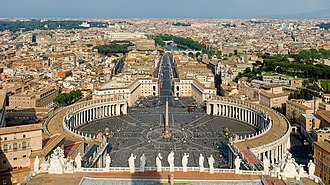
Vatican City is a very small independent country. It became its own state in 1929 through an agreement between Italy and the Pope. Today, it has its own leaders, citizens, flag, and stamps. With fewer than 1,000 people living there, it is the smallest country in the world.
Monaco
Main article: Monaco
Monaco is a tiny independent city-state next to France. It is famous for its casino, royal family, and beautiful harbor. Monaco has its own leaders and governs the same area, though it relies on France for protection.
Singapore
Main article: Singapore
Singapore is an island city-state in Southeast Asia. It has about 6 million people living in an area of 728 square kilometres. Singapore became independent in 1965 after leaving Malaysia. It has its own money, a big airport, busy ports, and a strong army to protect itself.
Contemporary non-sovereign city-states
Some cities are not independent countries but have a lot of self-rule within a larger country. They act like small independent cities even though they belong to a bigger nation. These places are often called "city-states" because they manage many of their own affairs.
Some cities with strong self-rule include:
- Spain: Ceuta and Melilla (as autonomous cities)
- Armenia: Yerevan (as an autonomous city)
- China: Hong Kong and Macau (as special administrative regions)
- South Korea: Sejong (as a self governing city)
- United Kingdom: Gibraltar (as a British Overseas Territory)
- United States: Washington, D.C. (as a federal district)
Other cities that are part of a group of states but have a lot of self-rule include:
- Argentina: Buenos Aires
- Austria: Vienna
- Belgium: Brussels
- Brazil: Brasília
- Germany: Bremen, Berlin and Hamburg
- Nigeria: Lagos
- Mexico: Mexico City
- Malaysia: Malacca, Penang
- Russia: Moscow, Saint Petersburg, and Sevastopol (disputed)
- Switzerland: Basel-Stadt and Geneva
States with similar characteristics
Some small countries today share traits with city-states. Places like Djibouti, Qatar, Brunei, Kuwait, Bahrain, and Malta are mainly focused on one big city. For example, Luxembourg City is so important that the whole country is named after it. However, these places also include smaller towns and rural areas, unlike true city-states like Singapore.
Tiny countries with many people living close together, such as San Marino, are sometimes called city-states even if they do not have one large city.
Proposed city-states
Main article: Urban secession
London
Main article: London independence
Some people want London to become its own city-state, separate from the United Kingdom.
Jerusalem
There have been ideas about Jerusalem becoming an independent city-state protected by the United Nations or international groups. Jerusalem is very important to three major religions—Judaism, Christianity, and Islam—which creates some tensions. Both Israel and Palestine consider Jerusalem their capital, leading to disagreements, especially about East Jerusalem. The UN partition plan for Palestine suggested a special international setup for Jerusalem called Corpus separatum, but this plan was not accepted by Palestinian leaders.
Hong Kong
Sovereign State of the Bektashi Order
Main article: Sovereign State of the Bektashi Order
There is a proposal for a new city-state in Tirana, the capital of Albania, called the Sovereign State of the Bektashi Order. If approved by the Albanian Parliament and a vote by the people, this small state would be led by the Bektashi Order and would be similar to Vatican City. The idea was suggested by Albania’s Prime Minister Edi Rama and the leader of the Bektashi Order Baba Mondi. They believe this could help promote peaceful Muslim values. If created, it would be very small, surrounded by the eastern parts of Tirana, and could become the smallest nation in the world.
Images
Related articles


This article is a child-friendly adaptation of the Wikipedia article on City-state, available under CC BY-SA 4.0.
Images from Wikimedia Commons. Tap any image to view credits and license.