 Safekipedia
Compass
Adapted from Wikipedia · Discoverer experience
A compass is a device that shows the cardinal directions used for navigation and geographic orientation. It typically consists of a magnetized needle or another element, such as a compass card or compass rose, that pivots to align itself with magnetic north. Other methods may be used, including gyroscopes, magnetometers, and GPS receivers.
Compasses often show angles in degrees: north corresponds to 0°, and the angles increase clockwise, so east is 90°, south is 180°, and west is 270°. These numbers allow the compass to show azimuths or bearings which are commonly stated in degrees. If local variation between magnetic north and true north is known, then direction of magnetic north also gives direction of true north.
Among the Four Great Inventions, the magnetic compass was first invented as a device for divination as early as the Chinese Han dynasty (since c. 206 BC), and later adopted for navigation by the Song dynasty Chinese during the 11th century. The first usage of a compass recorded in Western Europe and the Islamic world occurred around 1190.
The magnetic compass is the most familiar compass type. It functions as a pointer to "magnetic north", the local magnetic meridian, because the magnetized needle at its heart aligns itself with the horizontal component of the Earth's magnetic field. The needle is mounted on a low-friction pivot point, so it can turn easily. When the compass is held level, the needle turns until it settles into its equilibrium orientation.
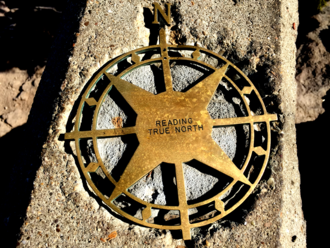
In navigation, directions on maps are usually expressed with reference to geographical or true north, the direction toward the Geographical North Pole, the rotation axis of the Earth. Depending on where the compass is located on the surface of the Earth the angle between true north and magnetic north can vary widely with geographic location. The local magnetic declination is given on most maps, to allow the map to be oriented with a compass parallel to true north.
History
Main article: History of the compass
The compass has a long and interesting history. One of the earliest known uses of magnetism was by the ancient Greeks, who noticed that a special type of rock called lodestone could attract iron. This special rock was found in a place called Magnesia in Anatolia.
In ancient China, people also discovered the magnetic properties of lodestone. They used it to make a "south-pointing spoon" for telling directions. Later, they made compasses from iron needles that were magnetized using lodestone. These compasses helped people find their way during travel and exploration. Over time, compasses were improved, and by the early 20th century, they were made with liquid-filled needles for better accuracy.
Design
Modern compasses usually have a magnetized needle or dial inside a capsule filled with liquid. This liquid helps the needle move smoothly and stay steady. Important parts of the compass, like the north end of the needle, often glow in the dark so you can use the compass even when it's sunny or cloudy.
Many compasses also have extra tools, like a protractor, to help with reading maps and taking directions. They might include special sights to look at faraway objects more clearly or scales to measure distances on maps. Some compasses are made for use on boats and have special designs to stay steady even when the boat moves a lot.
Military compasses sometimes use different designs, like cards instead of needles, and some have special lights to see in the dark. However, these special lights can fade over time.
Compassesa can be tricky near the Earth's magnetic poles, where they might not point correctly. They can also be affected by nearby metal objects or strong magnetic fields, which can make them point in the wrong direction.
Variants
A thumb compass is a special type of compass often used in orienteering, a sport where reading maps and understanding the terrain is very important. These compasses usually do not have many degree markings and are mainly used to line up maps to magnetic north. They often have a large needle or indicator to make it easier to see and are sometimes transparent so that a person can look at their map through the compass.
Other compasses include the earth inductor compass, which uses the Earth's magnetic field to find direction. Small electronic compasses, called eCompasses, are found in devices like mobile phones and use tiny sensors to detect direction. There are also special compasses for different purposes, like the Qibla compass used by Muslims to find the direction to Mecca, and the prismatic compass used by surveyors and explorers for very precise measurements. The luopan is a compass used in practices like feng shui.
Construction
To build a compass, you need a magnetic rod. This can be made by rubbing a piece of iron or steel with a special stone called a lodestone. The magnetized rod is placed on a surface where it can move freely. This allows it to point toward Earth’s magnetic north, helping people find directions.
Early compasses were simple and showed only north and the four main directions: north, south, east, and west. Later, they were divided into more points. Today, most compasses use a system of 360 degrees around the dial. Some places use different systems, but the main idea is the same: to help people know where they are going.
Use
A magnetic compass helps people find directions by pointing toward magnetic north, which is close to but not exactly the same as true north. To get the right direction, you need to adjust for two things: variation and deviation. Variation is the difference between magnetic north and true north, and it changes depending on where you are. Deviation happens when nearby metal objects or electric currents affect the compass.
When using a compass with a map, you can find the exact direction to a place by aligning the compass with the map’s north. Some compasses can adjust for the difference between magnetic north and true north, making it easier to follow the right path. It’s important to keep compasses away from magnets and electronic devices, as these can mess up the readings. Always place the compass on a flat surface so the needle can move freely.
Non-magnetic compasses
There are several ways to find north without using magnetism. Two special tools that help with this are the gyrocompass and the GPS-compass.
A gyrocompass works like a fast-spinning wheel that uses the Earth's rotation to find the direction of true north. It is often used on ships because it is not affected by certain metals inside the ship. Large ships usually depend on gyrocompasses, while smaller boats might use electronic tools or keep magnetic compasses as a safety backup.
GPS receivers can also find directions very accurately by using signals from satellites in space. These tools can tell not only which way you are going but also how fast you are moving. They are very useful because they find true north and are not disturbed by changes in Earth's magnetic field. However, they need to stay connected to the satellites to work properly.
Images
Related articles



This article is a child-friendly adaptation of the Wikipedia article on Compass, available under CC BY-SA 4.0.
Images from Wikimedia Commons. Tap any image to view credits and license.