 Safekipedia
Czechoslovak Socialist Republic
Adapted from Wikipedia · Discoverer experience
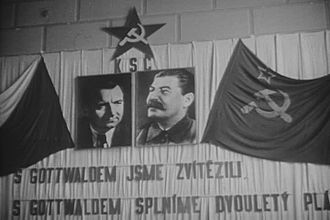
The Czechoslovak Socialist Republic was the name of Czechoslovakia from 1948 until 1989. During this time, the country was ruled by the Communist Party of Czechoslovakia and was closely tied to the Soviet Union. This period began after a big political change called the coup d'état of February 1948, when the Communist Party took control of the government.
At first, the country was called the Czechoslovak Republic, but in 1960, its name was changed to the Czechoslovak Socialist Republic. This change happened when a new set of rules, called the 1960 Constitution of Czechoslovakia, was put in place. The new name showed that the country was now officially a socialist state.
In 1989, people in Czechoslovakia wanted big changes. This led to what is known as the Velvet Revolution, a peaceful movement that ended communist rule. After this, the country's name was changed again in 1990 to the Czech and Slovak Federative Republic. This new name reflected the partnership between the Czech and Slovak parts of the country, which later split into two separate nations, the Czech Republic and Slovakia.
Name
The official name of the country was the Czechoslovak Socialist Republic. This name means "Land of the Czechs and Slovaks". The word "Czech" comes from the name of an old group of people called the West Slavic tribe. During the time this country existed, people often just called it "Czechoslovakia".
History
Main articles: History of Czechoslovakia and History of Czechoslovakia (1948–1989)
Before 1945, Czechoslovakia's leader agreed with Soviet demands, which included taking property from people. In 1945, a new government formed with six parties, but the Communist Party grew strong. By 1946, they won many votes and hoped to fully control the country.
In February 1948, the Communist Party took control of Czechoslovakia with help from the Soviet Union. They changed the government's name to the "Czechoslovak Socialist Republic" in 1960, showing their complete control. In 1968, the Soviet Union and other nearby countries invaded to stop changes that would have made the country more open. In 1989, people protested and ended Communist rule. By 1993, Czechoslovakia split into two countries: the Czech Republic and Slovakia.
Main articles: Normalization (Czechoslovakia) and History of Czechoslovakia (1989–1992)
Geography
The Czechoslovak Socialist Republic was surrounded by several countries. To the west were West Germany and East Germany. To the north was Poland, and to the east was the Soviet Union (through the Ukrainian SSR). To the south were Hungary and Austria.
Politics
Main article: Politics of Communist Czechoslovakia
Further information: Eastern Bloc politics
The Communist Party of Czechoslovakia was the only party that could hold power. After 1948, many members were removed from the party, especially those who had been part of other parties before. Important jobs in the government, military, and businesses were given only to people the party trusted.
The country was part of the group of countries controlled by the Soviet Union. People were not allowed to leave without permission, and there were strict rules for everyone. Even though there were two parts to the country, decisions were mostly made by the central party leaders.
Leaders of the Communist Party
See also: List of presidents of Czechoslovakia and List of prime ministers of Czechoslovakia
Foreign relations
Communist-controlled Czechoslovakia worked with other countries in groups like the Comecon, Warsaw Pact, and the UN.
Administrative divisions
Main article: History of administrative divisions of Czechoslovakia
- 1960–1992: 10 regions (kraje), Prague, and (since 1970) Bratislava; divided in 109–114 districts (Okresy); the kraje were abolished temporarily in Slovakia in 1969–1970 and for many functions since 1991 in Czechoslovakia; in addition, the two internal republics, the Czech Socialist Republic, and Slovak Socialist Republic, were established in 1969.
| Name | Photo | Title | In office |
|---|---|---|---|
| Antonín Novotný | First Secretary | 14 March 1953 – 5 January 1968 | |
| Alexander Dubček | First Secretary | 5 January 1968 – 17 April 1969 | |
| Gustáv Husák | First Secretary / General Secretary | 17 April 1969 – 17 December 1987 as First Secretary 1969–1971 as General Secretary 1971–1987 | |
| Miloš Jakeš | General Secretary | 17 December 1987 – 24 November 1989 | |
| Karel Urbánek | General Secretary | 24 November 1989 – 20 December 1989 | |
| Ladislav Adamec | Chairman | 21 December 1989 – 1 September 1990 |
Economy
Main article: Economy of Communist Czechoslovakia
Further information: Eastern Bloc economies
The Czechoslovak Socialist Republic had a planned economy managed by the communist party, much like the Soviet Union. It focused strongly on making machines and metals but needed to import important materials like iron. Because the government prioritized making machines over everyday products, people often found it hard to get good quality items, leading to shortages.
In the 1950s, the country's economy grew quickly, which helped improve wages and living conditions for many people. The country made many machines, chemicals, and foods, though it used more energy and materials than needed. Agriculture provided most of the country's food but relied on imports during tough weather. Most of Czechoslovakia's trade was with other communist countries.
Demographics
Society and social groups
Main article: Society of Communist Czechoslovakia
In 1962, laws changed to no longer punish people for certain personal choices.
Religion
Main article: Religion in Communist Czechoslovakia
During the time when the government followed strict rules, religious groups faced many challenges. The government took actions to limit the influence of religious institutions and controlled their property. Many religious leaders were sent away for long periods, and the number of priests decreased significantly. By 1991, most people in Czechoslovakia were either Roman Catholic or had no specific religious beliefs, with some also following Evangelical Lutheran traditions. The situation differed between the Czech Republic and Slovakia.
Culture and society
Health, social welfare and housing
Main article: Health and Social Welfare in Communist Czechoslovakia
After World War II, everyone in Czechoslovakia could get free health care. The government focused on preventing illness, with clinics in factories and towns helping people stay healthy. In the 1960s and 1970s, health care in the countryside got much better.
Mass media
Main article: Mass media in Communist Czechoslovakia
Further information: Eastern Bloc information dissemination
The media in Czechoslovakia was managed by the Communist Party of Czechoslovakia (KSČ). People could not own newspapers or radio stations themselves, though some small groups like churches could publish a few papers. All publications were checked by a government office to make sure they followed the rules.
Military
Main article: Czechoslovak People's Army
During the time when Czechoslovakia was led by communist leaders, the country's military was known as the Czechoslovak People's Army. This army was an important part of the nation and was supported by the Soviet Union. It played a role in defending the country and showing loyalty to the communist government that was in power.
Images
Related articles



This article is a child-friendly adaptation of the Wikipedia article on Czechoslovak Socialist Republic, available under CC BY-SA 4.0.
Images from Wikimedia Commons. Tap any image to view credits and license.