 Safekipedia
Federal judiciary of the United States
Adapted from Wikipedia · Discoverer experience
The federal judiciary of the United States is one of the three branches of the U.S. federal government organized under the U.S. Constitution and laws of the federal government. It is different from the state court system, which operates separately. The federal judiciary mainly includes the U.S. Supreme Court, the U.S. courts of appeals, and the U.S. district courts, along with some other special courts.
Article III of the Constitution requires the creation of a Supreme Court and allows Congress to set up additional federal courts and decide what cases they can handle. According to this article, federal judges are chosen by the president and approved by the Senate. Once appointed, they serve for their entire lives unless they step down, are removed by impeachment, or pass away.
Courts
Further information: List of courts of the United States, Federal tribunals in the United States, and State supreme courts of the United States
All federal courts can be recognized because their names include the words "United States" (short for "U.S."). State courts never use this name.
Federal courts are split into two main types: trial courts and appellate courts. Trial courts hear cases first, while appellate courts review decisions made by the lower courts.
U.S. Supreme Court
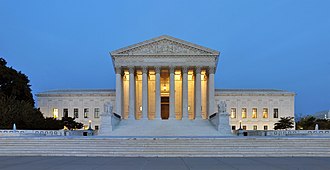
The Supreme Court of the United States is the highest court. It mainly hears appeals from lower courts and can choose which cases to review. It does not automatically hear every case.
U.S. Courts of Appeals
The United States courts of appeals are the middle-level federal courts. They must hear appeals from lower courts. There are 13 groups, or circuits, of these courts across the country. Most decisions can be appealed to the Supreme Court, but for many cases, the Courts of Appeals make the final decision.
U.S. District Courts
The United States district courts are the main federal trial courts. There are 94 of them, spread across the country. Most cases are decided by a single judge.
Other tribunals
Besides these main federal courts, there are other special courts that handle specific types of cases, such as claims related to veterans or taxes. These include courts for bankruptcy, tax issues, and other special areas.
Judges
Further information: List of United States federal judges by longevity of service, List of current United States circuit judges, and List of current United States district judges
Federal judges, including Supreme Court justices, are chosen by the president and approved by the Senate. They stay in their jobs until they decide to leave, are removed for serious reasons, retire, or pass away.
Besides the main courts, Congress can create special groups to help the president with certain tasks. These groups have judges who work for a set time. Some of these judges, called magistrate judges, help in the main courts. Others, known as administrative law judges (including immigration judges), work within government agencies. They help make decisions but cannot make final choices about very important matters like freedom or property without a main court judge reviewing their decisions.
Administration
See also: CM/ECF and PACER (law)
The Judicial Conference of the United States helps make important decisions for the U.S. federal courts. It creates and changes rules for how cases are handled. The Administrative Office of the United States Courts supports the courts by managing their budget, providing secure buildings, and helping with daily operations.
There are also special groups called judicial councils in each circuit that help make sure cases are handled fairly and quickly. The Federal Judicial Center studies and teaches about the federal courts. The Judicial Panel on Multidistrict Litigation groups similar cases from different areas together. The United States Marshals Service protects the courts and helps move people who are waiting for their court cases. Federal Public Defender offices help people who cannot afford lawyers for federal offenses. The Supreme Court Police keep the Supreme Court building safe.
Accountability
See also: Supreme Court of the United States § Criticism and controversies
People who work in the federal courts have fewer protections than in many other jobs. Some who have faced unfair treatment at work have asked for better rules and more open information about gifts that judges receive. This would help everyone know if a judge should step aside from a case because of a conflict of interest or a recusal.
Some believe that judges have taken power away from juries in the United States. Not all Americans trust the courts, with only 35 percent feeling confident in them based on a 2024 poll.
Legal procedure
Further information: Federal Rules of Civil Procedure
The U.S. Supreme Court has said that the Constitution puts some limits on what federal courts can do. For example, there are rules that stop lower courts from giving advice before a real problem exists. There are also rules that stop federal courts from changing decisions made by state courts.
Only the Supreme Court can make decisions about federal law that must be followed by state courts. Decisions from lower federal courts can help guide state courts, but they do not have to be followed exactly.
History
Further information: Judicial appointment history for United States federal courts, Article Three of the United States Constitution, and Judicial reform
The first rules for United States courts were set up before the Constitution, letting Congress create courts for special cases like crimes at sea or fights between states.
When the Constitution started in 1789, it let Congress build the whole federal court system. Only the Supreme Court was required by the Constitution itself. The Judiciary Act of 1789 made the first lower federal courts and the first judges allowed by the Constitution.
Related articles



This article is a child-friendly adaptation of the Wikipedia article on Federal judiciary of the United States, available under CC BY-SA 4.0.