 Safekipedia
Flame test
Adapted from Wikipedia · Discoverer experience
A flame test is a simple way to check if certain elements are present in a sample. Even though it is not very reliable by today’s standards, it used to be an important part of studying chemicals. When we look at flames, we can see different colors depending on what elements are burning. This happens because the energy from the fire makes the electrons in the atoms move, and when they settle back down, they give off light of specific colors.
This idea is connected to how fireworks work and to a more advanced science called atomic emission spectroscopy. By watching the color of the flame, scientists can often guess which elements are in the sample. It’s a quick and easy test that helps us understand what’s inside different materials.
History
Robert Bunsen created the famous Bunsen burner in 1855. This tool was great for flame tests because its flame did not change the colors shown by the materials being tested. With the Bunsen burner and a special tool called a prism, scientists could look at the colors of different elements. In 1860, Bunsen and Gustav Kirchhoff saw new colors—sky-blue and dark red—which helped them find two new metals: caesium and rubidium. Today, people still use this simple method to teach students how to find metals in different samples.
Process
A flame test is a way to check for some elements by heating a sample and watching the color of the flame. The sample can be mixed with special liquid to make it easier to see. Different tools like wooden splints or cotton swabs can be used to hold the sample. It is important to be careful because some substances can catch fire or be harmful.
The color of the flame can change depending on the heat and air. Sometimes, a special glass is used to help see the colors better. However, this test has limits. Not all elements show a clear color, and some colors can be hard to see. The results can also depend on how the test is done.
Principle
In flame tests, tiny particles called ions get heated up. When they heat up, they glow and then calm down, sending out tiny bits of light called photons. The amount of energy in these glowing particles and the light they send out is special to each element. This special glowing and light is what helps us know which element is present. This same glowing idea is used in other tests like flame emission spectroscopy, atomic emission spectroscopy, and flame photometry.
Common elements
Some common elements and their corresponding colors are:
| Symbol | Name | Color | Image |
|---|---|---|---|
| Al | Aluminium | Silver-white, in very high temperatures such as an electric arc, light blue | |
| As | Arsenic | Blue | |
| B | Boron | Bright green |  |
| Ba | Barium | Light apple green |  |
| Be | Beryllium | White | |
| Bi | Bismuth | Azure blue | |
| Ca | Calcium | Brick/orange red; light green as seen through blue glass. | 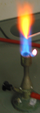 |
| Cd | Cadmium | Brick red | |
| Ce | Cerium | Yellow | |
| Co | Cobalt | Silvery white | |
| Cr | Chromium | Silvery white | |
| Cs | Caesium | Blue-violet | |
| Cu(I) | Copper(I) | Blue-green | |
| Cu(II) | Copper(II) (non-halide) | Green |  |
| Cu(II) | Copper(II) (halide) | Blue-green | |
| Fe(II) | Iron(II) | Gold, when very hot such as an electric arc, bright blue, or green turning to orange-brown | |
| Fe(III) | Iron(III) | Orange-brown |  |
| Ge | Germanium | Pale blue | |
| H | Hydrogen | Pale blue | |
| Hf | Hafnium | White | |
| Hg | Mercury | Red | |
| In | Indium | Indigo blue |  |
| K | Potassium | Lilac invisible through cobalt blue glass (purple) |  |
| Li | Lithium | Carmine red; invisible through green glass | 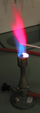 |
| Mg | Magnesium | Colorless due to magnesium oxide layer, but burning Mg metal gives an intense white | |
| Mn(II) | Manganese(II) | Yellowish green | |
| Mo | Molybdenum | Yellowish green | |
| Na | Sodium | Bright yellow; Golden; invisible through cobalt blue glass. See also Sodium-vapor lamp |  |
| Nb | Niobium | Green or blue | |
| Ni | Nickel | Colorless to silver-white | |
| P | Phosphorus | Pale blue-green | |
| Pb | Lead | Blue-white |  |
| Ra | Radium | Crimson red | |
| Rb | Rubidium | Violet red |  |
| S | Sulfur | Blue |  |
| Sb | Antimony | Pale green |  |
| Sc | Scandium | Orange | |
| Se | Selenium | Azure blue | |
| Sn | Tin | Blue-white | |
| Sr | Strontium | Crimson to scarlet red; yellowish through green glass and violet through blue cobalt glass |  |
| Ta | Tantalum | Blue | |
| Te | Tellurium | Pale green | |
| Ti | Titanium | Silver-white | |
| Tl | Thallium | Pure green | |
| V | Vanadium | Yellowish green | |
| W | Tungsten | Green | |
| Y | Yttrium | Carmine, crimson, or scarlet red | |
| Zn | Zinc | Colorless to blue-green | |
| Zr | Zirconium | Mild/dull red |
Related articles


This article is a child-friendly adaptation of the Wikipedia article on Flame test, available under CC BY-SA 4.0.
Images from Wikimedia Commons. Tap any image to view credits and license.