Giro d'Italia
For the women's race, see Giro d'Italia Women.
The Giro d'Italia (pronounced ˈdʒiːro diˈtaːlja; meaning 'Tour of Italy'), also known simply as the Giro, is a yearly multiple-stage road cycling race held mainly in Italy. The first race was organized in (/wiki/1909_Giro_d'Italia) to increase sales of the newspaper La Gazzetta dello Sport, and the race is still run by a subsidiary of that paper's owner. It has been held every year since 1909, except during the two world wars. As the Giro became more famous and popular, the race was made longer, and riders from all over the world joined, not just Italians. The Giro is a UCI World Tour event, so most of the teams in the race are UCI WorldTeams, with some extra teams invited as 'wild cards'.
The Giro is one of the three-week-long Grand Tours of professional cycling. After the Tour de France, it is the second most important stage race in the world. The Triple Crown of Cycling is the achievement of winning the Giro, the Tour, and the UCI Road World Championships in the same season. The Giro is usually held in May, sometimes continuing into early June. The route changes each year, but the format stays the same, with at least two time trials and a trip through the mountains of the Alps, including the Dolomites. Like the other Grand Tours, the modern Giro normally has 21 stages over a 23- or 24-day period that includes two or three rest days.
The rider with the lowest total time is the leader of the general classification and wears the pink jersey. The general classification gets the most attention, but stage wins are prestigious too. There are also other contests within the Giro: the points classification, the mountains classification for climbers, the young rider classification for riders under the age of 25, and the team classification.
Main article: History of the Giro d'Italia
History
The idea for the race came from the Tour de France and the success that L'Auto had with it. The editor of La Gazzetta dello Sport, Tullo Morgagni, first suggested an Italian tour, and the newspaper's rival, Corriere della Sera, was also planning a bicycle race. After the newspaper's earlier races, the Giro di Lombardia and Milan–San Remo, the owner decided to go ahead. The first race began on 13 May 1909 at Piazzale Loreto in Milan, with 127 riders. Luigi Ganna won, and 49 riders finished the race.
Over the following decades, the race was paused from 1915 to 1918 because of the First World War. The rivalry between Gino Bartali and Fausto Coppi divided Italy in the 1940s and 1950s, and Alfredo Binda was the dominant rider of the 1920s. Later, Eddy Merckx won many stages in the 1970s, and Marco Pantani won in 1998. The 2017 race was the 100th edition. In 2024, Tadej Pogačar won on his debut, and in 2025, Simon Yates took the race lead near the end.
Classifications
Main article: List of Giro d'Italia classification winners
Most riders on each team try to win the overall race. Other competitions let different types of riders compete too. These include points, mountains, and a classification for young riders. The general classification is the oldest of the four. Each leader wears a special jersey. If a rider leads more than one classification, he wears the jersey of the most important one. The general classification is the most sought-after prize. Riders' times are added up after each stage, and the rider with the lowest total leads the race. The leader wears a pink jersey. The color was chosen because La Gazzetta dello Sport, the paper that created the Giro, printed on pink paper. Eddy Merckx wore the pink jersey for 78 stages, more than any other rider.
The mountains classification gives points to the first riders to reach the top of each big climb. The points classification is for sprinters, and its leader wears a red jersey. Gianni Motta was the first winner of the points classification. The young rider classification is only for riders who are 25 or younger that year, and its leader wears a white jersey. The Giro also has team classifications and some smaller awards. Some awards are no longer used, such as the black jersey for the last rider overall.
| Type | 1st | 2nd | 3rd | |
|---|---|---|---|---|
 | Flat finish | 10″ | 6″ | 4″ |
| Intermediate Sprint | 3″ | 2″ | 1″ | |
| Tipologia | 1st | 2nd | 3rd | 4th | 5th | 6th | 7th | 8th | 9th | |
|---|---|---|---|---|---|---|---|---|---|---|
 | Cima Coppi | 50 | 30 | 20 | 14 | 10 | 6 | 4 | 2 | 1 |
| First Category | 40 (50) | 18 (24) | 12 (16) | 9 | 6 | 4 | 2 | 1 | - |
| Second Category | 18 | 8 | 6 | 4 | 2 | 1 | - | - | - |
 | Third Category | 9 | 4 | 2 | 1 | - | - | - | - | - |
| Fourth Category | 3 | 2 | 1 | - | - | - | - | - | - |
| Type | 1st | 2nd | 3rd | 4th | 5th | 6th | 7th | 8th | 9th | 10th | 11th | 12th | 13th | 14th | 15th | |
|---|---|---|---|---|---|---|---|---|---|---|---|---|---|---|---|---|
 | Finish/Time Trial | 25 | 20 | 16 | 14 | 12 | 10 | 9 | 8 | 7 | 6 | 5 | 4 | 3 | 2 | 1 |
| Intermediate sprint | 8 | 6 | 4 | 3 | 2 | 1 | ||||||||||
The race
The Giro d'Italia has either 21 or 20 stages, plus a short prologue (an individual time trial under 8 km (5 mi) long) and two or three rest days. There are three kinds of stages: mass-start stages, individual time trials, and team time trials. Most of the 21 racing days are mass-start stages. Each Giro usually has two time trials, and sometimes three. In mass-start stages, the first three finishers get time bonuses of 10, 6, and 4 seconds. In some years, riders also get bonuses of 3, 2, and 1 seconds at intermediate sprints. Italian sprinter Mario Cipollini holds the record for the most stage wins, with 42.
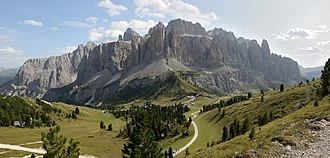
The Giro is known for its steep and difficult climbs. The race traditionally passes through the Alps, with some of the longest climbs in the Dolomites. The first Alpine pass used was the Sestriere in (/wiki/1911_Giro_d'Italia). The Dolomites were first used in (/wiki/1937_Giro_d'Italia), when the race crossed the Rolle Pass and the Passo di Costalunga. Some of the most famous mountains in the Giro are the Passo dello Stelvio, Passo Pordoi, and Passo di Gavia. Since (/wiki/1965_Giro_d'Italia), the highest point of the Giro has been called the Cima Coppi, in honor of the great Italian climber Fausto Coppi.
The first Giro time trial, held in (/wiki/1933_Giro_d'Italia), covered 62 km (39 mi) between Bologna and Ferrara and was won by Alfredo Binda. Some editions have ended with a time trial, and some have included a mountain time trial. Modern Giros often start with a short trial called a prologue, which decides who wears pink on the first day. The first prologue was held in the 1968 Giro d'Italia around the streets of Campione d'Italia and was won by Frenchman Charly Grosskost. The first team time trial took place in the 1937 Giro d'Italia. The Italian team Legnano won it on a 60 km (37 mi) course from Viareggio to Marina di Massa.
The start and finish of the Giro
Main article: List of Giro d'Italia starts
For almost 50 years, the Giro started and finished in Milan, where the headquarters of the Gazzetta dello Sport is located. In (/wiki/1911_Giro_d'Italia), these events took place in Rome to celebrate the 50th anniversary of Italy's unification. Apart from rare exceptions, Milan was the usual start and finish. Since the 1960s, however, the starting city has changed each year, and finishes in cities such as Verona, Brescia, Trieste, Turin and Rome have become more common.
Cities spend a lot of money to host the start of the Giro, which they call La Grande Partenza, hoping to earn it back through tourism, attention and other benefits. Denmark spent an estimated $3.86 million to host the opening stages of the 2012 edition. Bulgaria spent an estimated €48.5 million to host the opening stages of the 2026 edition.
Starts outside Italy
For the first 47 editions, the race started in Italy. In (/wiki/1965_Giro_d'Italia), it made its first start in another country, San Marino, and has since had twelve more foreign starts. The 2018 start in Jerusalem was met with controversy, as activists called for the race to be moved because they said it hid problems with Israel's human rights record. The race went ahead as planned, and every team selected for the Giro took part, including two teams with Arabic ownership: the Bahrain-Mérida team and the United Arab Emirates team. The planned start of the 2020 race in Hungary was cancelled because of the COVID-19 pandemic.


Media coverage
The Giro is broadcast across Europe and is also available in other parts of the world:
- Europe: Eurosport
- Italy: Rai Sport
- France: L'Équipe TV
- United States: HBO Max
Related events
A women's version of the Giro, called the Giro d'Italia Women, has been held since 1988. It is part of the UCI Women's World Tour and is one of the longest races in women's professional cycling. It usually lasts eight to ten days. Since 2024, RCS Sport has run the race, which is also the company that runs the men's race.
A race for riders under 23 years old was first held in 1970. It is now called Giro Next Gen, and RCS Sport also runs this race.

Quiz time!
5 questions about Giro d'Italia
Why was the Giro d'Italia first started?
Pictures
Keep exploring




This article is a child-friendly adaptation of the Wikipedia article on Giro d'Italia, available under CC BY-SA 4.0.
Images from Wikimedia Commons. Tap any image to view credits and license.