 Safekipedia
History of Los Angeles
Adapted from Wikipedia · Discoverer experience
The modern history of Los Angeles began in 1781 when 44 settlers from central New Spain (modern Mexico) established a permanent settlement in what is now Downtown Los Angeles. This settlement was instructed by Spanish Governor of Las Californias, Felipe de Neve, and authorized by Viceroy Antonio María de Bucareli.
After sovereignty changed from Mexico to the United States in 1849, Los Angeles saw great changes. The completion of the Santa Fe railroad line from Chicago to Los Angeles in 1885 brought many new people, mostly White Protestants from the Midwest and Upland South.
Los Angeles grew quickly, with a strong economy based on farming, oil, tourism, real estate, and movies. Its motion picture industry made the city world-famous, and World War II brought new industry, especially high-tech aircraft construction. The city developed many suburban areas and built many freeways.
Since the 1960s, growth has slowed, and traffic delays have become well-known. New arrivals, especially from Mexico and Asia, changed the city's population. While old industries like farming, oil, military, and aircraft have declined, tourism, entertainment, and high-tech industries remain strong. Droughts and wildfires have become more frequent, putting pressure on the city's water security.
Indigenous history
By 3000 BCE, people who spoke the Hokan language lived in the area. They fished, hunted sea animals, and gathered wild seeds. Later, new people arrived, possibly because of drought, and they spoke a Uto-Aztecan language called Tongva. The Tongva called the Los Angeles region Yaa.
By the 1700s CE, there were many native people in California, including about 5,000 in the Los Angeles basin. The Tongva lived on land covering about 4,000 square miles (10,000 km2), including areas near the Los Angeles and San Gabriel rivers and islands such as Santa Barbara, San Clemente, Santa Catalina, and San Nicolas. They traded with nearby groups like the Chumash, Cahuilla, Mojave, Juaneños, and Luiseños.
The Tongva had their own beliefs and traditions. They believed in gods and held special ceremonies. They used natural plants in their rituals. Their language was called Kizh or Kij. Before Europeans arrived, the Tongva had chosen good places to live, especially near the Los Angeles River, where a village called Yaanga provided food and help to later settlers.
Spanish era
Further information: Pueblo de Los Angeles
In 1542 and 1602, the first Europeans to visit the area were Captain Juan Rodríguez Cabrillo and Captain Sebastián Vizcaíno. The first permanent settlement began when the Portolá expedition arrived on August 2, 1769.
Plans for the pueblo
Although Los Angeles was founded by families from Sonora, it was the Spanish governor who gave the town its name.
In 1777, Governor Felipe de Neve visited Alta California and decided to create towns to support the military. He chose Santa Barbara, San Jose, and Los Angeles for these new towns. His plans followed Spanish city rules made by King Philip II in 1573. These rules helped shape the biggest towns in the area, including Los Angeles.
The Spanish plan called for a central square with a church, government buildings, and streets in a grid. This layout included space for farming and homes.
Pobladores
Main article: Los Angeles Pobladores
The Pobladores were the 22 adults and 22 children from Sonora who founded Los Angeles. Most were of mixed heritage. In December 1777, leaders approved the founding of Los Angeles and a military post at Santa Barbara.
The leader in charge of finding settlers could only gather 12 settlers and 45 soldiers after searching many places. They, like others in New Spain, had mixed backgrounds.
The official founding date of the city is September 4, 1781. The families arrived from New Spain earlier that year, and some had already started working on their land.
Spanish pueblo
The town grew as more people arrived. In 1784, a small chapel was built. By 1800, there were 29 buildings around the central square. By 1821, Los Angeles had become a thriving farming town, the largest in Southern California.
The Spanish gave Los Angeles about five miles of land on each side. Each settler got land for farming. When they arrived, the area had lots of trees, rivers, and animals like deer and bears. There were also many fish in the rivers.
The first settlers built a system of ditches to bring water from the river to their farms. Indians helped bring fresh water and worked for the settlers, who paid them with goods and sometimes money.
In the 1780s, San Gabriel Mission faced a revolt from Indians who were unhappy with being forced to work on land they used to own. A young Indian leader, Toypurina, led an attack on the mission but was caught.
In 1787, new rules were made to protect Indians and give them more choices about where to live. In 1795, a group traveled through areas now known as the Simi Valley, Conejo-Calabasas region, and San Fernando Valley, observing Indians working on farms and ranches.
Marriages between settlers and Indians began soon after the town was founded. By 1811, Los Angeles had over five hundred people. In 1820, a new road was built connecting Los Angeles to San Francisco Bay.
Mexican era
Mexico became independent from Spain in 1821, and people in places like Los Angeles celebrated by raising the Mexican flag. This brought new opportunities, and the population grew from about 650 people in 1820 to nearly 1,680 by 1841.
Los Angeles became an official city in 1835 and was the main city of the region. New stores opened, and trade grew, especially after the Mexican government made mission lands available. Many new people arrived from the United States and Europe. One man, Jean-Louis Vignes, planted a big vineyard and made wine, which became very popular in California. 1
1
Early American era
In 1849, Lieutenant Edward Ord surveyed Los Angeles to confirm and extend the streets of the city. His survey put the city into the real-estate business, creating its first real-estate boom and filling its treasury. Street names were changed from Spanish to English. Further surveys and street plans replaced the original plan for the pueblo with a new civic center south of the Plaza and a new use of space.
During the Gold Rush years in northern California, Los Angeles became known for its role in supplying beef and other foodstuffs to hungry miners in the north. With the temporary absence of a legal system, the city quickly was submerged in lawlessness.
John Gately Downey, the seventh governor of California was sworn into office on January 14, 1860, thereby becoming the first governor from Southern California.
Plight of the Indigenous
Los Angeles was incorporated as a U.S. city on April 4, 1850. Five months later, California was admitted into the Union. Although the Treaty of Guadalupe Hidalgo required the U.S. to grant citizenship to the Native Americans of former Mexican territories, it did not happen for another 80 years. The Constitution of California deprived Indians of any protection under the law, considering them as non-persons.
With the coming of the U.S. citizens, disease took a great toll among the Native Americans. Self-employed Natives were not allowed to sleep over in the city.
Industrial expansion and growth
In the 1870s, Los Angeles was still little more than a village of 5,000. By 1900, there were over 100,000 occupants of the city.
By the 1880s, families began moving out of Aliso Street near Chinatown to more upscale neighborhoods which transformed residences into boarding houses or parlor houses.
Los Angeles grew into a major tourist spot in the late 1800s with the establishment of new transportation networks, and hotels.
Much of Los Angeles County was farmland, with an emphasis on cattle, dairy products, vegetables and citrus fruits. After 1945, most of the farmland was converted into housing tracts.
Early transportation and railroads
The city's first railroad, the Los Angeles & San Pedro Railroad, was inaugurated in October 1869 by John G. Downey and Phineas Banning. It ran 21 miles (34 km) between San Pedro and Los Angeles.
The town continued to grow at a moderate pace. Railroads finally arrived to connect with the Central Pacific and San Francisco in 1876. The impact was small. Much greater was the impact of the Santa Fe system (through its subsidiary California Southern Railroad) in 1885. The Santa Fe and Southern Pacific lines provided direct connections to the East, competed vigorously for business with much lower rates, and stimulated economic growth, bringing in tens of thousands of new residents, primarily from the Midwest. Tourists poured in by the thousands every week, and many planned on returning or resettling.
The city still lacked a modern harbor. Phineas Banning excavated a channel out of the mud flats of San Pedro Bay leading to Wilmington in 1871. Banning had already laid track and shipped in locomotives to connect the port to the city. Harrison Gray Otis, founder and owner of the Los Angeles Times, and a number of business colleagues embarked on reshaping southern California by expanding that into a harbor at San Pedro using federal dollars.
This put them in conflict with Collis P. Huntington, president of the Southern Pacific Company and one of California's "Big Four" investors in the Central Pacific and Southern Pacific.
During the late 1800s the construction of the Southern Pacific Railroad was conducted by Chinese workers. The Southern Pacific Railroad connected Los Angeles to San Francisco. It played an important role in the economic and industrial growth in both the state of California and the city of Los Angeles.
In 1876 the Newhall railroad tunnel located 27 miles (43 km) north of Los Angeles between the town of San Fernando and Lyons Station Stagecoach Stop (now Newhall) was completed, providing the final link from San Francisco to Los Angeles for the railroad. The 6,940-foot-long railroad tunnel (2,115.3 m) took a year and a half to complete. More than 1,500 mostly Chinese laborers took part in the tunnel construction, which began at the south end of the mountain on March 22, 1875.
The San Pedro forces eventually prevailed (though it required Banning and Downey to turn their railroad over to the Southern Pacific). Work on the San Pedro breakwater began in 1899 and was finished in 1910. Otis Chandler and his allies secured a change in state law in 1909 that allowed Los Angeles to absorb San Pedro and Wilmington, using a long, narrow corridor of land to connect them with the rest of the city.
Streetcar service in Los Angeles began with horsecars (1874–1897), cable cars (1885–1902) and electric streetcars starting in 1887–1963. In 1898, Henry Huntington and a San Francisco syndicate led by Isaias W. Hellman purchased five trolley lines, consolidated them into the Los Angeles Railway (the 'yellow cars') and two years later founded the Pacific Electric Railway (the 'red cars'). Los Angeles Railway served the city and the Pacific Electric Railway served the rest of the county. At its peak, Pacific Electric was the largest electrically operated interurban railway in the world. Over 1,000 miles (1,600 km) of tracks connected Los Angeles with Hollywood, Pasadena, San Pedro, Long Beach, Venice Beach, Santa Monica, even as far as Riverside, San Bernardino, Santa Ana, and Newport Beach.
Old Chinatown
First built in the 1860s, Old Chinatown in Los Angeles was once located on the site of what now is Union Station. Old Chinatown was centered on Alameda Street which was also where the former Red Light district of Los Angeles was. In 1984, an archaeological excavation of El Pueblo de Los Angeles Historical Monument led by John Romani uncovered several artifacts of Chinese, Euro- American, and Native American origin. There were historic features that were also found which dated to early Euro-American and Chinese American establishments.
Although there had been some anti-Chinese behavior in the preceding decades, editorial attacks in the local press beginning just before 1870 was followed by increased attacks. The Los Angeles Chinese massacre of 1871, a racial massacre targeting Chinese immigrants occurred on October 24, 1871 when approximately 500 white and Hispanic Americans attacked, harassed, robbed, and murdered the ethnic Chinese residents. Nineteen Chinese immigrants were killed, fifteen of whom were later hanged by the mob in the course of the riot.
Oil discovery
Oil was discovered by Edward L. Doheny in 1892, near the present location of Dodger Stadium. The Los Angeles City Oil Field was the first of many fields in the basin to be exploited, and in 1900 and 1902, respectively, the Beverly Hills Oil Field and Salt Lake Oil Field were discovered a few miles west of the original find. Los Angeles became a center of oil production in the early 20th century, and by 1923, the region was producing one-quarter of the world's total supply; it is still a significant producer, with the Wilmington Oil Field having the fourth-largest reserves of any field in California.
Early labor movements
At the same time that the Los Angeles Times was spurring enthusiasm for the expansion of Los Angeles, the newspaper was also trying to turn it into a union-free or open shop town. Fruit growers and local merchants who had opposed the Pullman strike in 1894 subsequently formed the Merchants and Manufacturers Association (M & M) to support the Times's anti-union campaign.
The California labor movement, with its strength concentrated in San Francisco, largely had ignored Los Angeles for years. However, in 1907, the American Federation of Labor decided to challenge the open shop. In 1909, the city fathers placed a ban on free speech from public streets and private property except for the Plaza.
On Christmas Day, 1913, police attempted to break up an rally of 500 taking place in the Plaza. Encountering resistance, the police waded into the crowd attacking them with their clubs. One citizen was killed. In the aftermath, the authorities attempted to impose martial law in the wake of growing protests.
The open shop campaign continued from strength to strength, although not without meeting opposition from workers. By 1923, the Industrial Workers of the World had made considerable progress in organizing the longshoremen in San Pedro and led approximately 3,000 men to walk off the job.
Flooding and water supply
The Los Angeles River flowed clear and fresh all year, supporting 45 Tongva villages in the area. The source of the river was the aquifer under the San Fernando Valley, supplied with water from the surrounding mountains.
Early settlers were more than a little discouraged by the region's diverse and unpredictable weather. They watched helplessly as long droughts weakened and starved their livestock, only to be drowned and carried off by ferocious storms. During the years of little rain, people built too close to the riverbed, only to see their homes and barns later swept to sea during a flood. The location of the Los Angeles Plaza had to be moved twice because of previously having been built too close to the riverbed. Worse, floods changed the river's course. When the settlers arrived, the river joined Ballona Creek to discharge in Santa Monica Bay. A fierce storm in 1835 diverted its course to Long Beach, where it stays today.
Some of the most concentrated rainfall in the history of the United States has occurred in the San Gabriel Mountains north of Los Angeles and Orange Counties.
The greatest daily rainfall recorded in California was 26.12 inches on January 23, 1943, at Hoegees near Mt. Wilson in the San Gabriel Mountains.
Quibbling between city and county governments delayed any response to the flooding until a massive storm in 1938 flooded Los Angeles and Orange counties. The federal government stepped in. To transfer floodwater to the sea as quickly as possible, the Army Corps of Engineers paved the beds of the river and its tributaries. The corps also built several dams and catchment basins in the canyons along the San Gabriel Mountains to reduce the debris flows. It was an enormous project, taking years to complete.
Today, the Los Angeles River functions mainly as a flood control.
The drilling of wells and pumping of water from the San Fernando Valley aquifer dried up the river by the 1920s. By 1980, the aquifer was supplying drinking water for 800,000 people. In that year, it was discovered that the aquifer had been contaminated.
For its first 120 years, the Los Angeles River supplied the town with ample water for homes and farms. It was estimated that the annual flow could have supported a town of 250,000 people—if the water had been managed right. But Angelenos were among the more profligate users of water in the world. In the semi-arid climate, they were forever watering their lawns, gardens, orchards, and vineyards. Later, they needed more to support the growth of commerce and manufacturing. By the beginning of the 20th century, the town realized it quickly would outgrow its river and would need new sources of water.
Legitimate concerns about water supply were exploited to gain backing for a huge engineering and legal effort to bring more water to the city and allow more development. The city fathers had their eyes on the Owens River, about 250 miles (400 km) northeast of Los Angeles in Inyo County, near the Nevada state line. It was a permanent stream of fresh water fed by the melted snows of the eastern Sierra Nevada. It flowed through the Owens River Valley before emptying into the shallow, saline Owens Lake, where it evaporated.
Sometime between 1899 and 1903, Harrison Gray Otis and his son-in-law successor, Harry Chandler, engaged in successful efforts at buying cheap land on the northern outskirts of Los Angeles in the San Fernando Valley. At the same time, they enlisted the help of William Mulholland, chief engineer of the Los Angeles Water Department (later the Los Angeles Department of Water and Power or LADWP), and J.B. Lippencott, of the United States Reclamation Service.
Lippencott performed water surveys in the Owens Valley for the Service while secretly receiving a salary from the City of Los Angeles. He succeeded in persuading Owens Valley farmers and mutual water companies to pool their interests and surrender the water rights to 200,000 acres (800 km2) of land to Fred Eaton, Lippencott's agent and a former mayor of Los Angeles. Lippencott then resigned from the Reclamation Service, took a job with the Los Angeles Water Department as assistant to Mulholland, and turned over the Reclamation Service maps, field surveys and stream measurements to the city. Those studies served as the basis for designing the longest aqueduct in the world.
By July 1905, the Times began to warn the voters of Los Angeles that the county would soon dry up unless they voted bonds for building the aqueduct. Artificial drought conditions were created when water was run into the sewers to decrease the supply in the reservoirs and residents were forbidden to water their lawns and gardens.[citation needed]
On election day, the people of Los Angeles voted for $22.5 million worth of bonds to build an aqueduct from the Owens River and to defray other expenses of the project. With this money, and with an Act of Congress allowing cities to own property outside their boundaries, the city acquired the land that Eaton had acquired from the Owens Valley farmers and started to build the aqueduct. On the occasion of the opening of the Los Angeles Aqueduct on November 5, 1913, Mulholland's entire speech was five words: "There it is. Take it."
20th century
Hollywood
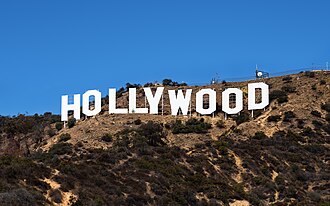
Hollywood has been linked worldwide with movies for over a hundred years. It became a city in 1903 but joined Los Angeles in 1910. In the early 1900s, filmmakers from New York moved there because the sunny weather was perfect for filming all year. It grew into the heart of movie-making in the United States, becoming home to actors, directors, and singers, and also helped grow television and music industries.
Notable events
Los Angeles hosted the Summer Olympics in 1932. The Los Angeles Memorial Coliseum, opened in 1923, was expanded to hold over 100,000 people for Olympic events. Olympic Boulevard still honors this time today and is still used by the USC Trojans football team.
Annexations and consolidations
The City of Los Angeles stayed within its original boundaries until the 1890s. The first big additions were Highland Park and Garvanza to the north, and the South Los Angeles area. In 1906, the city annexed the Shoestring, a narrow strip of land leading to the Port of Los Angeles. The port cities of San Pedro and Wilmington joined in 1909, and Hollywood became part of Los Angeles in 1910. This brought the city up to 90 square miles and gave it a unique shape. More areas joined over the years, growing the city to 450 square miles by 1932.
Civic corruption and police brutality
In the early 1900s, there was a lot of corruption in Los Angeles City Hall and the Los Angeles Police Department. Some city leaders took money from business owners who wanted to operate without following the rules. In 1937, a citizen named Clifford Clinton started a campaign to clean up city government. With the help of Judge Fletcher Bowron, changes were made to make the police department more professional and less influenced by politics.
LAX: Los Angeles International Airport
Mines Field opened as a private airport in 1930 and was bought by the city in 1937. It was renamed Los Angeles Airport in 1941 and became Los Angeles International Airport in 1949. Before LAX, most flights were at Hollywood Burbank Airport and Grand Central Airport in Glendale. Since then, LAX has grown a lot, with many hotels and warehouses built nearby.
World War II
During World War II, Los Angeles became a key place for making airplanes, ships, and war supplies. Many companies in the area helped build aircraft like the B-17s, B-25s, A-36s, and P-51 Mustangs. The city grew quickly because so many people came to work in these factories.
Postwar: Baby boomers
After the war, many developers bought land cheaply and built homes, changing Southern California’s main industry to real estate. In 1955, Walt Disney opened Disneyland in Anaheim, and Universal Studios opened a theme park in 1964. Major League Baseball teams the Dodgers and Giants moved to Los Angeles and San Francisco in 1958. California’s population grew to nearly 20 million by 1970. Los Angeles became a big center for making cars, tires, furniture, and clothes. Construction boomed with new homes built for veterans and others.
Racially restrictive housing covenants
For many years, housing rules in Los Angeles stopped people of certain races from buying homes in many neighborhoods. These rules, called covenants, were agreements that said only certain people could live in a home. They often kept out people who were not white. These rules were used to keep neighborhoods separated by race and class. They were finally stopped by court decisions in the late 1940s and 1950s.
Economic and demographic changes
In the 1990s, many factories in Los Angeles closed down, and jobs moved away. But the film, television, and music industries stayed strong. The ports of Los Angeles and Long Beach became very important for trade, bringing in many jobs. Downtown Los Angeles started to change with new homes and buildings built in old commercial areas. The city’s population also changed, with more Latino, Asian, and other groups moving in over the years.
1980s
In the 1980s, Los Angeles saw many street gangs grow and drugs become a big problem. There was also a growing difference between rich and poor people in the city. New public transportation systems were built, including subways and light rail, though some plans faced delays and problems.
1990s
In 1992, after a police beating of Rodney King was shown on TV and the officers were not found guilty, riots broke out in Los Angeles. Sadly, many people died and there was a lot of damage to property. In 1994, a big earthquake hit the city, causing a lot of damage and some deaths. That same year, a famous trial involving a celebrity also caused a lot of discussion and feeling among people in the city.
21st century
2000s
By the end of the 1900s, some areas of Los Angeles felt disconnected from city decisions, leading to votes to split the city. These votes were rejected in 2002.
James Hahn became mayor in 2001.
Antonio Villaraigosa became mayor in 2005.
In 2007, Hollywood writers stopped working because they wanted to be paid more for movies sold on DVD. This stopped TV and movie making for a while. The writers got some wins, but they stopped working again in 2023.
2010s
Eric Garcetti became mayor in 2013.
In 2017, Los Angeles was chosen to host the 2028 Summer Olympics. The city promised to improve public transportation, but by 2024, many projects were delayed.
In 2018, a big fire damaged parts of Los Angeles. The fire was caused by mistakes made by a utility company.
2020s
In 2020, a helicopter crash happened in cloudy weather, and Kobe Bryant, a famous basketball player for the Lakers, was among those who died. Many people in Los Angeles were shocked.
The COVID-19 pandemic began in Los Angeles in 2020. The city closed many places, including schools and parks. A stay-at-home order was put in place.
During the summer of 2020, Los Angeles saw large protests about unfair treatment of Black people, following an event in Minnesota. There were some disturbances during these protests.
In 2021, Los Angeles had many cases of COVID-19. Over the next few years, the disease returned each summer.
Karen Bass became mayor in 2022. There were concerns about some officers in the sheriff’s department.
In 2023, Hollywood writers stopped working again because they were worried about artificial intelligence taking their jobs. TV and movie making stopped, but the writers got some of what they wanted.
In early 2025, a series of wildfires affected the Los Angeles area. These fires caused damage to many homes and forced many people to leave. The fires were made worse by dry weather and strong winds.
In June 2025, Los Angeles had protests, and federal forces were sent to help.
Population history
Los Angeles grew quickly over the years. By 1900, the city had more than 100,000 people. By 1930, it had over a million, and by 1960, more than two million. In 1990, the population passed three million. Around 1982, Los Angeles became the second largest city in the United States, just behind Chicago, with about 3.02 million people.
By 2020, Los Angeles had grown to about 3.9 million residents.
_Sources: Historical Census Populations of Counties and Incorporated Cities in California, 1850–2010
| Year | Population | Growth |
|---|---|---|
| 1790 | 131 | — |
| 1800 | 315 | 184 |
| 1810 | 365 | 50 |
| 1820 | 650 | 285 |
| 1830 | 1,300 | 650 |
| 1840 | 2,240 | 940 |
| 1850 | — | — |
| 1860 | 4,385 | — |
| 1870 | 5,730 | 1,345 |
| 1880 | 11,200 | 5,470 |
| 1890 | 50,400 | 39,200 |
| 1900 | 102,500 | 52,100 |
| 1910 | 319,200 | 216,700 |
| 1920 | 576,700 | 257,500 |
| 1930 | 1,238,048 | 661,348 |
| 1940 | 1,504,277 | 266,229 |
| 1950 | 1,970,358 | 466,081 |
| 1960 | 2,479,015 | 508,657 |
| 1970 | 2,816,061 | 337,046 |
| 1980 | 2,966,850 | 150,789 |
| 1990 | 3,485,398 | 518,548 |
| 2000 | 3,694,820 | 209,422 |
| 2010 | 3,792,621 | 97,801 |
| 2020 | 3,898,747 | 106,126 |
Images
Related articles



This article is a child-friendly adaptation of the Wikipedia article on History of Los Angeles, available under CC BY-SA 4.0.
Images from Wikimedia Commons. Tap any image to view credits and license.