Honey
Honey is a sweet, thick substance made by several kinds of bees, and the best known of these are honey bees. Bees make and store honey to feed their colonies. They collect sugary liquids from plants, mostly flower nectar, or from other insects, such as the honeydew made by aphids. The honey is refined both inside the bees' bodies and later in the hive, where water evaporates and leaves a thick, sugary liquid.
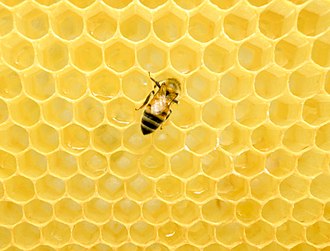
Honey bees store their honey in the hive, inside a structure made of beeswax called honeycomb. The honeycomb is made of hundreds or thousands of six-sided cells, where the bees put honey to save for later. Other honey-making bees store it in different ways. For example, the stingless bee keeps its honey in small pots made of wax and resin.
People collect honey from wild bee colonies or from hives of bees that are cared for by humans. Honey from honey bees is the kind people know best, because it is produced and sold all over the world. Caring for bees is called beekeeping or apiculture, and raising stingless bees is usually called meliponiculture.
Honey tastes sweet because it contains a lot of the sugars fructose and glucose. It is about as sweet as sucrose, which is ordinary table sugar. Honey also has useful qualities for baking and a distinctive flavor. Because honey has so much sugar and is acidic, many tiny living things cannot grow in it, so properly stored honey does not spoil. Honey found at ancient archaeological sites has been proven to be safe to eat even after thousands of years.
People have used honey since prehistoric times. Cave paintings in Cuevas de la Araña in Spain show people gathering honey at least 8,000 years ago. The honey bee Apis mellifera is an Old World insect, while the New World stingless bees were raised on a large scale by the Mayans since pre-Columbian times.
Formation
Honey bees make honey from nectar or honeydew and store it to feed the colony. Bees use its sugars for metabolic activity, which powers their flight muscles while foraging, and as food for their larvae. They save honey for hard times, such as overwintering. Most nectar is not eaten right away. It is regurgitated, broken down by enzymatic digestion, and then kept in storage as honey. Nectar usually has 70 to 80% water, while finished honey has about 18%. Honeydew from aphids and other true bugs is close to the sap those insects feed on. A bee sucks up these liquids through its proboscis into its honey stomach. In Apis mellifera, this stomach holds about 40 mg, which can take visits to more than one thousand flowers to fill. Salivary juices and proteins from the hypopharyngeal gland are added, and these substances start cleaving complex sugars like sucrose and starches into simpler sugars such as glucose and fructose. Hive bees pass the nectar along and bubble it between their mandibles so that water evaporates into the warm hive air. Until the honey is ready, its water content is high enough for ubiquitous yeast spores to reproduce and consume its sugars, so bees use an endogenous ability to make heat. Evaporation continues until the honey reaches 15.5% to 18% water. This makes it a supercooled solution, with more sugar than the saturation point of water would normally allow. For osmotic reasons, this much sugar stops fermentation. Bees then seal the cells with wax, and honey can last indefinitely, even after a beekeeper removes it.
Honey bees are not the only eusocial insects that make honey. All non-parasitic bumblebees and stingless bees do, and some wasps, such as Brachygastra lecheguana and Brachygastra mellifica, found in South and Central America, feed on nectar to make honey. Other wasps, such as Polistes versicolor, also eat honey, which is a far denser source of food energy than pollen. Humans have semi-domesticated several honey bee species by using their swarming stage, when a new colony can be moved into a Langstroth hive. People then harvest the honey, pollen, wax and resins the bees produce. Because swarms can still leave and form wild colonies, the term "semi-domesticated" is preferred. Commercial beekeepers often add honey supers, which are empty boxes placed on top of a hive, so the bees build more honeycomb instead of swarming.
Production
Honey is collected from wild bee colonies or from domesticated beehives. On average, a hive produces about 29 kilograms (65 lb) of honey per year. Wild nests are sometimes found by following a honeyguide bird. To collect honey safely, beekeepers usually calm the bees with a bee smoker. The smoke makes the bees less aggressive and hides the pheromones they use to communicate. The honeycomb is removed, and the honey is taken out by crushing it or by using a honey extractor. The honey is then usually filtered to remove beeswax and other debris. Before removable frames were invented, bee colonies were often sacrificed during the harvest and replaced the next spring. Since then, most beekeepers make sure their bees have enough food to survive winter, either by leaving some honey in the hive or by giving them sugar water or crystalline sugar, often called a "candyboard." How much food is needed depends on the type of bee and how long and harsh the local winters are. Many animal species are attracted to wild or domestic honey.
Honey is well suited to long-term storage because of its makeup and chemical properties, and it is still easy to digest after a long time. Honey, and objects placed in honey, have been preserved for centuries. (However, no edible honey has been found in Egyptian tombs; all such cases were other substances or only chemical traces.) The key to preservation is keeping moisture away. Cured honey has enough sugar to stop fermentation. If it is exposed to moist air, its hydrophilic properties pull moisture in, slowly diluting it until fermentation can begin. The long shelf life of honey is linked to an enzyme found in the stomach of bees. Bees mix glucose oxidase with nectar they had previously consumed, creating two byproducts, gluconic acid and hydrogen peroxide, which partly cause honey's acidity and stop bacteria from growing.
Adulteration
Honey is sometimes adulterated by adding other sugars, syrups or compounds. This may be done to change its flavour or thickness, lower production costs, or raise the fructose content, which can stop crystallization. Adulteration has been recorded since ancient times, when honey was mixed with plant syrups such as maple, birch or sorghum syrup and sold as pure honey. Today, clear, nearly flavourless corn syrup is the most common adulterant, and it can be hard to tell from real honey. The Codex Alimentarius of the United Nations says products labelled "honey" or "pure honey" must not be adulterated, though labelling rules vary between countries.
Scientists use tests such as Isotope ratio mass spectrometry to find added cane sugar or corn syrup by checking carbon isotopic signatures. No single test can detect every type of adulteration. In 2023, world honey production was 1.9 million tonnes, led by China, with Turkey, Ethiopia, and Iran as secondary producers.
 China | 463,500 |
 Turkey | 114,886 |
 Ethiopia | 84,591 |
 Iran | 80,389 |
 Argentina | 73,395 |
 United States | 62,855 |
| World | 1,893,805 |
| Source: FAOSTAT of the United Nations | |
Modern uses
Main article: Mellivory
Honey is used in cooking, baking, and desserts, as a spread on bread, and in drinks such as tea. It is also a sweetener in some commercial drinks. Because honey gives a lot of energy, it is an important food for almost all hunter-gatherer cultures in warm climates. The Hadza people rank honey as their favorite food. Honey hunters in Africa have a mutualistic relationship with certain species of honeyguide birds.
Possibly the world's oldest fermented beverage, dating from 9,000 years ago, is mead, also called "honey wine." It is made by adding yeast to honey-water must and fermenting it for weeks or months. The yeast Saccharomyces cerevisiae is commonly used in modern mead production. Mead comes in many varieties, including metheglin (with spices or herbs), melomel (with fruit juices, such as grape, called pyment), hippocras (with cinnamon), and sack mead (with a high concentration of honey). Many of these have been developed as commercial products, and there are hundreds of them in the United States. Honey is also used to make a mead beer called "braggot."
Physical and chemical properties
Honey's physical properties change with its water content, the flowers it comes from (pasturage is not linked; keep plain), temperature, and its sugars. Fresh honey is a supersaturated liquid, meaning it holds more sugar than water can usually dissolve. At room temperature, honey is a supercooled liquid, where glucose forms solid precipitated crystals within a thicker mixture of fructose and other ingredients. Honey has a density of about 1.38 to 1.45 kg/L at 20 °C. Crystallized honey melts between 40 and 50 °C. Below that, honey may be metastable and stay liquid until a seed crystal is added, or it may be "labile" and crystallize on its own. Honey rich in glucose, such as brassica honey, crystallizes almost right after harvest, while tupelo honey does not. Water and dextrin slow crystallization, and nucleation of tiny seed crystals is greatest between 5 and 8 °C. Honey does not freeze solid at very low temperatures. Instead, it becomes thick like other viscous liquids. Below about −42 to −51 °C, it passes a glass transition, becoming a glassy amorphous solid with no crystals.
The more water honey has, the more easily it flows. Its thickness is measured in poise. Although honey is thick, it has low surface tension, so its wettability is similar to water, glycerin, and most other liquids. This combination causes stickiness. Most honeys are Newtonian liquids, but some, such as honey from heather or mānuka, are non-Newtonian and thixotropic, becoming gel-like when still and runny when stirred. Because honey contains electrolytes, it conducts electrical conductivity, which helps measure its ash content. Honey also bends light, which is shown by its refractive index, and can be measured with a refractometer. It affects polarized light too. Honey is usually pale yellow to dark brown, but honey from Kudzu (Pueraria montana var. lobata) flowers can be red to purple. Honey absorbs moisture from the air, a process called hygroscopy, so it must be kept sealed. Honey stored at room temperature is often pasteurized to kill yeast. Like all sugars, honey caramelizes when heated enough, and catalysts such as acids and amino acids help create melanoidins through a Maillard reaction. Honey conducts heat poorly, unlike copper, so it takes a long time to reach thermal equilibrium. Honey has a kinematic viscosity, so heat moves through it by thermal diffusion rather than convection. Honey's pH is usually about 3.9. It contains amino, aromatic, and aliphatic acids, including gluconic acid made by glucose oxidase, plus smaller amounts of formic, acetic, butyric, citric, lactic, malic, pyroglutamic, propionic, valeric, capronic, palmitic, and succinic acids.
Honey's flavor and smell come from volatile organic compounds, which can vaporize into the air and create flavors and aromas. These include hydrocarbons, aldehydes, alcohols, ketones, esters, acids, benzenes, furans, pyrans, norisoprenoids, and terpenes. The amounts differ by plant source. For example, longan honey has many more than sunflower honey. Compounds such as linalool oxide, phenylacetaldehyde, benzyl ethanol, isophorone, and methyl nonanoate are often found in honey.
Classification
See also: Food grading
Honey is sorted by its source, whether it comes from flowers or not, and by how it is packaged and processed. Regional honeys are also identified. The pollen in honey shows which flowers and region it came from. Scientists use the rheological and melissopalynological properties of honey to find the main plant nectar used to make it. Monofloral honey is made mostly from the nectar sources of one type of flower, so it has a distinct flavor and color. North American examples include clover, orange blossom, sage, tupelo, buckwheat, fireweed, mesquite, sourwood, cherry, and blueberry. Polyfloral honey, also called wildflower honey, comes from many kinds of flowers, so its taste changes from year to year. Honeydew honey is made from the sweet secretions of aphids and from trees such as chestnut and oak. It is stronger and less sweet than nectar honey, and it can cause dysentery to the bees. In Greece, pine honey makes up 60–65% of honey production.
Honey is usually sold as a liquid, but it can be processed in many ways. Pasteurization heats honey to at least 72 °C (161 °F), which destroys yeast and delays crystals, but it also darkens the honey and changes its taste. Raw honey is not heated, though it may contain pollen and bits of wax. Filtered honey is very clear and does not crystallize quickly, which makes it popular in supermarkets. Some producers use diatomaceous earth to filter it, and ultrasonication is a method that uses sound instead of heat. Creamed honey is smooth and spreadable, and dried honey can be made into granules, sometimes with anticaking agents. Comb honey is sold in the wax comb, traditionally cut from wooden frames in honey supers. Honey can also be made into abbamele, which may be similar to molasses.
In the US, honey is graded voluntarily using USDA standards, based on water content, flavor, aroma, clarity, and absence of defects. Color is also noted, though it is not part of the grading scale. Good honey flows from a knife in a straight stream, and fresh honey in jars stays smooth rather than separating into layers. Honey may be warmed during bottling to slow crystallization, and heating too much can be seen in changes to diastase activity. Researchers in a 2008 Italian study used nuclear magnetic resonance spectroscopy to tell honey types apart, based on differences in amino acids such as phenylalanine and tyrosine.
| Grade | Soluble solids | Flavor and aroma | Absence of defects | Clarity |
|---|---|---|---|---|
| A | ≥ 81.4% | Good "has a good, normal flavor and aroma for the predominant floral source or, when blended, a good flavor for the blend of floral sources and the honey is free from caramelized flavor or objectionable flavor caused by fermentation, smoke, chemicals, or other causes with the exception of the predominant floral source" | Practically free "contains practically no defects that affect the appearance or edibility of the product" | Clear "may contain air bubbles which do not materially affect the appearance of the product and may contain a trace of pollen grains or other finely divided particles of suspended material which do not affect the appearance of the product" |
| B | ≥ 81.4% | Reasonably good "has a reasonably good, normal flavor and aroma for the predominant floral source or, when blended, a reasonably good flavor for the blend of floral sources and the honey is practically free from caramelized flavor and is free from objectionable flavor caused by fermentation, smoke, chemicals, or other causes with the exception of the predominant floral source" | Reasonably free "may contain defects which do not materially affect the appearance or edibility of the product" | Reasonably clear "may contain air bubbles, pollen grains, or other finely divided particles of suspended material which do not materially affect the appearance of the product" |
| C | ≥ 80.0% | Fairly good "has a fairly good, normal flavor and aroma for the predominant floral source or, when blended, a fairly good flavor for the blend of floral sources and the honey is reasonably free from caramelized flavor and is free from objectionable flavor caused by fermentation, smoke, chemicals, or other causes with the exception of the predominant floral source" | Fairly free "may contain defects which do not seriously affect the appearance or edibility of the product" | Fairly clear "may contain air bubbles, pollen grains, or other finely divided particles of suspended material which do not seriously affect the appearance of the product" |
| Substandard | Fails Grade C | Fails Grade C | Fails Grade C | Fails Grade C |
Nutrition
Honey is 17% water and 82% carbohydrates. It has very little dietary fiber and protein, and it has no fat. Honey gives almost no micronutrients. A 100 g (3.5 oz) serving of honey provides 300 calories.
Most of the sugar in honey is fructose (51%) and glucose (44%). Smaller amounts of galactose, maltose, and sucrose make up 3% or less of the sugars each. Honey's glycemic index can range from 31 to 78, depending on the variety. The color, smell, and taste of a batch of honey depend on the flowers the bees visited to make it.
Medical use and research
See also: Apitherapy
Honey is a folk treatment for burns and other skin injuries. Early evidence suggests it helps partial thickness burns heal 4–5 days faster than other dressings. Honey has long been used as a topical antibiotic by practitioners of traditional and herbal medicine. Its ability to fight germs was first shown by the Dutch scientist Bernardus Adrianus van Ketel in 1892. Many later studies have found that honey can work against both gram-positive and gram-negative bacteria, although its strength varies between honeys. For coughs in children, honey appears to help more than no treatment, diphenhydramine, and placebo. The World Health Organization also recommends honey for coughs and sore throats. There is no evidence that honey treats cancer, but it may help with side effects of radiation therapy or chemotherapy.
Honey is generally safe when eaten in normal food amounts, but eating too much, or having certain health conditions, can cause problems. Infants should not be given honey until after one year of age, because it can carry germs that cause botulism. Some honey can also be toxic. Main articles: Mad honey and Bees and toxic chemicals § Toxic honey. Honey made from certain flowers, such as rhododendrons and azaleas, can cause mad honey intoxication, with symptoms such as dizziness, weakness, and nausea. In New Zealand, honey can become toxic when bees collect honeydew from insects feeding on tutu bushes. Intoxication is rarely dangerous, though rare cases can be very serious. In myths and folk medicine, honey was used by ancient Greeks and Egyptians, and in Ayurveda and traditional Chinese medicine, to treat stomach problems, skin wounds, and burns.
History
People have collected hony for a very long time, long before honey bees were kept by humans. This old practice is known as honey hunting. A Mesolithic rock painting in a cave in Valencia, Spain, is at least 8,000 years old and shows two honey foragers collecting honey and honeycomb from a wild bees' nest. Humans followed the greater honeyguide bird to wild beehives. The oldest known honey remains were found in Georgia during the construction of the Baku–Tbilisi–Ceyhan pipeline, inside clay vessels from an ancient tomb. In ancient Georgia, several kinds of honey were buried with a person for their journey into the afterlife.
The first written records of beekeeping come from ancient Egypt, where honey was used to sweeten cakes, biscuits, and other foods, and as a base for unguents shown in Egyptian hieroglyphs. The dead were often buried in or with honey in Egypt, Mesopotamia, and other regions. In ancient Greece, beekeeping was so common around Athens that Solon passed a law about how far apart hives must be placed. In southern Illyria (today's Albania), the Abroi tribe was known for making mead, a wine made from honey.
Religious significance
Honey has had special meaning in many religions. In ancient Greek religion, honey in the form of nectar and ambrosia was the food of Zeus and the twelve Gods of Olympus. In the Hebrew Bible, the Promised Land is described 16 times as "the land of milk and honey," a way of saying the land was rich. For a long time, scholars thought the Hebrew word for honey meant a sweet syrup made from figs or dates, because there was no clear evidence of beekeeping in the ancient Near East at the time of earlier biblical stories such as Exodus, Judges, and Kings. In 2005, however, an apiary from the 10th century BC with 100 hives was found at Tel Rehov in Israel. It could produce about half a ton of honey each year.
In Jewish tradition, honey is a symbol of the new year, Rosh Hashanah. People dip apple slices in honey to bring a sweet new year. Pure honey is kosher, even though bees are insects, and it is considered a neutral food that can be eaten with either meat or dairy. Early Christians used honey as a symbol of spiritual perfection during christening ceremonies. In Islam, a chapter (Surah) of the Quran is called an-Nahl (the Bees). According to the teachings of Muhammad (hadith), he strongly recommended honey for healing purposes. In Hinduism, honey is one of the five elixirs of life (Panchamrita), and it is poured over statues of gods in a ritual called Madhu abhisheka. In Buddhism, honey is part of the festival of Madhu Purnima, when people give honey to monks to remember a story in which a monkey brought honey to Buddha's hungry disciples. This gift is often shown in Buddhist art. In Jainism, eating honey is strictly forbidden because of the religion's principle of nonviolence (ahimsa). Jains believe that honey is made by harming bees and that it contains tiny living things (nigoda) that are destroyed when it is eaten, which is why it is seen as a serious karmic wrong. These microorganisms are small living things that can only be seen with a microscope.
Popular culture
Honey is especially linked with Winnie-the-Pooh and Bamse's thunder honey.

Quiz time!
5 questions about Honey
Why does properly stored honey not spoil?
Pictures
Keep exploring



This article is a child-friendly adaptation of the Wikipedia article on Honey, available under CC BY-SA 4.0.
Images from Wikimedia Commons. Tap any image to view credits and license.