 Safekipedia
Karachi
Adapted from Wikipedia · Discoverer experience
Karachi is the capital city of the province of Sindh, Pakistan, and it is the largest city in the country. With over 20 million people, it is also the 12th largest city in the world. Located at the southern tip of the country along the Arabian Sea coast, Karachi was once the country's capital from 1947 to 1959.
The city began as a small village called Kolachi in 1729 and grew quickly, especially after the East India Company arrived in the mid-19th century. Today, Karachi is a major industrial and financial centre with an economy worth over $200 billion. It is home to important seaports like the Port of Karachi and Port Qasim, as well as the busiest airport, Jinnah International Airport.
Karachi is very diverse, with people from many different backgrounds living there. It is also a cultural hub, known for its fashion and arts. Despite facing some difficult times in the past, the city has become safer and continues to grow as one of the world's fastest-expanding urban areas.
Etymology
Karachi began around the year 1729 as a small village called Kolachi-jo-Goth. It was named after a woman named Mai Kolachi. Stories say her son bravely stopped a dangerous crocodile that had already hurt his brothers. Over time, the village grew and its name changed. By 1742, people started calling it Karachee, a shorter version of the original name. This name appeared in a report by Dutch sailors after a ship ran into trouble near the village.
History
Main articles: History of Karachi and Timeline of Karachi history
Early history
The region around Karachi has been home to people for thousands of years. Old stone tools have been found in the Mulri Hills near the city. Long ago, Karachi might have been known to travelers from ancient Greece.
Some believe Karachi was once a place called Barbarikon, a busy port near the Indus River. Others think it might have been called Ramya in old stories. Near Karachi, there was a harbor named Krokola, where a famous leader named Alexander the Great stopped with his ships.
In the year 711, a leader named Muhammad bin Qasim brought his army to the area around Karachi. Later, leaders from the Mughal Empire helped build up the land along the coast.
Kolachi settlement and the first port
In the 1700s, small groups of people began to live near Karachi. They built a little village called Kolachi-jo-Goth, naming it after a woman named Mai Kolachi. The village grew with people from different places, including Balochi tribes who moved there because of hard times in their homes.
The British took control of Karachi in 1839. They built forts and used the city as a base for their army. Karachi became important for trade because of its port, and many people from different countries and areas came to live there.
British control
Under British rule, Karachi grew fast. They built a big port and railways, which helped the city become a center for trade. Many new people moved to Karachi for jobs, making it a busy, lively place.
Post-independence
After Pakistan became independent in 1947, Karachi was chosen to be the country’s first capital. Many people who had to leave India moved to Karachi, changing the city’s makeup. Over time, Karachi has seen many changes, with people from all over coming to live there. It remains a very important city in Pakistan.
Geography
Main articles: Geography of Karachi and Environment of Karachi
Karachi is found along the coastline of Sindh province in southern Pakistan, right by the Karachi Harbour, a natural harbor on the Arabian Sea. The city sits on a flat coastal area with some rocky hills and marshlands. Mangrove forests grow in the salty waters near the harbor (see: Chinna Creek), stretching towards the big Indus River Delta. To the west of Karachi is Cape Monze, also called Ras Muari, known for its sea cliffs, rocky areas, and beaches.
Karachi is close to where two large pieces of Earth's surface, called tectonic plates, meet: the Indian tectonic plate and the Arabian tectonic plate. Inside the city are small hill ranges like the Khasa Hills and Mulri Hills, which act as a barrier between places like North Nazimabad and Orangi. These hills are part of a bigger range called the Kirthar Range and reach up to 528 meters high.
Climate
Main article: Climate of Karachi
Karachi has a tropical semi arid climate, which means it is dry but gets some rain. The city experiences long, hot summers with some humidity, thanks to its closeness to the Arabian Sea. Rain mostly falls between late June and September during the monsoon season. Even though summers can get very hot, cool sea breezes often help make things more comfortable. Winters, from December to February, are dry and pleasant. Because of the nearby desert, temperatures can sometimes get very high, but the sea keeps the air moist most of the year.
Cityscape
Glimpse of I. I. Chundrigar Road, as captured from the southern vantage point overlooking Chinna Creek.
Karachi started growing around its harbor in the late 1700s and became important because of its location as a seaport. Unlike older Pakistani cities such as Lahore, Multan, and Peshawar, Karachi was built more recently. The area known as Mithadar marks where the city of Kolachi was before British rule.
During British times, Karachi was split into “New Town” and “Old Town.” The New Town had planned areas for homes, businesses, and military use. The Old Town was less planned and had many local residents without good water or electricity. The British built the Karachi Cantonment in the New Town for their military needs.
Today, Karachi has many different neighborhoods. Some, like Clifton, have big, old houses near the sea. Others, like Orangi and Nazimabad, grew later and have homes for middle-income families. Upscale areas such as Defence were built by the Pakistan Army. The city also includes islands like Baba and Bhit Islands, Oyster Rocks, and Manora, which is now connected to land by a narrow stretch called Sandspit. Newer areas such as Gulistan-e-Johar, Gulshan-e-Iqbal, Federal B. Area, Malir, Landhi, and Korangi were developed after 1970.
About 35% of Karachi’s people live in areas without proper city planning or services.
Economy
Main article: Economy of Karachi
Karachi is the biggest city in Pakistan and is very important for the country's money and business. Even though there were some problems in the late 1980s and 1990s, Karachi stays the main place for Pakistan's economy. The city helps nearby places like Hyderabad and Thatta with its strong economy.
As of 2021, Karachi's economy was worth about $190 billion and growing. It helps a lot with Pakistan's overall money, making up almost a quarter of the country's total. Many jobs in Karachi are in parts of the economy that are not usually counted, like small shops and home-based work. Karachi is also doing well compared to other cities in Pakistan.
Today, Karachi is growing fast in spending and is expected to have many new families with good incomes soon. Big companies from other countries also see Karachi as a good place to do business.
Finance and banking
Most of Pakistan's banks are in Karachi, especially on I. I. Chundrigar Road, which is very important for the country's money matters. Many big companies from around the world have their main offices in Karachi, and the Pakistan Stock Exchange is also there.
Media and technology
Main articles: Media in Karachi, Cinema in Karachi, List of television stations in Karachi, List of magazines in Karachi, and List of newspapers in Karachi
Karachi was the first city in Pakistan to have good cable networks, and it now has many technology and media companies. The city has become a place where companies outsource software work. There are many television and radio stations based in Karachi.
Industry
Industry is a big part of Karachi's economy. The city has many big companies that make things like clothes, cement, steel, machines, chemicals, and food. About a third of Pakistan's factories are in Karachi. There are also many smaller factories and shops that employ lots of people.
Karachi has special areas for factories and also a big center for shows and events.
Revenue collection
Because Karachi has Pakistan's biggest ports and many factories, it helps collect a lot of the country's taxes and duties. Many big companies pay their taxes in Karachi, even if they work in other parts of the country. The ports in Karachi collect most of the money from things brought into Pakistan. About a quarter of Pakistan's money comes from Karachi.
| Name of estate | Location | Established | Area in acres |
|---|---|---|---|
| SITE Karachi | SITE Town | 1947 | 4700 |
| Korangi Industrial Area | Korangi Town | 1960 | 8500 |
| Landhi Industrial Area | Landhi Town | 1949 | 11000 |
| North Karachi Industrial Area | New Karachi Town | 1974 | 725 |
| Federal B Industrial Area | Gulberg Town | 1987 | |
| Korangi Creek Industrial Park | Korangi Creek Cantonment | 2012 | 250 |
| Bin Qasim Industrial Zone | Bin Qasim | 1970 | 25000 |
| Karachi Export Processing Zone | Landhi Town | 1980 | 315 |
| Pakistan Textile City | Bin Qasim | 2004 | 1250 |
| West Wharf Industrial Area | Keamari Town | 430 | |
| SITE Super Highway Phase-I | Super Highway | 1983 | 300 |
| SITE Super Highway Phase-II | Super Highway | 1992 | 1000 |
Demographics
Main articles: Demographics of Karachi, Ethnic groups in Karachi, and Religion in Karachi
Karachi is a very diverse city with many different groups of people living together. The largest group speaks Urdu, followed by Pashtun speakers, Sindhi speakers, and Punjabi speakers. There are also smaller groups such as Baloch, Saraiki, Hindko, Brahui, Kashmiri, Shina, Balti, Gujarati, Memons, and others. In 2023, Karachi had about 20.3 million people, making it one of the fastest-growing cities in the world.
Karachi has many languages spoken there. Urdu is the most common, but Pashto, Sindhi, Punjabi, Balochi, Saraiki, Hindko, and other languages are also spoken. The city grew quickly after Pakistan’s independence in 1947 because many people moved there for jobs and a better life.
Religion
Main article: Religion in Karachi
Karachi is mostly a Muslim city, with over 96% of people following Islam. There are also Christians, Hindus, Zoroastrians, and small communities of other faiths. Before Pakistan was created, Karachi had many Hindus, but most moved to India after independence. Today, Karachi still has a Hindu community, along with Christians and a small number of Zoroastrians.
| # | Language | Speakers (2023) | Speakers (2017) | Speakers (1998) | Speakers (1981) |
|---|---|---|---|---|---|
| 1 | Urdu | 10,315,905 (50.67%) | 6,779,142 (42.30%) | 4,497,747 (48.52%) | 2,830,098 (54.34%) |
| 2 | Pashto | 2,752,148 (13.52%) | 2,406,011 (15.01%) | 1,058,650 (11.42%) | 453,628 (8.71%) |
| 4 | Sindhi | 2,264,189 (11.12%) | 1,709,877 (10.67%) | 669,340 (7.22%) | 327,591 (6.29%) |
| 3 | Punjabi | 1,645,282 (8.08%) | 1,719,636 (10.73%) | 1,292,335 (13.94%) | 710,389 (13.64%) |
| 6 | Balochi | 808,352 (3.97%) | 648,964 (4.04%) | 402,386 (4.34%) | 228,636 (4.39%) |
| 5 | Saraiki | 753,903 (3.70%) | 798,031 (4.98%) | 195,681 (2.11%) | 18,228 (0.35%) |
| 7 | Others | 1,817,695 (8.94%) | 1,963,233 (12.25%) | 1,153,126 (12.44%) | 639,560 (12.27%) |
| All | 20,357,474 (100%) | 16,024,894 (100%) | 9,269,265 (100%) | 5,208,132 (100%) |
| Rank | District | Population (2023 census) | Population (2017 census) | Area (Sq. km.) | Density (2023) | Density (2017) |
|---|---|---|---|---|---|---|
| 1 | East | 3,921,742 | 2,875,315 | 139 | 28,213.97 | 20,685.72 |
| 2 | Central | 3,822,325 | 2,971,382 | 69 | 55,396.01 | 43,063.51 |
| 3 | Korangi | 3,128,971 | 2,577,556 | 108 | 28,971.95 | 23,866.26 |
| 4 | West | 2,679,380 | 2,077,228 | 370 | 7,241.57 | 5,614.13 |
| 5 | Malir | 2,432,248 | 1,924,364 | 2,160 | 1,126.04 | 890.90 |
| 6 | South | 2,329,764 | 1,769,230 | 122 | 19,096.43 | 14,501.89 |
| 7 | Kemari | 2,068,451 | 1,829,837 | 559 | 3,700.27 | 3,273.41 |
| All | 20,357,474 | 16,024,894 | 3,527 | 5,771.90 | 4,543.49 | |
| Religious group | 1872 | 1881 | 1891 | 1901 | 1911 | 1921 | 1931 | 1941 | 2017 | 2023 | ||||||||||
|---|---|---|---|---|---|---|---|---|---|---|---|---|---|---|---|---|---|---|---|---|
| Pop. | % | Pop. | % | Pop. | % | Pop. | % | Pop. | % | Pop. | % | Pop. | % | Pop. | % | Pop. | % | Pop. | % | |
Islam  | 33,018 | 55.81% | 38,946 | 52.94% | 52,957 | 50.34% | 60,003 | 51.43% | 74,075 | 48.76% | 100,436 | 46.31% | 122,847 | 46.61% | 162,447 | 42.01% | 14,382,744 | 96.63% | 18,189,474 | 96.53% |
Hinduism  | 23,157 | 39.14% | 24,617 | 33.47% | 44,503 | 42.3% | 48,169 | 41.29% | 66,038 | 43.47% | 100,683 | 46.42% | 120,595 | 45.76% | 192,831 | 49.87% | 156,452 | 1.05% | 211,138 | 1.12% |
Christianity  | 2,223 | 3.76% | 4,161 | 5.66% | 5,986 | 5.69% | 6,098 | 5.23% | 7,936 | 5.22% | 9,649 | 4.45% | 12,765 | 4.84% | 17,466 | 4.52% | 329,702 | 2.22% | 416,309 | 2.21% |
Zoroastrianism  | 748 | 1.26% | 937 | 1.27% | 1,375 | 1.31% | 1,823 | 1.56% | 2,165 | 1.43% | 2,702 | 1.25% | 3,334 | 1.26% | 3,700 | 0.96% | —N/a | —N/a | 1,435 | 0.01% |
Judaism  | 7 | 0.01% | —N/a | —N/a | 128 | 0.12% | 349 | 0.3% | 535 | 0.35% | 645 | 0.3% | 943 | 0.36% | 1,051 | 0.27% | —N/a | —N/a | —N/a | —N/a |
Jainism  | 4 | 0.01% | 9 | 0.01% | 99 | 0.09% | 125 | 0.11% | 647 | 0.43% | 1,118 | 0.52% | 629 | 0.24% | 3,214 | 0.83% | —N/a | —N/a | —N/a | —N/a |
| Tribal | 0 | 0% | —N/a | —N/a | 32 | 0.03% | 0 | 0% | 0 | 0% | 4 | 0% | 135 | 0.05% | —N/a | —N/a | —N/a | —N/a | —N/a | —N/a |
Sikhism  | 0 | 0% | —N/a | —N/a | 0 | 0% | 0 | 0% | —N/a | —N/a | 1,425 | 0.66% | 2,254 | 0.86% | 5,835 | 1.51% | —N/a | —N/a | 2,299 | 0.01% |
Buddhism  | 0 | 0% | —N/a | —N/a | 0 | 0% | 0 | 0% | —N/a | —N/a | 41 | 0.02% | 53 | 0.02% | 75 | 0.02% | —N/a | —N/a | —N/a | —N/a |
Ahmadiyya  | —N/a | —N/a | —N/a | —N/a | —N/a | —N/a | —N/a | —N/a | —N/a | —N/a | —N/a | —N/a | —N/a | —N/a | —N/a | —N/a | 8,751 | 0.06% | 7,948 | 0.04% |
| Others | 0 | 0% | 4,890 | 6.65% | 119 | 0.11% | 96 | 0.08% | 507 | 0.33% | 180 | 0.08% | 10 | 0% | 36 | 0.01% | 6,753 | 0.05% | 15,241 | 0.08% |
| Total population | 59,157 | 100% | 73,560 | 100% | 105,199 | 100% | 116,663 | 100% | 151,903 | 100% | 216,883 | 100% | 263,565 | 100% | 386,655 | 100% | 14,884,402 | 100% | 18,843,844 | 100% |
Transportation
Main article: Transport in Karachi
Road
Main article: List of streets in Karachi
Karachi has a big network of roads, about 15,500 kilometres long, with about 5 million vehicles using them each day.
The city has special roads called Signal-Free Corridors. These are like express roads that let cars travel long distances without stopping at traffic lights. Some important roads include Karsaz Road, Rashid Minhas Road, University Road, Shahrah-e-Faisal, Shahrah-e-Pakistan, and Sher Shah Suri Road.
There is also the Lyari Expressway, a toll road along the Lyari River, meant to help reduce traffic. North of Karachi is the Karachi Northern Bypass, and a Malir Expressway is being built along the Malir River.
Karachi is the end point of the M-9 motorway, which connects to cities like Hyderabad, Peshawar, Islamabad, Lahore, Multan, and Faisalabad. It is also the end point of the N-5 National Highway to Thatta and the N-25 National Highway to Quetta. The N-10 National Highway goes to Gwadar.
Rail
Karachi is connected to the rest of the country by Pakistan Railways. The main stations are Karachi City Station and Karachi Cantonment Railway Station. There is also an international rail link called the Thar Express, which goes to India.
The railway also carries goods from Karachi port to places in northern Pakistan. The Main Line-1 Railway, which connects Karachi to Peshawar, is being upgraded. This will let trains travel faster, at about 160 kilometres per hour.
Public transport
Metrobus
The government is building the Karachi Metrobus, a bus system with six lines covering 150 kilometres. Two lines are already working, and another is being built.
People's Bus Service
In 2022, a new bus service started with over 100 buses on 12 routes. The buses have air conditioning, Wi‑Fi, seats for people who need help, and can fit wheelchairs. There are red buses for everyone, pink buses just for women, and white electric buses that don’t pollute the air.
Karachi Circular Railway
Karachi Circular Railway is a train system that used to run all the time from 1969 to 1999. It stopped, but in November 2020, it started working again, just a little. Plans are to make it a fast, modern train system by 2025. It will connect the city centre to many parts of Karachi.
Tramway service
Karachi had a tramway service that started in 1884 but closed in 1975. There are plans to start it again, and Turkey has offered to help.
Air
Karachi’s Jinnah International Airport is the busiest airport in Pakistan. It handles about 7.2 million passengers each year. The current terminal was built in 1992 and has sections for international and domestic flights. The airport is a main place for Pakistan International Airlines and other airlines to fly from. It has flights to many places in Asia, the Gulf States, Europe, and North America.
Sea
The biggest ports in Pakistan are the Port of Karachi and the nearby Port Qasim. The Port of Karachi is the oldest port in Pakistan. Port Qasim is 35 kilometres east of Karachi on the Indus River. These ports handle most of Pakistan’s trade. They have modern tools for moving goods, including special areas for big containers and oil. The ports are part of the Maritime Silk Road.
Civic administration
Main articles: Politics of Karachi, List of mayors of Karachi, List of Union Councils of Karachi, and Commissioner of Karachi
City government
Main article: Government of Karachi
Karachi has a complex system of local government. The city is divided into six District Municipal Corporations: Karachi East, Karachi West, Karachi Central, Karachi South, Malir, and Korangi. Each district is split into Union Committees, with representatives chosen by the people.
The city also includes six areas called cantonments, managed directly by the Pakistani military. Important city services like water and planning are controlled by the Government of Sindh.
Historical background
In 1846, leaders in Karachi created a group to manage health issues during a disease outbreak. Over time, this group grew into different city organizations. In 1976, Karachi became a larger city corporation. During the early 1900s, the city improved with new roads and parks. In 1948, Karachi became part of Pakistan as a special area, but later joined the province of West Pakistan in 1959.
Union councils (2001–11)
In 2001, Karachi was organized into five districts, with many smaller areas called union councils. Each union council had elected members to help make decisions. This system changed in 2011.
District Municipal Corporations (2011–present)
In 2011, Karachi went back to using its original districts. There are now six District Municipal Corporations, each managing local services like water, roads, and lighting. The Karachi Metropolitan Corporation helps with big city projects and services.
City planning
The Karachi Development Authority and other planning groups help develop areas around Karachi. These groups are controlled by the government instead of the city's local leaders. Each district manages its own building rules, while some areas are planned by the military.
Municipal services
Karachi’s water is managed by the Karachi Water and Sewerage Board, providing about 640 million gallons daily. Most water comes from the Indus River and Hub Dam, reaching the city through canals and pipes. About 80% of homes have piped water, but many areas rely on private tankers. A new water project, K-IV, is being built to bring more water from Keenjhar Lake.
Most homes in Karachi are connected to sewers operated by the same board. However, much of the sewage isn’t treated before entering waterways. Some areas, like Orangi, built their own sewer systems with community help. Waste collection is a challenge, with many residents using private services instead of city pickup.
Electricity in Karachi mainly comes from oil, gas, coal, and nuclear plants, with some wind power nearby. While most areas get steady power, some face daily outages, especially in summer. Some areas without proper electricity use illegal connections.
Education
Main article: Education in Karachi
Karachi has many schools and universities. Children can start school in grade one and continue through grade twelve. After that, they can go to university for higher education. Both public and private schools operate in Karachi.
The city is home to some important universities. The University of Karachi is the largest, with over 24,000 students. Other well-known schools include the Aga Khan University and Hamdard University, which offer many different subjects like medicine, engineering, and arts. Karachi also has special schools for business and computer science.
Healthcare
Main articles: List of hospitals in Karachi and Environment of Karachi
Karachi is an important place for medical care and research. It has many hospitals, including public and private ones, as well as medical schools. Some well-known hospitals are Lady Dufferin Hospital, National Institute of Cardiovascular Diseases, Civil Hospital, and Aga Khan University Hospital.
In 2017, the city started a system to warn people about extreme heat, which helped keep everyone safe during hot weather. During the COVID-19 pandemic in 2020–2021, vaccines were provided in the main hospitals.
Entertainment, tourism and culture
Main article: Culture of Karachi
See also: Culture of Pakistan, Muhajir culture, and Sindhi culture
Shopping malls
Main article: Cinema in Karachi
Karachi has some of the biggest shopping places in Pakistan and South Asia. The city’s largest mall is Lucky One Mall, with over two hundred stores. Another popular spot is Dolmen Mall in Clifton, which has been featured on CNN. A new huge mall called ‘Mall of Karachi’ will open soon at the base of Bahria Icon Tower, Pakistan’s tallest building.
Museums and galleries
Karachi is full of interesting places to learn about history and art. The National Museum of Pakistan shows the famous “Priest-King” statue from the ancient Indus Valley civilization. Mohatta Palace, a beautiful old house once owned by a wealthy businessman, is now open for visitors. Other important museums in the city include the Pakistan Airforce Museum, the Pakistan Maritime Museum, and the MagnifiScience Centre, which is the country’s first interactive science museum. You can also visit Wazir Mansion, where Pakistan’s founder Muhammad Ali Jinnah was born, and Quaid-e-Azam House, his old home, both preserved for people to see.
Theatre and cinema
Karachi has many places for watching plays and movies. The National Academy of Performing Arts teaches young people about music and theatre. Groups like Thespianz Theater put on fun performances for kids and families. Although Lahore is famous for Pakistan’s film industry, Karachi holds the Kara Film Festival each year, showing many different films from around the world. Some popular cinemas in Karachi include Bambino Cinema, Capri Cinema, and Cinepax Cinema.
Music
Karachi has a lively music scene. The All Pakistan Music Conference holds an annual music festival, started in 2004. The National Arts Council also hosts musical events and mushaira, where poets share their work.
Social issues
The city of Karachi faces many challenges due to its large population and rapid growth. There have been issues with crime, though efforts to improve safety have helped lower some of these problems in recent years.
The city also struggles with pollution, including dirty air, water, and noise. Poor infrastructure, like broken roads and crowded streets, makes daily life difficult for many people. During the rainy season, flooding can cause streets and homes to fill with water, making travel hard and sometimes dangerous.
Architecture
See also: Pakistani architecture and List of tallest buildings in Karachi
Karachi has many buildings with different styles of design. In areas like Saddar and Clifton, you can find old buildings from the early 1900s, including styles like neo-classical and neo-Gothic. Famous old buildings include Frere Hall, Empress Market, and St. Patrick's Cathedral.
The city also has modern buildings, such as the Pakistan State Oil Headquarters and several big mosques like the Grand Jamia Mosque. Many tall skyscrapers are being built, especially in Clifton.
Sports
Main article: List of sports venues in Karachi
Cricket
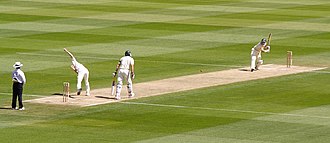
Cricket has been played in Pakistan since before the country was created in 1947. The first international cricket match in Karachi happened on November 22, 1935, between the team from Sindh and an Australian team. About 5,000 people watched that match. Karachi is also where a special type of cricket ball called "tape ball" was invented. It is safer and cheaper than regular cricket balls.
The first big cricket match at the National Stadium was played between Pakistan and India on February 26, 1955. Since then, Pakistan’s national cricket team has won 20 out of 41 important matches called Test matches at that stadium. The first One Day International match there was against the West Indies on November 21, 1980, and it went right down to the last ball.
The National Stadium hosted some matches during the 1996 Cricket World Cup, including games between Pakistan and South Africa, Pakistan and England, and a quarter-final between South Africa and the West Indies.
A new cricket stadium called Rafi Cricket Stadium is being built in Bahria Town. When it is finished, it will be the largest cricket stadium in Pakistan, able to hold over 50,000 spectators.
Football
The area of Lyari in Karachi is very important for football in Pakistan. Many players from Lyari have helped the national football team, especially in the 1960s, which is often called the early Golden Age of Pakistani football. Famous players from that time include Abdul Ghafoor, known as the “Pakistani Pelé,” and Muhammad Umer. Two big football stadiums, the Kakri Ground and the People’s Football Stadium, are located in Karachi. In 2005, Karachi hosted the SAFF Championship and the Super Football League in 2007, both of which drew big crowds.
Other sports
Karachi has a special place in sports history. Some people say that in 1877, the first rules for badminton were tried out in Karachi when it was part of British India, possibly at Frere Hall.
Karachi has hosted the National Games of Pakistan seven times, most recently in 2007.
Golf is becoming more popular in Karachi, with several clubs in the city. Karachi also has places for field hockey, boxing, squash, and polo, as well as marinas and boating clubs. The National Bank of Pakistan Sports Complex is a venue for first-class cricket and a multi-purpose sports facility.
Professional teams of Karachi
Notable people
Main article: List of people from Karachi
Karachi has been home to many famous people throughout its history. These individuals have come from many different backgrounds and have made their mark in various fields. The city continues to be a place where people from around the world gather and contribute to its rich culture.
Twin towns and sister cities
Main article: List of twin towns and sister cities in Pakistan
Karachi has friendly connections with several cities around the world. These include:
Images
Related articles




This article is a child-friendly adaptation of the Wikipedia article on Karachi, available under CC BY-SA 4.0.
Images from Wikimedia Commons. Tap any image to view credits and license.