Leonardo da Vinci
Leonardo di ser Piero da Vinci (15 April 1452 – 2 May 1519) was an Italian polymath of the High Renaissance. He worked as a painter, draughtsman, engineer, scientist, theorist, sculptor, and architect. He became known first for his painting, but he is also famous for his notebooks, where he drew and wrote about subjects including anatomy, astronomy, botany, cartography, painting, and palaeontology. Leonardo is widely seen as a genius who was the ideal of the Renaissance humanist. His collective works helped shape European art, and only his younger contemporary Michelangelo had an equal effect.
Leonardo was born outside of marriage to a successful notary and a lower-class woman in, or near, Vinci in Tuscany. He was taught in Florence by the Italian painter and sculptor Andrea del Verrocchio. He started his career in Florence, then spent much time working for Ludovico Sforza in Milan. Later he worked in Florence and Milan again, and briefly in Rome, while a large following of imitators and students gathered around him. At the invitation of Francis I, he spent his last three years in France, where he died in 1519. Since his death, his achievements, wide interests, personal life, and scientific way of thinking have continued to inspire interest and admiration, which has made him a frequent namesake and subject in culture.
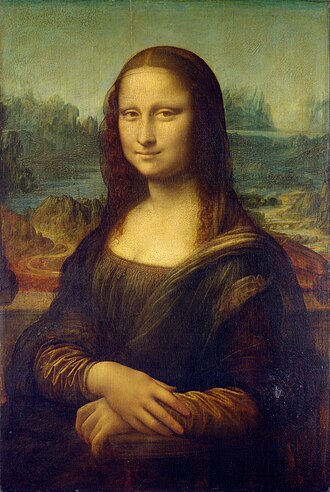
Leonardo is considered one of the greatest painters in the history of Western art and is often credited as a founder of the High Renaissance. Many of his works were lost, and fewer than 25 attributed major works survive, including many unfinished works. Even so, he created some of the most influential paintings in the Western canon. The Mona Lisa is regarded as the world's most famous painting. The Last Supper is the most reproduced religious painting of all time, and his drawing Vitruvian Man is also regarded as a cultural icon. In 2017, Salvator Mundi, which is attributed to Leonardo in whole or in part, was sold at auction for US$450.3 million. This set a new record for the most expensive painting ever sold at public auction.
Leonardo was admired for his technological ingenuity. He conceptualised flying machines, a type of armoured fighting vehicle, concentrated solar power, a ratio machine that could be used in an adding machine, and the double hull. Few of his designs were built during his lifetime, and many were not practical, because modern scientific methods for metallurgy and engineering were still in their infancy during the Renaissance. Some of his smaller inventions, however, entered manufacturing without much notice, such as an automated bobbin winder and a machine for testing the tensile strength of wire. He made major discoveries in anatomy, civil engineering, hydrodynamics, geology, optics, and tribology, but he did not publish his findings, and they had little to no direct influence on later science.
Biography
Leonardo da Vinci was born on 15 April 1452 in, or close to, the Tuscan hill town of Vinci, about 35 kilometres (22 miles) from Florence. He was born out of wedlock to Piero da Vinci, a Florentine legal notary, and Caterina, who came from the lower class. Very little is known about his childhood. Around the age of 14, he became a studio boy in the workshop of Andrea del Verrocchio, the leading Florentine painter and sculptor of his time. By 1472, he qualified as a master in the Guild of Saint Luke. In 1482, he went to Milan to offer his services to the Duke of Milan, Ludovico Sforza, and he worked there for many years, painting The Last Supper. When Sforza was overthrown in 1500, Leonardo moved to Venice, and later he served Cesare Borgia as a military architect and engineer. He returned to Florence, where he began his portrait of Lisa del Giocondo, the model for the Mona Lisa.
In 1516, Leonardo entered the service of King Francis I of France and lived at the manor house Clos Lucé near the royal Château d'Amboise. He died at Clos Lucé on 2 May 1519, at the age of 67. Vasari records that the King held Leonardo's head in his arms as he died, although this story may be legend rather than fact. Leonardo was buried in the Collegiate Church of Saint Florentin at the Château d'Amboise. Some 20 years later, the goldsmith and sculptor Benvenuto Cellini reported Francis as saying that there had never been another man born who knew as much as Leonardo.
Personal life
Main article: Personal life of Leonardo da Vinci
Leonardo left thousands of pages of notes and drawings, but he rarely wrote about his own life. During his lifetime, people were curious about his many talents, his "great physical beauty" and "infinite grace," as described by Vasari. He loved animals, and he likely followed vegetarianism. Vasari also wrote that Leonardo bought caged birds and set them free. Leonardo had many notable friends, including mathematician Luca Pacioli, with whom he worked on the book Divina proportione in the 1490s. Apart from friendships with Cecilia Gallerani and the Este sisters, Beatrice and Isabella, he seems to have had few close relationships with women.
Salaì joined Leonardo's household in 1490 as an assistant. Within a year, Leonardo wrote a list of his faults, calling him "a thief, a liar, stubborn, and a glutton." Even so, Leonardo was very kind to him, and Salaì stayed in his household for the next thirty years. Many people think Salaì's paintings were less skilled than those of other pupils, such as Marco d'Oggiono and Boltraffio. Leonardo kept most of his private life secret. Writers, including Sigmund Freud in Leonardo da Vinci, A Memory of His Childhood and Walter Isaacson in his biography of Leonardo, have discussed his close bonds with his pupils Salaì and Melzi.
Paintings
See also: List of works by Leonardo da Vinci
For about four hundred years, Leonardo was known mainly as a painter. A small group of paintings, some known to be his and some thought to be his, are considered among the world's great masterpieces. Students have copied them for centuries, and by the 1490s Leonardo was already being called a "Divine" painter. His work stands out for his new ways of applying paint, his knowledge of anatomy, light, plants, and rocks, and his interest in physiognomy and how people show feelings on their faces and in their gestures. His most famous paintings are the Mona Lisa, The Last Supper, and the Virgin of the Rocks.
Leonardo first became well known for helping to paint the Baptism of Christ in the workshop of Verrocchio. In the 1480s he began several important works, including Saint Jerome in the Wilderness and the Adoration of the Magi, but neither was finished. He finished the Virgin of the Rocks, and he painted the portrait Lady with an Ermine. In the 1490s he painted The Last Supper for a church in Milan, but the paint began to fade and crack quickly. Later, in the 1500s, he worked on The Battle of Anghiari and the Mona Lisa, which is famous for its soft, mysterious smile.
Drawings
Leonardo was a prolific draughtsman. He kept journals full of small sketches and detailed drawings of many things that caught his interest. There are also many studies for paintings, some of which are linked to famous works such as The Adoration of the Magi, The Virgin of the Rocks and The Last Supper. His earliest dated drawing is a Landscape of the Arno Valley from 1473, which shows the river, the mountains, Montelupo Castle and the farmlands beyond it in great detail. Among his best-known drawings are the Vitruvian Man, a study of the proportions of the human body, and the Head of an Angel for The Virgin of the Rocks in the Louvre. He also made a botanical study of the Star of Bethlehem, and a large chalk drawing of The Virgin and Child with Saint Anne and Saint John the Baptist, which uses the soft shading technique of sfumato, as in the Mona Lisa. It is thought that he never made a painting from this drawing.
Leonardo also drew many "caricatures," which are exaggerated but seem to be based on watching real people. Vasari wrote that Leonardo looked for interesting faces in public to use as models. There are also many studies of young men, often linked to Salaì, and of drapery (the folds of cloth). Like the architects Donato Bramante, who designed the Belvedere Courtyard, and Antonio da Sangallo the Elder, Leonardo experimented with designs for churches with a central plan. Some appear in his journals, but none was ever built.
Journals and notes
See also: List of works by Leonardo da Vinci § Manuscripts
Renaissance humanism did not see science and the arts as opposites. Leonardo's studies in science and engineering are sometimes thought to be as impressive and new as his art. He recorded them in 13,000 pages of notes and drawings that combine art and natural philosophy, the forerunner of modern science. He made and kept these notes every day throughout his life and travels, always watching the world around him. They cover a huge range of topics, from lists of groceries and people who owed him money to designs for wings and shoes for walking on water. They include paintings, faces, animals, babies, dissections, plants, rocks, whirlpools, war machines, flying machines and buildings.
After Leonardo died, most of these notebooks, which were first loose sheets of different types and sizes, were left to his pupil and heir Francesco Melzi, who had the very hard task of publishing them. Some of Leonardo's drawings were copied by an anonymous Milanese artist for a planned book on art (Codex Huygens, c. 1570). After Melzi died in 1570, the collection passed to his son Orazio, who at first had little interest in it. Some papers were taken to Pisa, where the architect Giovanni Magenta made them return to Orazio, who then gave the volumes to Magenta. Orazio later gave seven of the manuscripts to Pompeo Leoni for publication, and one of these became the Codex Atlanticus. After Orazio's death, his heirs sold the rest, and the works were scattered. Today they are held in places such as the Royal Library at Windsor Castle, the Louvre, the Biblioteca Nacional de España, the Victoria and Albert Museum, the Biblioteca Ambrosiana in Milan, and the British Library in London, and others are at Holkham Hall, the Metropolitan Museum of Art, and with private owners John Nicholas Brown I and Robert Lehman. The Codex Leicester is owned by Bill Gates and shown once a year in different cities around the world. Most of Leonardo's writing is in mirror-image cursive, which may have been easier for him as a left-handed writer. He used shorthand and symbols, and often covered one topic in both words and pictures on the same sheet. Why he did not publish them during his lifetime is unknown.
Science and inventions
Main article: Science and inventions of Leonardo da Vinci
Leonardo studied the world by describing and drawing things in great detail. He did not focus much on experiments or theory. Because he had no formal training in Latin or mathematics, scholars of his time mostly ignored him as a scientist, although he taught himself Latin. He made many keen observations, such as writing "Il sole non si muove" ("The Sun does not move"). In the 1490s he studied mathematics with Luca Pacioli and drew regular solids for the book Divina proportione, published in 1509. While living in Milan, he studied light from the summit of Monte Rosa. His notes on fossils are considered influential on early palaeontology. His journals suggest he planned several treatises. A treatise on anatomy was seen in 1517 by a secretary of Cardinal Louis d'Aragon. Parts of his work on anatomy, light and landscape were later published as A Treatise on Painting, with engravings based on drawings by the Classical painter Nicolas Poussin. Fritjof Capra argues that Leonardo, as a "Renaissance Man", was a different kind of scientist from Galileo, Newton and others, because his thinking combined the arts, especially painting.
Leonardo began studying the human body while an apprentice to Verrocchio, and he became skilled at drawing muscles, tendons and other visible features. With permission, he dissected bodies at the Hospital of Santa Maria Nuova in Florence and later in Milan and Rome, working with Marcantonio della Torre of the University of Pavia. He made more than 240 detailed drawings, including of the human skeleton, the heart and vascular system, the reproductive organs, and one of the first scientific drawings of a foetus in the womb. He also studied bodily humours, ventricles, and the aorta, and he was the first to define atherosclerosis and liver cirrhosis. As an engineer, he designed many machines, including a flying machine idea called an ornithopter, a rotor design, and an aerial screw recorded in the Codex Atlanticus. He wrote to Ludovico il Moro that he could build machines for defence and siege, and he worked on river and canal projects with Niccolò Machiavelli, Lombardy's plains and the Loire. His notebooks hold many inventions, including musical instruments, a mechanical knight and a steam cannon. Research by Marc van den Broek suggests many of his ideas had earlier versions. In 1493 he first described the 'laws' of sliding friction, which he studied while looking at perpetual motion. His results were not published, and Guillaume Amontons is now usually credited for these laws. Duncan Dowson named Leonardo the first of the 23 "Men of Tribology" for this work.
Legacy
Further information: Cultural references to Leonardo da Vinci and List of things named after Leonardo da Vinci
Leonardo had no formal academic training, but many historians see him as the best example of a "Renaissance man" or "universal genius," a person with "unquenchable curiosity" and a "feverishly inventive imagination." Art historian Helen Gardner said that the range of his interests had no equal in recorded history. People admired him during his own lifetime, and that admiration has continued. Writers from the 1500s through the 1900s praised his talent, and many still do today. Experts still study his notebooks, his paintings, and his life. The Elmer Belt Library of Vinciana at the University of California, Los Angeles is a special collection of his work.
In 2019 and 2020, on the 500th anniversary of Leonardo's death, the Louvre in Paris held the largest single exhibit of his work ever. The Mona Lisa is often regarded as the most famous portrait ever made, and The Last Supper is the most reproduced religious painting of all time.
Location of remains
Leonardo was buried in the collegiate church of Saint Florentin at the Château d'Amboise on 12 August 1519, but the current location of his remains is unclear. Much of the château was damaged during the French Revolution, and the church was demolished in 1802. Some graves were destroyed, scattering the bones, so the whereabouts of Leonardo's remains are disputed. In 1863, fine-arts inspector general Arsène Houssaye searched the site and found a partial skeleton, a bronze ring, white hair, and stone pieces with letters that were read as "Leonardus Vinci." A silver shield near the bones showed a beardless Francis I, who looked like the king during Leonardo's time in France.
Houssaye thought the large skull showed Leonardo's intelligence, but author Charles Nicholl calls this a "dubious phrenological deduction." Art historian Mary Margaret Heaton wrote in 1874 that the skeleton's height would suit Leonardo. The remains were returned to the château and placed in the chapel of Saint Hubert in 1874, and a plaque says the contents are only presumed to be his. In 2016, it was announced that DNA tests would be conducted to check the identity, and the remains may be sequenced. In 2019, documents showed that Houssaye had kept the ring and a lock of hair, which were displayed at the Leonardo Museum in Vinci from 2 May 2019, the 500th anniversary of the artist's death. In mid-2021, a long study of Leonardo's genetic genealogy by Alessandro Vezzosi and Agnese Sabato found that the artist has 14 living male relatives.

Quiz time!
5 questions about Leonardo da Vinci
Besides painting, what was Leonardo also famous for?
Pictures
Keep exploring


This article is a child-friendly adaptation of the Wikipedia article on Leonardo da Vinci, available under CC BY-SA 4.0.
Images from Wikimedia Commons. Tap any image to view credits and license.