 Safekipedia
Optics
Adapted from Wikipedia · Discoverer experience
Optics is a fascinating part of physics that explores how light behaves. It looks at how light moves, how it interacts with different materials, and how we can use tools to see or control it. Optics mainly focuses on visible light, but it also includes ultraviolet and infrared light, as well as other types of waves like radio waves, microwaves, and X-rays.
In optics, scientists often use simple models to understand light. One common model is called geometric optics, where light is thought of as straight rays that bounce off surfaces or bend when they pass through them. Another model, physical optics, includes effects like bending and overlapping waves, which the ray model can't explain.
Optics is important in many areas, such as astronomy, where telescopes help us see stars and planets, and in medicine, where special tools help doctors look inside the body. Everyday items like mirrors, lenses, and lasers all rely on the principles of optics to work.
History
Main article: History of optics
See also: Timeline of electromagnetism and classical optics
Optics started a long time ago when ancient people like the Egyptians and Mesopotamians made lenses from shiny stones such as quartz. These early lenses were found in places like Crete and Rhodes. Later, the Romans and Greeks used water-filled glass balls as lenses.
Ancient Greek thinkers had different ideas about how we see. Some thought we see by receiving copies of objects, while others believed our eyes sent out rays to see. Over time, many smart people added to our understanding of light and vision. Important steps included the work of Euclid, who linked vision to geometry, and Alhazen, who tested how light behaves through experiments.
In the Middle Ages, scholars in the Muslim world built on these ideas. They improved lens designs and wrote important books about light. In the 1200s, eyeglasses were invented in Italy, leading to better tools like microscopes and telescopes. Later scientists like Johannes Kepler, Isaac Newton, and Christiaan Huygens explained more about how light works. Their discoveries helped create the science of optics that we study today.
Classical optics
Classical optics is divided into two main parts: geometrical optics and physical optics. In geometrical optics, light is thought of as traveling in straight lines. In physical optics, light is seen as waves.
Geometrical optics looks at how light behaves when it hits different surfaces. For example, when light hits a mirror, it reflects at the same angle it came in at. This is why mirrors show clear images. When light passes from one material to another, like from air to water, it bends. This bending is why objects in water look wavy or closer than they really are.
Physical optics studies how light acts like waves. This explains effects like rainbows and patterns of light and dark bands. When light waves meet, they can add up to make brighter or darker areas, a phenomenon called interference. Another wave effect is diffraction, where light spreads out when it passes through a small opening or around an edge. These wave behaviors help scientists understand and create many optical tools and technologies.
| combined waveform | ||
| wave 1 | ||
| wave 2 | ||
| Two waves in phase | Two waves 180° out of phase | |
Modern optics
Main articles: Optical physics and Optical engineering
Modern optics is the study of light and how it behaves. It became very important in the 1900s. Scientists look at how light works with tiny particles, which helps us understand devices like lasers, cameras, and computer chips. These tools use special properties of light that we can only explain with advanced science.
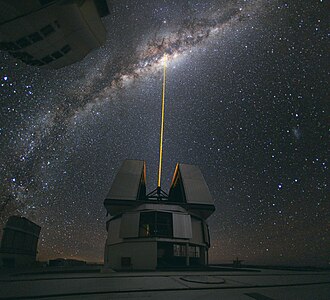
One amazing tool is the laser. Lasers create a very strong, focused beam of light. The first laser was made in 1960, and since then, lasers have been used in many everyday things like scanning items at the store, playing music and movies, and even in doctors’ offices. Lasers help us send information quickly through fibre-optic cables and are used in many fun and important ways.
Applications
Further information: Optical phenomenon
Optics is a part of everyday life. Many people use eyeglasses or contact lenses to help their vision, and optics is important in many things we use, like cameras. Rainbows and mirages are beautiful examples of optical effects. Optical communication helps us connect through the Internet and modern telephony.
Human eye
Main articles: Human eye and Photometry (optics)
Our eyes work by focusing light onto a special layer of cells called the retina at the back of the eye. Light first passes through the clear front part of the eye, called the cornea, then through a small opening called the pupil, and finally through the eye’s lens, which helps focus the light. This light reaches the retina, where cells help us see. Some cells, called rods, help us see in low light, while others, called cones, help us see colors and details.
Vision can change as we grow older or due to certain conditions. For example, presbyopia makes it harder to see close objects, hyperopia makes it hard to see close objects clearly, myopia makes it hard to see far objects clearly, and astigmatism causes blurry or distorted vision. These can often be corrected with special corrective lenses.
Visual effects
Main articles: Optical illusion and Perspective (graphical)
For the visual effects used in film, video, and computer graphics, see visual effects.
Optical illusions are images that our brain sees differently from how they really are. These can happen because of how light behaves or because of how our brain processes what we see. Some famous illusions include the Ames room, Hering, Müller-Lyer, Orbison, Ponzo, Sander, and Wundt illusions. These tricks use lines and shapes to make us see distance in a certain way. There’s also the moon illusion, where the moon looks bigger when it’s near the horizon compared to when it’s high in the sky.
Optical instruments
Main article: Optical instruments
Simple lenses and mirrors have many uses, like in photographic lenses, magnifying glasses, and rear-view mirrors. When we combine mirrors, prisms, and lenses, we can make more complex tools. Two important examples are microscopes, which make tiny things look bigger, and telescopes, which let us see faraway objects in space.
Photography
Main article: Science of photography
Photography uses lenses and special materials or digital sensors to capture light. Photographers need to think about how much light is coming into the camera and how long to leave the shutter open. The aperture, or opening, of the camera’s lens controls how much light enters and also affects how much of the scene will be in focus. There are different types of lenses, like normal lenses that mimic human vision, wide-angle lenses that show a broad view, and telephoto lenses that zoom in on distant objects.
Atmospheric optics
Main article: Atmospheric optics
The sky and weather create many beautiful optical effects. The blue color of the sky happens because tiny particles in the air scatter blue light more than other colors. During sunrise or sunset, the sky can turn reds and oranges because the sunlight passes through more air. Other effects like halos and sun dogs are caused by ice crystals in the atmosphere. Rainbows appear when sunlight passes through raindrops, bending and reflecting to create arcs of color.
Images
Related articles




This article is a child-friendly adaptation of the Wikipedia article on Optics, available under CC BY-SA 4.0.
Images from Wikimedia Commons. Tap any image to view credits and license.