 Safekipedia
London Marathon
Adapted from Wikipedia · Discoverer experience
The London Marathon is an annual marathon held in London, England. Founded by athletes Chris Brasher and John Disley in 1981, it is typically held in April, although it moved to October for 2020, 2021, and 2022 due to the COVID-19 pandemic. The mostly flat course follows the River Thames, starting in Blackheath and finishing at The Mall. Hugh Brasher, the son of Chris, is the current race director, and Nick Bitel serves as chief executive.
The marathon includes several types of races. There is a mass race for anyone who wants to join, professional races for men and women long-distance runners, elite-level wheelchair races for men and women, and a shorter 3-mile mini marathon for athletes under 17. In 2026, a new paid 5km run called Friday Night Lights will take place at Battersea Park on the Friday before the main event.
One important part of the London Marathon is its charity running tradition. Runners often take part to help raise money, and the event has helped collect over £1.4 billion for good causes since it began.
Since 2006, the elite races have been part of the World Marathon Majors, a group of seven top marathons around the world. Many amazing records have been set in London, including the breaking of the marathon world record seven times. Notable achievements include Sabastian Sawe breaking the 2-hour barrier in 2026, and women like Grete Waitz, Ingrid Kristiansen, Paula Radcliffe, and Mary Jepkosgei Keitany setting new best times. The current elite course records are held by Sabastian Sawe and Paula Radcliffe. The current wheelchair records belong to Marcel Hug and Catherine Debrunner. The race is also supported by a title sponsor and has been called the "TCS London Marathon" since 2022.
Editions
The London Marathon started in 1981 and is held every year in London, England. Most years, it takes place in April, but it moved to October for three years during the COVID-19 pandemic. The race follows a flat path along the River Thames, beginning in Blackheath and ending at The Mall. In 2020, only a small group of top athletes and special invited participants were allowed to race.
| Edition | Date | Applicants | Accepted | Starters | Finishers | Official charity |
|---|---|---|---|---|---|---|
| 1 | 29 March 1981 | 20,000 | 7,747 | 7,055 | 6,255 | —N/a |
| 2 | 9 May 1982 | 90,000 | 18,059 | 16,350 | 15,116 | —N/a |
| 3 | 17 April 1983 | 60,000 | 19,735 | 16,500 | 15,793 | —N/a |
| 4 | 13 May 1984 | 70,000 | 21,142 | 16,992 | 15,675 | |
| 5 | 21 April 1985 | 83,000 | 22,274 | 17,500 | 15,873 | |
| 6 | 20 April 1986 | 80,000 | 25,566 | 19,261 | 18,067 | British Sports Association for the Disabled (autistic) |
| 7 | 10 May 1987 | 80,000 | 28,364 | 21,485 | 19,586 | Farnham Park Trust |
| 8 | 17 April 1988 | 73,000 | 29,979 | 22,469 | 20,932 | SportsAid |
| 9 | 23 April 1989 | 72,000 | 31,772 | 24,452 | 22,701 | The Evelina Family Trust Special Olympics |
| 10 | 22 April 1990 | 73,000 | 34,882 | 26,500 | 25,013 | Battle of Britain Appeal Community Action Trust |
| 11 | 21 April 1991 | 79,000 | 33,485 | 24,500 | 23,435 | Action on Addiction Royal Marsden Cancer Research |
| 12 | 12 April 1992 | 83,000 | 34,250 | 24,500 | 23,833 | Guy's Hospital Evelina London Children's Hospital Tuskforce |
| 13 | 18 April 1993 | 68,000 | 35,820 | 25,000 | 24,495 | St John Ambulance Snowden Award Scheme |
| 14 | 17 April 1994 | 72,000 | 37,379 | 26,000 | 25,242 | British Heart Foundation Childline |
| 15 | 2 April 1995 | 79,000 | 39,097 | 27,000 | 25,377 | Leonard Cheshire Disability Cancer Relief Macmillan |
| 16 | 21 April 1996 | 68,000 | 39,173 | 27,134 | 26,806 | British Heart Foundation National Asthma Campaign |
| 17 | 13 April 1997 | 78,000 | 39,813 | 29,500 | 29,189 | British Heart Foundation NSPCC |
| 18 | 26 April 1998 | 96,000 | 42,228 | 30,663 | 29,972 | Age Concern Diana, Princess of Wales Memorial Fund |
| 19 | 18 April 1999 | 87,000 | 43,774 | 31,582 | 30,849 | Whizz-Kidz Leukaemia Research |
| 20 | 16 April 2000 | 93,000 | 42,596 | 32,620 | 31,698 | Mencap |
| 21 | 22 April 2001 | 92,000 | 43,517 | 31,156 | 30,318 | MS Society |
| 22 | 14 April 2002 | 99,000 | 46,083 | 33,297 | 32,950 | Outward Bound FCWL |
| 23 | 13 April 2003 | 111,000 | 45,629 | 32,746 | 32,324 | Shelter |
| 24 | 18 April 2004 | 108,000 | 45,219 | 32,746 | 32,012 | Sense British Heart Foundation |
| 25 | 17 April 2005 | 132,000 | 47,969 | 35,600 | 35,300 | Help the Hospices |
| 26 | 23 April 2006 | 119,000 | 47,020 | 33,578 | 33,250 | The Stroke Association Anthony Nolan |
| 27 | 22 April 2007 | 128,000 | 50,039 | 36,396 | 35,729 | WellChild |
| 28 | 13 April 2008 | 120,000 | 48,630 | 35,037 | 34,637 | Heart UK Spinal Injuries Association |
| 29 | 26 April 2009 | 155,000 | 49,995 | 35,884 | 35,404 | The Children's Trust |
| 30 | 25 April 2010 | 163,000 | 51,378 | 36,956 | 36,666 | CLIC Sargent |
| 31 | 17 April 2011 | 163,926 | 50,532 | 35,303 | 34,872 | Oxfam |
| 32 | 22 April 2012 | 170,150 | 50,200 | 37,227 | 36,812 | Prostate Cancer Charity (now Prostate Cancer UK) (Breast Cancer Care) |
| 33 | 21 April 2013 | 167,449 | 48,323 | 34,631 | 34,381 | YouthNet Age UK |
| 34 | 13 April 2014 | 169,682 | 49,872 | 36,337 | 35,977 | Anthony Nolan |
| 35 | 26 April 2015 | 172,888 | 51,696 | 38,020 | 37,793 | Cancer Research UK |
| 36 | 24 April 2016 | 247,069 | 53,152 | 39,523 | 39,140 | NSPCC |
| 37 | 23 April 2017 | 253,930 | 53,229 | 40,048 | 39,487 | Heads Together |
| 38 | 22 April 2018 | 386,050 | 54,685 | 40,926 | 40,220 | Teenage Cancer Trust |
| 39 | 28 April 2019 | 414,168 | 56,398 | 42,906 | 42,549 | Dementia Revolution |
| 40 | 4 October 2020 | 457,861 | 77 | 77 | 61 | Mencap |
| 41 | 3 October 2021 | 36,401 | 35,596 | Macmillan | ||
| 42 | 2 October 2022 | 350,000 | 42,000 | 40,619 | British Heart Foundation | |
| 43 | 23 April 2023 | 49,675 | 49,272 | 43,965 | Great Ormond Street Hospital | |
| 44 | 21 April 2024 | 578,304 | 65,725 | 54,218 | 53,000 | Samaritans |
| 45 | 27 April 2025 | 840,318 | 57,449 | 56,640 | Pancreatic Cancer UK | |
| 46 | 26 April 2026 | 1,133,813 | Marie Curie |
History
The London Marathon began in 1981, created by Olympic champion Chris Brasher and athlete John Disley. It takes place around the River Thames, starting in Blackheath and finishing at The Mall. Many people join each year, and the race has grown very popular since it started.
The first London Marathon had over 6,000 runners finish. Even people using wheelchairs can join, and this has helped show that everyone can take part in sports. The race continues to be a big event in London each year.
Organisation
The London Marathon is led by Hugh Brasher, son of one of its founders, and Nick Bitel as chief executive. In the past, David Bedford and Bitel helped make big changes to the race, like updating the course in 2005.
Medical care for the marathon is provided by many doctors and volunteers from St. John Ambulance, who set up first aid stations along the route. The BBC provides live coverage of the event. There are different groups of runners, including Elite Women, Wheelchair racers, and Elite Men, followed by everyone else.
There are plans for 2027 to possibly split the marathon over two days to allow more people to participate.
Course
The London Marathon takes place on a mostly flat path around the River Thames. It is 26.2 miles long and is considered one of the fastest courses in the world.
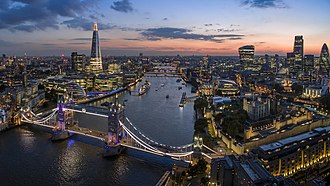
Runners begin at three starting points near Blackheath and follow markers every mile. They pass many famous places such as the Old Royal Naval College, Cutty Sark, Tower Bridge, the London Eye, Big Ben, and Buckingham Palace, ending at The Mall. Because of the COVID-19 pandemic, the 2020 race used a different, shorter route around St James's Park.
Results
Main article: List of winners of the London Marathon
London is one of the top seven world marathons that form the World Marathon Majors competition. The first marathon in 1981 had many runners, with the men's race tied between American Dick Beardsley and Norwegian Inge Simonsen. The first women's race was won by Briton Joyce Smith. In 1983, the first wheelchair races began with competitors from the British Sports Association for the Disabled.
Many world records have been set in the London Marathon. Khalid Khannouchi of the United States set the men's record in 2002, and British runner Paula Radcliffe set the women's record in 2003. In 2017, Mary Keitany of Kenya set a record for women’s marathons, and in 2023, Kenyan Kelvin Kiptum set a men’s course record. In 2026, Sabastian Sawe broke the men's world record with an amazing time. Marcel Hug of Switzerland and Manuela Schär hold the wheelchair race records.
Amateur runners
The London Marathon is popular with amateur runners, who make up most of the thousands of participants. Many run in fun costumes to support charity causes.
Some amazing stories have come from these runners. In 2002, Lloyd Scott finished the race wearing a deep sea diving suit. In 2003, former boxer Michael Watson, who was told he would never walk again, finished the marathon over six days. In 2006, Olympic champion Steve Redgrave raised a lot of money for charity, setting a record for the most sponsorship collected during a marathon. Other runners have also set records or shown great spirit, making the London Marathon a special event for everyone.
Entry
Runners can enter the London Marathon in several ways. Most spots are for people who raise money for charities. These runners help support important causes and have raised over £1.4 billion since the marathon began.
Other ways to enter include a general lottery, where it is now very hard to get a spot, and a special group for runners who are very fast for their age. There are also places for teams, famous people, and top athletes.
Mini Marathon
The Virgin Money Giving Mini London Marathon is a fun race for younger runners, and it is connected to The London Marathon. Kids aged under 13, under 15, and under 17 from all of London's areas, plus teams from ten parts of England and three nearby countries — Scotland, Wales, and Northern Ireland — can take part. The race uses the last part of the main marathon course, which is about 3 miles long. There is also a special race for athletes in wheelchairs, and the event serves as the British Athletics 3-mile Championships.
BBC live coverage
The BBC has shown the London Marathon on TV since it began in 1981, and has broadcast it live in full since 1984. Famous presenters have included Sue Barker, Jonathan Edwards, and Gabby Logan on BBC One, with others like Jonathan Edwards, Sonali Shah, and Helen Skelton on BBC Two. Well-known commentators have included David Coleman and Paula Radcliffe, among others.
Each year, the BBC uses a special theme tune from the film The Trap, written by Ron Goodwin and played by the Bournemouth Symphony Orchestra.
Sponsorship and marketing
The London Marathon has had many sponsors over the years. It started with Gillette in the early 1980s, and later had sponsors like Mars, ADT, NutraSweet, and Flora. In 2010, Virgin Money became the sponsor and the race was called the Virgin Money London Marathon. In 2022, a new sponsor, Tata Consultancy Services, took over.
Other companies also use the marathon to show off their brands, such as New Balance, Lucozade Sport, and Fuller's Brewery.
Images
Related articles


This article is a child-friendly adaptation of the Wikipedia article on London Marathon, available under CC BY-SA 4.0.
Images from Wikimedia Commons. Tap any image to view credits and license.