 Safekipedia
Madhya Pradesh
Adapted from Wikipedia · Discoverer experience
Madhya Pradesh is a large state in central India with a capital city called Bhopal. Other important cities in the state include Indore, Gwalior, Jabalpur, Chhindwara, and Sagar. It is the second largest Indian state by area and has a population of over 72 million people, making it the fifth largest state by population.
The land that makes up Madhya Pradesh today was once part of the ancient Avanti Mahajanapada, a region that included the important city of Ujjain. Over time, many different rulers controlled the area, including the Maratha Empire. After British rule, the area was reorganised several times before becoming the state of Madhya Pradesh in 1956.
Today, Madhya Pradesh has a strong economy and is rich in minerals such as diamond and copper. The state is also known for its forests, which cover about a quarter of its land. Farmers in Madhya Pradesh grow many important crops, including pulses, oilseeds, and medicinal plants. The state has been growing faster than India as a whole and has received awards for its tourism.
Etymology
The name Madhya Pradesh comes from two Sanskrit words: madhya, meaning "middle" or "central", and pradeś, meaning "state" or "province". So, the name literally means "central province".
History
Main article: History of Madhya Pradesh
Madhya Pradesh has a long and rich history. Evidence suggests people lived here as far back as the Middle Pleistocene era, with ancient remains found in the Narmada Valley. The area saw the rise of early cities like Ujjain, which became an important center. Many kingdoms, including the Mauryan Empire and the Gupta Empire, ruled this region over the centuries.
Later, the area was influenced by various empires and dynasties, such as the Satavahanas, the Vakatakas, and the Rajputs. Important temples and monuments, like those at Khajuraho, were built during this time. In more recent history, the region was part of British India and played a role in the country's struggle for independence. After India gained freedom, Madhya Pradesh was formed in 1950 and later changed shape when the state of Chhattisgarh was created in 2000.
[Mesolithic](/wiki/Mesolithic) rock painting, <a href="/wiki/Bhimbetka_rock_shelters">Bhimbetka rock shelters</a>, a UNESCO World Heritage Site in <a href="/wiki/Raisen_district">Raisen</a>
<a href="/wiki/Kandariya_Mahadeva_Temple">Kandariya Mahadeva Temple</a>, Khajuraho
-
.JPG)
Bateshwar temple complex, Padavli, Morena
Ekatarso Mahadeva Temple, Mitaoli, Morena
<a href="/wiki/Sasbahu_Temple,_Gwalior">Saas and Bahu Temples</a>, [Gwalior Fort](/wiki/Gwalior_Fort)
<a href="/wiki/Teli_ka_Mandir">Teli Temple</a>, [Gwalior](/wiki/Gwalior) Fort
Shiva Temple, <a href="/wiki/Bhojpur,_Madhya_Pradesh">Bhojpur</a>
Lakshmi Temple, <a href="/wiki/Orchha">Orchha</a>
Brahma statue with various deities at <a href="/wiki/Amarkantak">Amarkantak</a>
<a href="/wiki/Gwalior_Fort">Man Mandir</a>, Gwalior Fort
Assi Khambo ki Baoli, Gwalior Fort
Maa Chamunda Mata Temple, <a href="/wiki/Dewas">Dewas</a>
Mahakaleshwar Temple, <a href="/wiki/Ujjain">Ujjain</a>
Maheshwar Ghats and Fort, Maheshwar, <a href="/wiki/Khargone">Khargone</a>
Omkareshwar Temple, <a href="/wiki/Khandwa">Khandwa</a>
Geography
Location in India
Madhya Pradesh means "Central Province" and sits in the heart of India. It lies between latitudes 21.6°N and 26.30°N and longitudes 74°9'E and 82°48'E. The state is crossed by the Narmada River, which flows between the Vindhya and Satpura mountain ranges. These ranges traditionally mark the boundary between northern and southern India. The highest point in the state is Dhupgarh, standing at 1,350 meters (4,429 feet) above sea level.
Madhya Pradesh shares borders with Gujarat to the west, Rajasthan to the northwest, Uttar Pradesh to the northeast, Chhattisgarh to the east, and Maharashtra to the south.
Climate
Madhya Pradesh experiences three main seasons: summer, monsoon, and winter. Summers, from March to June, can get very hot, with temperatures often above 34.6°C. Eastern areas tend to be hotter than western parts, with some places reaching over 42°C in May. Winters, starting in November, are generally dry and pleasant, with temperatures in the north staying between 15°C and 18°C in January.
The monsoon season begins in mid-June, bringing most of the state’s rainfall between June and September. The southeast gets the most rain, with some areas receiving over 150 centimeters, while the northwest gets less. The average yearly rainfall is about 1,194 millimeters, though some southeastern places get up to 2,150 millimeters.
Ecology
The state has about 94,689 square kilometers of forest, covering 30.7% of its land. This is about 12.3% of India’s total forest area. Forests are less dense in the north and west, where many cities are located. Different climates and soils create many types of forests. In January 2019, over 1.5 million people helped plant 66 million trees along the Narmada River in just 12 hours.
Flora and fauna
Main article: Flora and fauna of Madhya Pradesh
Madhya Pradesh has eleven National Parks, including Kuno National Park, Bandhavgarh National Park, and Kanha National Park. There are also many nature reserves and biosphere reserves, such as Pachmarhi Biosphere Reserve and Amarkantak biosphere reserve. The state is home to many animals, including tigers, monkeys, and birds like the dudhraj, which is the state bird. Important trees include teak and sal.
State symbols of Madhya Pradesh
Rivers
Madhya Pradesh has many rivers. The Narmada River is the longest, flowing westward through a valley between the Vindhya and Satpura ranges. It is considered very sacred by people in the region. Other important rivers include the Tapti River, which runs parallel to the Narmada, and several tributaries like the Banjar and Tawa. The Vindhyas separate the Ganges basin, with rivers like the Chambal and Shipra flowing into the Yamuna. The Shipra River is especially sacred and hosts a big festival every 12 years.
Regions
Madhya Pradesh has several distinct areas, including the Kaimur Plateau, Vindhyan Plateau, Narmada valley, and Malwa Plateau, among others.
Administration
Main article: List of districts of Madhya Pradesh
For easier management, Madhya Pradesh is divided into 55 districts grouped into 10 divisions, such as Bhopal Division, Jabalpur Division, and Indore Division.
Cities
Main article: List of cities in Madhya Pradesh by population
| Title | Symbol | Image |
|---|---|---|
| State animal | Barasingha (Rucervus duvaucelii) | |
| State bird | Indian paradise flycatcher (Terpsiphone paradisi) | |
| State tree | banyan tree (ficus bengalensis) | |
| State fish | Mahasheer (Tor tor) | |
| State Flower | Madonna lily (Lilium candidum) |
Demographics
Madhya Pradesh is home to many different groups of people, including various tribes and communities. Some of the main tribes are Gond, Bhil, Baiga, Korku, Bhadia, Halba, Kaul, Mariya, Malto, and Sahariya. Certain areas, like Mandla and Jhabua, have many tribal people living there.
Hindi is the main language spoken in Madhya Pradesh, used in government and by most people. Other languages include Malvi, Bundeli, Bagheli, Nimadi, Bhili, Marathi, Gondi, and Urdu. Each of these languages adds to the state's rich cultural mix.
Most people in Madhya Pradesh follow Hinduism. There are also communities that practice Islam, Jainism, Buddhism, Christianity, and Sikhism. The state has many important places for Hindus to visit, such as Amarkantak and Omkareshwar.
| Year | Pop. | ±% |
|---|---|---|
| 1951 | 18,615,000 | — |
| 1961 | 23,218,000 | +24.7% |
| 1971 | 30,017,000 | +29.3% |
| 1981 | 38,169,000 | +27.2% |
| 1991 | 48,566,000 | +27.2% |
| 2001 | 60,348,000 | +24.3% |
| 2011 | 72,597,565 | +20.3% |
| Source: Census of India | ||
Culture
Madhya Pradesh is a beautiful state with many special traditions and places. Three important sites here have been named World Heritage Sites by UNESCO: the Khajuraho Group of Monuments, the Buddhist Monuments at Sanchi, and the Rock Shelters of Bhimbetka.
The state is also famous for its music. In 2023, Gwalior was named a City of Music by UNESCO. It is known as the capital of Hindustani classical music, and many famous musicians were born there. The state has many types of folk music and dances, adding to its rich cultural life.
Economy
Main article: Economy of Madhya Pradesh
Madhya Pradesh's economy in 2013–14 had a total value of ₹ 4,509 billion (about US$ 72.7 billion). Each person in the state earned about US$ 871 that year, which was among the lowest in the country. The state's economy grew slowly at first but improved, reaching 8% growth in 2010–11 and 12% in 2011–12.
The state is known for its honey production, especially in the Morena district. Madhya Pradesh's economy depends heavily on farming. Important crops include wheat, soybean, rice, cotton, and sugarcane. Forest products like tendu leaves for rolling beedi also play a role.
Madhya Pradesh has several special economic zones, including technology zones in Indore and Gwalior, a mineral-based zone in Jabalpur, and an agriculture-based zone also in Jabalpur. Indore is the main commercial center, and many big companies have set up factories there. Key industries include making machinery, chemicals, medicines, food products, and textiles.
The state has large reserves of diamonds, copper, coal, and other minerals. It also produces natural white stone that is exported around the world. Madhya Pradesh is important for tourism, with popular spots like Gwalior, Sanchi, and Khajuraho attracting visitors.
Infrastructure
Energy
Madhya Pradesh has a big ability to make electricity, with over 33,000 megawatts of power as of March 2026. The Rewa Ultra Mega Solar project is a large solar park covering 1,590 acres, providing 750 megawatts of power. Almost all homes in the state have electricity.
The Singrauli area is important for energy, with lots of coal mines used in local power plants. Wind energy is also used in the Malwa region, where many windmills generate power.
Transport
Buses and trains help people travel across Madhya Pradesh. The state has many roads, including 20 national highways, and a rail network that connects different cities. Jabalpur is an important place for the West Central Railway.
Big bus stations are in Bhopal, Gwalior, Indore, and Jabalpur. The state does not have a coastline but has special ports for loading cargo. Indore has the busiest airport, followed by Bhopal. Other airports are in Gwalior, Jabalpur, and Khajuraho.
Other
Madhya Pradesh has many health centers and hospitals. Cities like Bhopal, Indore, Jabalpur, and Ujjain have seen big improvements in their buildings and services. Indore is known for being very clean, winning awards many years in a row. Gwalior is famous around the world for its music.
Media
Many Hindi newspapers are read in Madhya Pradesh, such as Dainik Bhaskar and Dainik Jagran. English newspapers like Times of India and Hindustan Times also have editions from Bhopal and Jabalpur.
| Power | Capacity (MW) |
|---|---|
| Thermal | |
| Renewable | |
| Hydro | |
| Nuclear |
| Road type | Length (in km) |
|---|---|
| National Highways | |
| State Highways | |
| Major District Roads |
Government and politics
Main articles: Government of Madhya Pradesh and Legislative Assembly of Madhya Pradesh
See also: List of Chief Ministers of Madhya Pradesh and List of Governors of Madhya Pradesh
Madhya Pradesh has a legislative assembly with 230 seats. The state also sends 40 members to the Parliament of India: 29 are elected to the Lok Sabha (Lower House) and 11 to the Rajya Sabha (Upper House). The Governor, appointed by the President of India, is the constitutional head of the state. The Chief Minister, who is the elected leader of the state legislature, holds the executive powers. Currently, the governor is Mangubhai C. Patel, and the chief minister is Mohan Yadav of the Bharatiya Janata Party (BJP).
Over the years, Madhya Pradesh's politics have seen changes. After India gained independence, the Indian National Congress (INC) was a major party, with leaders like Ravishankar Shukla and Kailash Nath Katju as Chief Ministers. In the 1960s, other parties began to grow. The 1980s and 1990s brought more changes, with new parties appearing. Since the early 2000s, the main parties have been the BJP and the INC, with smaller parties sometimes joining in.
Administration
See also: List of districts of Madhya Pradesh and List of cities in Madhya Pradesh by population
Madhya Pradesh is divided into 55 Districts. These districts are grouped into 10 larger areas called divisions. The state has many local governments for villages and towns, including 55 district councils, 376 smaller area councils, 313 block councils, and over 23,000 village councils.
The big cities in Madhya Pradesh have their own city governments, called Municipal Corporations. These help manage the needs of people living in urban areas.
Villages
Education
Madhya Pradesh has many schools and universities. In 2011, about 69% of people could read and write. The state has lots of primary, high, and higher secondary schools, plus many colleges for engineering, management, and medicine.
Some important schools and universities in Madhya Pradesh include IIT Indore, IIM Indore, AIIMS Bhopal, and NIT Bhopal. There are also special universities like Dr. Hari Singh Gour University in Sagar and Indira Gandhi National Tribal University in Amarkantak and Anuppur.
Tourism
Madhya Pradesh is called the “Heart of India” because of its rich culture, wildlife, and beautiful nature. It has many special places to visit, including important historic sites like Khajuraho, Bhimbetka, and Sanchi, as well as places where tigers live, old forts such as the Gwalior Fort, beautiful temples, and colorful festivals. These attractions make it a popular place for people to explore.
Notable people
Main article: List of people from Madhya Pradesh
Madhya Pradesh has been home to many famous individuals who have made important contributions in various fields. While the full list is extensive, this state has produced notable figures in areas such as politics, arts, and sports, reflecting its rich cultural heritage and diverse talents.
Sports
Madhya Pradesh has many popular sports. In 2013, the state government chose Mallakhamba as the official state sport. People in Madhya Pradesh enjoy playing cricket, kabaddi, hockey, football, basketball, volleyball, cycling, swimming, badminton, and table tennis. Traditional games like kho kho, gilli danda, sitoliya, kanche, and langdi are favorites in the countryside.
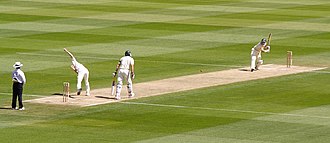
Cricket is especially loved in Madhya Pradesh. The state has several international cricket stadiums, including Nehru Stadium in Indore, Captain Roop Singh Stadium in Gwalior, and Holkar Cricket Stadium in Indore. Madhya Pradesh’s cricket team had a great moment in 2022 when they won their first Ranji Trophy title by defeating a very strong team from Mumbai. The state also supports other sports teams, such as a hockey team called the Bhopal Badshahs and a football team that competes in national tournaments.
Images
Related articles


This article is a child-friendly adaptation of the Wikipedia article on Madhya Pradesh, available under CC BY-SA 4.0.
Images from Wikimedia Commons. Tap any image to view credits and license.