 Safekipedia
Maharashtra
Adapted from Wikipedia · Discoverer experience
Maharashtra is a large state in the western part of India, sitting on the Deccan Plateau. It borders the Arabian Sea to the west and shares borders with several other Indian states, including Karnataka, Goa, Telangana, Chhattisgarh, Gujarat, and Madhya Pradesh, as well as the union territory of Dadra and Nagar Haveli and Daman and Diu.
The area now known as Maharashtra has a long history, with many different groups ruling over it throughout the years. In the 19th century, the British East India Company took control of most of the region. After India gained independence in 1947, the area became part of Bombay State. In 1960, it was split to create the modern states of Maharashtra and Gujarat.
Today, Maharashtra is one of India’s most important states. Its capital, Mumbai, is the country’s financial and commercial center. The state has a large economy, with many industries and a strong service sector. Maharashtra is also known for its rich culture and many important historical places, including several UNESCO World Heritage Sites such as the Ajanta Caves and Elephanta Caves.
Etymology
The name "Maharashtra" likely comes from the word for "the country of Mahars." Mahars lived in many parts of the region. The Marathi language grew from an old language called Maharashtri Prakrit. Words like Marathi and Maratha may share the same roots, but we aren't completely sure how they all connect.
Some scholars think the words Maratha and Maharashtra come from "Mahā" and "Rāṣṭrikā," which could refer to a group of leaders in the Deccan area. Another idea is that it means "great chariot" or "great charioteer," pointing to skilled fighters who moved into the area.
Old texts mention a place called Anaratta, home to a group known as the Abhiras. This area was also called Surastra, possibly linked to a group called the Rastrikas. Over time, the name evolved into Maharashtra. Some modern scholars question this idea, thinking it might be a later, more formal explanation.
History
Main articles: History of Maharashtra, Maratha Empire, and Samyukta Maharashtra Movement
See also: Chronology of statehood of Maharashtra
Many old settlements from the time of the Jorwe culture (around 1300–700 BCE) have been found in Maharashtra. One of the biggest settlements was at Daimabad, which had a mud wall and a special temple.
Maharashtra was ruled by many groups over the years, including the Maurya Empire, the Satavahana dynasty, and later the Chalukya dynasty. Important leaders like Pulakeshin II and Vikramaditya II helped the Chalukya rule strongly.
In the 1300s, the Delhi Sultanate took over parts of Maharashtra. Later, local leaders formed new kingdoms, and in the 1600s, Shivaji founded the Maratha Empire. After Shivaji’s death, battles continued with the Mughal Empire. Later, the Maratha Empire grew strong again and ruled much of India.
The British East India Company took control in the early 1800s after the Third Anglo-Maratha War. British rule brought changes like new roads, railways, schools, and universities. Leaders like Bal Gangadhar Tilak and Jyotirao Phule worked for independence and social change.
After India gained independence in 1947, many areas were combined to form Bombay State. In 1960, Maharashtra became its own state, with Mumbai as its capital. Today, Maharashtra still has disagreements with the nearby state of Karnataka over some areas.
Geography
Main article: Geography of Maharashtra
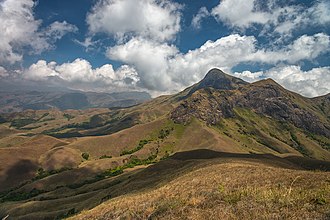
Maharashtra is a big state in western India, covering an area of 307,713 km2. It has a long coastline of 840 kilometres along the Arabian Sea. The state's most famous feature is the Western Ghats, also called the Sahyadri Range, which runs along the western edge. These mountains have an average height of 1,200 metres. To the east of these mountains lies the wide Deccan Plateau.
The state has several important rivers, such as the Krishna and Godavari, which help with farming and water supply. Maharashtra is divided into five main geographic areas: Konkan along the coast, Khandesh in the north, Desh in the center, Marathwada in the southeast, and Vidarbha in the east.
Climate
Maharashtra has a tropical wet and dry climate. Summers are hot, with temperatures rising to between 40 °C and 45 °C, while winters are cooler. The southwest monsoon brings most of the state's rain from June to September. Coastal areas receive heavy rainfall, while areas farther inland can be quite dry and sometimes face droughts.
Flora and fauna
Maharashtra has three important areas for plants and animals: the Western Ghats, the Deccan Plateau, and the West coast. These areas are home to many different kinds of plants and animals. The state has many forests, covering about 20% of its land.
Maharashtra has many types of forests, including areas with tall, dense trees and others with more open woodland. Common animals in the state include monkeys, wild pigs, tigers, leopards, and many types of deer. The coast has many kinds of fish and other sea creatures. The state works to protect its tigers in special areas called tiger reserves.
Regions, divisions and districts
Main article: List of districts of Maharashtra
See also: List of talukas of Maharashtra and List of cities in Maharashtra by population
Maharashtra has five main geographical areas: North Maharashtra, Konkan, Marathwada, Vidarbha, and Desh or Western Maharashtra.
The state has six administrative areas: Amravati, Aurangabad, Konkan, Nagpur, Nashik, and Pune. These areas are split into 36 districts. Each district is managed by a special officer chosen by the government.
There are also smaller groups within the districts called sub-divisions and talukas, which help with organizing villages and land matters. Urban areas in Maharashtra are managed by different groups like Municipal Corporations, Municipal Councils, and Nagar panchayats.
Largest cities or towns in Maharashtra As of the 2011 Census | |||||||||
|---|---|---|---|---|---|---|---|---|---|
| Rank | Name | District | Pop. | Rank | Name | District | Pop. | ||
| 1 | Mumbai | Mumbai City district | 18,414,288 | 11 | Kolhapur | Kolhapur | 660,861 | ||
| 2 | Pune | Pune | 5,049,968 | 12 | Sangli | Sangli | 650,000 | ||
| 3 | Nagpur | Nagpur | 2,497,777 | ||||||
| 4 | Nashik | Nashik | 2,362,769 | ||||||
| 5 | Thane | Thane | 1,886,941 | ||||||
| 6 | Aurangabad | Aurangabad | 1,189,376 | ||||||
| 7 | Solapur | Solapur | 951,118 | ||||||
| 8 | Amravati | Amravati | 846,801 | ||||||
| 9 | Jalgaon | Jalgaon | 737,411 | ||||||
| 10 | Nanded | Nanded | 550,564 | ||||||
Demographics
Maharashtra is one of the most crowded states in India. In 2011, it had over 112 million people, making it the second-most populous state in the country. About 55% of people lived in villages, while 45% lived in cities.
Many different groups of people call Maharashtra home. The largest group is called Maratha, followed by a large number of people from groups known as Other Backward Classes. There are also communities such as Adivasis, including the Thakar, Warli, Konkana, and Halba groups. Some people also moved to Maharashtra from other states, especially from Uttar Pradesh, Gujarat, and Karnataka.
Religion
Main article: Religion in Maharashtra
Most people in Maharashtra follow Hinduism. Other religions practiced there include Islam, Buddhism, Jainism, Christianity, and Sikhism. There are also small groups of Jews and people who follow Zoroastrianism, known as Parsis.
Language
Further information: Languages of India and Marathi people
Marathi is the main language of Maharashtra, but many other languages are spoken there too. Hindi, Urdu, Gujarati, Bhili, Khandeshi, Telugu, and Kannada are some of these languages. In cities like Mumbai, people speak many different languages because people from all over India live there.
| Year | Pop. | ±% |
|---|---|---|
| 1901 | 19,391,643 | — |
| 1911 | 21,474,523 | +10.7% |
| 1921 | 20,849,666 | −2.9% |
| 1931 | 23,959,300 | +14.9% |
| 1941 | 26,832,758 | +12.0% |
| 1951 | 32,002,564 | +19.3% |
| 1961 | 39,553,718 | +23.6% |
| 1971 | 50,412,235 | +27.5% |
| 1981 | 62,782,818 | +24.5% |
| 1991 | 78,937,187 | +25.7% |
| 2001 | 96,878,627 | +22.7% |
| 2011 | 112,374,333 | +16.0% |
| Source: Census of India | ||
Governance and administration
Main article: Government of Maharashtra
See also: Politics of Maharashtra and List of chief ministers of Maharashtra
Maharashtra is governed through a parliamentary system of representative democracy, like other Indian states. It is one of six states in India with a bicameral legislature, which includes the Vidhan Sabha (Legislative Assembly) and the Vidhan Parishad (Legislative Council). The Legislative Assembly has 288 elected members serving five-year terms. The Legislative Council is a permanent body of 78 members, with one-third of them retiring every two years.
The government of Maharashtra is led by a Governor appointed by the President of India. The leader of the majority party or coalition in the Legislative Assembly becomes the chief minister, supported by a council of ministers. The governor serves mainly in a ceremonial role, while the chief minister and council manage daily government functions.
The state is divided into 6 divisions and 36 districts. Each division is overseen by a Divisional commissioner, and each district by a Collector and District Magistrate. Urban areas are managed by Municipal Corporations, Municipal Councils, Nagar Panchayats, and Cantonment Boards, while rural areas follow the Panchayati Raj system with Zilla Parishads, Panchayat Samitis, and Gram Panchayats.
The Maharashtra Police is led by a Director general of police (DGP). In each district, a Superintendent of Police (SP) manages law and order, supported by police service officers. In cities, a Commissioner of Police (CP) heads the police force.
The judiciary includes the Maharashtra High Court (The High Court of Bombay), with regional branches in Nagpur, Aurangabad, and Panaji. The High Court appoints judges, and lower courts operate at district and taluka levels.
Politics
See also: Politics of Maharashtra and List of chief ministers of Maharashtra
Maharashtra’s politics have been shaped by major parties like the Indian National Congress, Bharatiya Janata Party, Nationalist Congress Party, and Shiv sena. Over the years, alliances have shifted, with parties sometimes working together and sometimes competing.
Leadership in Maharashtra often passes within families, a common pattern in Indian politics. Important leaders have included Yashwantrao Chavan, Sharad Pawar, and Devendra Fadnavis. In recent years, coalitions have changed frequently, with new partnerships forming and old ones ending.
In 2019, a new coalition called Maha Vikas Aghadi was formed, but it later dissolved. In 2022, a new government was created with the BJP and Shiv sena. By late 2024, the Mahayuti coalition, including the BJP, Shiv sena, and NCP, won important elections, partly due to support from voters for programs helping women and strong campaign efforts.
Economy
Main article: Economy of Maharashtra
Maharashtra has a strong economy with many important industries. It leads in manufacturing, trade, media, technology, and more. Mumbai, the state's capital, is the financial center of India with many big companies and stock markets. The state attracts investments and has many taxpayers.
The service sector is the biggest part of Maharashtra's economy. It also has a lot of startups and is a top place for foreign investment. Maharashtra makes a big share of India's industrial output and has many big companies.
Maharashtra's industries include chemicals, food products, petroleum, machinery, textiles, and motor vehicles. The state is also known for its creative industries like advertising, fashion, film, music, and software. Mumbai is a major center for film and television, including Bollywood.
With many people living in rural areas, farming is also important. Main crops include rice, millet, sugarcane, cotton, and spices like turmeric. The state also has a big livestock and poultry population. Cooperatives help with farming and other industries.
| Net state domestic product at factor cost at current prices (2004–05 base) Figures in crores of Indian rupees | |
| Year | Net state domestic product |
|---|---|
| 2004–2005 | ₹3.683 trillion (US$39 billion) |
| 2005–2006 | ₹4.335 trillion (US$46 billion) |
| 2006–2007 | ₹5.241 trillion (US$55 billion) |
| 2007–2008 | ₹6.140 trillion (US$65 billion) |
| 2008–2009 | ₹6.996 trillion (US$74 billion) |
| 2009–2010 | ₹8.178 trillion (US$86 billion) |
| 2013–2014 | ₹15.101 trillion (US$160 billion) |
| 2014–2015 | ₹16.866 trillion (US$180 billion) |
| 2021–2022 | ₹31.441 trillion (US$330 billion) |
| 2022–2023 | ₹36.458 trillion (US$390 billion) |
| 2023–2024 | ₹40.551 trillion (US$430 billion) |
| 2024–2025 | ₹45.487 trillion (US$480 billion) |
Transport
Main article: Transport in Maharashtra
See also: List of airports in Maharashtra
Chhatrapati Shivaji Maharaj International Airport (Mumbai)
A container ship at Jawaharlal Nehru Port Trust
Maharashtra has a big and varied transportation system with the most roads in India. In 2011, the state had 267,452 kilometers (166,187 miles) of roads. The Maharashtra State Road Transport Corporation runs buses that many people use for travel. You can also find taxis and auto-rickshaws in cities.
Trains are important too. The first train in India ran from Mumbai to Thane in 1853. Today, several railway zones manage the trains, with big stations like Chhatrapati Shivaji Terminus and Thane being very busy. The Mumbai Rajdhani Express is a fast train linking Mumbai to New Delhi.
The main ports are Mumbai Port and Jawaharlal Nehru Port, both managed by the national government. There are also about 48 smaller ports. Chhatrapati Shivaji Maharaj International Airport is the biggest airport, with other important airports in Pune, Nagpur, Nashik, and Shirdi. Smaller airports are found in places like Aurangabad, Kolhapur, Jalgaon, and Nanded.
Education
See also: Education in Maharashtra and List of higher education institutions in Maharashtra
The 2011 census showed that in Maharashtra, most men could read and write, with about 88 out of every 100 men able to do so. For women, about 76 out of every 100 could read and write.
Maharashtra has a long history of helping to build modern schools and colleges in India. Important people, like missionaries, leaders, and social reformers, helped start these schools and colleges a long time ago, during a time when Britain ruled India.
Some of Maharashtra’s oldest schools and colleges began in the early 1800s. For example, a famous college for women started in 1916, and a well-known engineering school began in 1854. Many more colleges were started in the 1980s when the government allowed more private schools to open.
Primary and secondary level education
Schools in Maharashtra are run either by the government or by private groups, including some religious groups. Most schools teach students in Marathi, English, or Hindi, and sometimes in Urdu. These schools follow rules set by different boards, such as the Maharashtra State Board.
After finishing secondary school, students in Maharashtra usually spend two more years in a junior college or a similar program. They can choose to study liberal arts, commerce, or science. After that, they can go on to different kinds of colleges or universities.
Tertiary education
Maharashtra has many universities. One of the biggest is the University of Mumbai, which started in 1857. It has many colleges connected to it. The state also has top schools like the Indian Institute of Technology Bombay and many other well-known colleges and institutes.
There are special universities for different areas, like agriculture and law, spread across the state to help students in every region. There are also schools that offer training for jobs like building, fixing cars, and many other skills. Community colleges offer shorter programs and welcome many students.
Infrastructure
Healthcare
Maharashtra has good health services with many hospitals and clinics. In 2011, the state had over 30,000 hospital beds, including special hospitals just for women. There are both traditional Indian medicine and modern hospitals. The state works hard to keep people healthy, and many families can get help paying for medical costs through special programs.
Energy
Maharashtra uses a lot of electricity because it has many people. The state makes most of its electricity from coal and natural gas. A special group called Mahavitaran makes sure electricity reaches homes and businesses. Maharashtra was the biggest electricity producer in India in 2012, with lots of power plants helping to supply energy.
Environmental protection and sustainability
The government of Maharashtra has a group called the Maharashtra Pollution Control Board that helps keep the air and water clean. They follow rules to stop pollution and protect nature. In 2018, the state also made a law to stop using plastic and thermocol products to help keep the environment safe.
Main article: Ministry of Health and Family Welfare
Main articles: Bachelor of Ayurveda, Medicine and Surgery, Indian states, total fertility rate, Infant mortality, maternal mortality, Public health services, social insurance, social welfare program, National Rural Health Mission
Culture
Main articles: Culture of Maharashtra and List of State Protected Monuments in Maharashtra
Cuisine
Main article: Maharashtrian cuisine
Maharashtrian cuisine has many different dishes, some mild and some very spicy. Common foods include wheat, rice, jowar, bajri, vegetables, lentils, and fruit. Popular dishes include puran poli, ukdiche modak, and Thalipeeth. Street foods like Batata wada, Misal Pav, Pav Bhaji, and Vada pav are enjoyed by many locals.
Meals are often served on a plate called a thali. The foods on a thali are arranged in a special way. Both meat and vegetable dishes are eaten with rice, chapatis, or bhakris made from jowar, bajra, or rice flour. A typical meal might include chapati or bhakri, dal, rice, amti, bhaji or usal, chutney, koshimbir (salad), and buttermilk or Sol kadhi.
Attire
Traditionally, many Marathi women wore the sari, often with special local designs. Today, many women in cities wear modern clothes like skirts and trousers or shalwar kameez with a traditional nauvari or nine-yard lugade. Older women still wear the five-yard sari, especially for special events.
Men often wear modern clothing, but they also wear traditional clothes like the dhoti and pheta for cultural events. The Gandhi cap is common among older men in rural areas. Women wear traditional jewelry from the Maratha and Peshwa dynasties. Kolhapuri saaj, a special necklace, is popular among Marathi women. In cities, both men and women usually wear modern clothes.
Music
Maharashtra and its artists have played a big role in keeping and growing Hindustani classical music for over a century. The Sawai Gandharva Bhimsen Festival in Pune, started by Bhimsen Joshi in the 1950s, is one of India’s most important music festivals.
Cities like Kolhapur and Pune help keep music forms like Bhavageet and Natya Sangeet alive. Mumbai is a big center for popular music, especially film songs, which made up 72% of music sales in India in 2009. Many famous music composers and singers live in Mumbai.
In recent years, new music styles like rap have grown in Maharashtra, especially in Mumbai. The city also has festivals for Western music like blues. In 2006, the Symphony Orchestra of India was started at the NCPA in Mumbai. It is India’s only professional symphony orchestra.
Maharashtra also has a rich tradition of folk music, including Bhajan, Bharud, Kirtan, Gondhal, and Koli Geet.
Dance
Marathi dances come from folk traditions. Lavani is a popular dance in the state. The Bhajan, Kirtan, and Abhangas of the Warkari sect are part of their daily life. Koli dance, called 'Koligeete', is very popular. It comes from the Koli people, who are fishermen. Both men and women dance in pairs, showing movements like waves and casting nets.
Theatre
Main article: Marathi theatre
Modern theatre in Maharashtra began during the British colonial era in the 19th century. It is based mostly on Western styles but also includes forms like Sangeet Natak (musical drama). In recent years, Marathi Tamasha has been used in some new plays. Marathi theatre includes many types of plays, from funny social stories, farces, and historical plays to serious drama. Famous playwrights like Vijay Tendulkar, Purushottam Laxman Deshpande, Mahesh Elkunchwar, Ratnakar Matkari, and Satish Alekar have influenced theatre all over India. Mumbai is also home to theatre in other languages like Gujarati, Hindi, and English.
The National Centre for the Performing Arts (NCP) in Mumbai is a big cultural center that hosts events in music, dance, theatre, film, literature, and photography.
Literature
Main article: Marathi literature
Maharashtra’s literature is about the lives of Marathi people in different parts of the state. The Marathi language is written in the Devanagari script. The oldest Marathi literature is Dnyaneshwari, a commentary on the Bhagavad Gita by the 13th-century saint Dnyaneshwar, and devotional poems called abhangs by poets like Namdev and Gora Kumbhar. Later, saints like Tukaram, Eknath, and Rama by Ramdas wrote poems praising God.
In the 19th century, Marathi literature included works by social and political activists like Balshastri Jambhekar, Bal Gangadhar Tilak, Gopal Hari Deshmukh, Mahadev Govind Ranade, Jyotirao Phule, and Vishnushastri Krushnashastri Chiplunkar. Keshavasuta was a leader in modern Marathi poetry. Vinayak Damodar Savarkar wrote many essays, novels, poems, and plays.
Four Marathi writers have won the Jnanpith Award, India’s top literary prize. They include novelists Vishnu Sakharam Khandekar, Bhalchandra Nemade, Vishnu Vaman Shirwadkar, and Vinda Karandikar. Other well-known writers from the 20th century include playwright Ram Ganesh Gadkari, novelist Hari Narayan Apte, poet and novelist B. S. Mardhekar, Pandurang Sadashiv Sane, Vyankatesh Madgulkar, Pralhad Keshav Atre, Chintamani Tryambak Khanolkar, and Lakshman Shastri Joshi. Vishwas Patil, Ranjit Desai, and Shivaji Sawant wrote novels about Maratha history. P. L. Deshpande became popular after independence for writing about urban middle-class life. His work includes humor, travel books, plays, and biographies. Other recent authors include Narayan Gangaram Surve, Shanta Shelke, Durga Bhagwat, Suresh Bhat, and Narendra Jadhav.
Cinema
Main articles: Bollywood and Marathi cinema
Maharashtra is a key place for India’s entertainment industry. Mumbai has many film studios and facilities. Mainstream Hindi films are popular there, especially in cities. Mumbai is the biggest center for making films and television shows, and about a third of all Indian films are made in the state. Big Bollywood movies, some costing up to ₹1.5 billion (US$16 million), are filmed there.
The first Indian feature film, Raja Harishchandra, was made in Maharashtra by Dadasaheb Phalke in 1913. Phalke is known as the father of Indian cinema. The Dadasaheb Phalke Award is India’s highest award for cinema, given each year by the Government of India for lifetime work in Indian cinema.
The Marathi film industry, which started in Kolhapur, has now spread across Mumbai. It is known for art films. Early Marathi film directors include Dadasaheb Phalke, V. Shantaram, Raja Thakur, Bhalji Pendharkar, Pralhad Keshav Atre, Baburao Painter, and Dada Kondke. Later directors like Jabbar Patel, Mahesh Manjrekar, Amol Palekar, and Sanjay Surkar made well-known Marathi films.
Durga Khote was one of the first women from respected families to enter films, breaking social norms. Lalita Pawar, Sulabha Deshpande, and Usha Kiran acted in Hindi and Marathi movies. In the 1970s and 1980s, Smita Patil, Ranjana Deshmukh, and Reema Lagoo appeared in both art and mainstream films in Hindi and Marathi. Rohini Hattangadi won a BAFTA Award for Best Actress in a Supporting Role for her role as Kasturba Gandhi in Gandhi (1982). Bhanu Athaiya was the first Indian to win an Oscar for Best Costume Design for Gandhi (1982). In the 1990s and 2000s, Urmila Matondkar and Madhuri Dixit starred in popular and critically praised films in Hindi and Marathi.
Early Marathi cinema stars included Suryakant Mandhare. Later, Shriram Lagoo, Nilu Phule, Vikram Gokhale, and Dilip Prabhavalkar acted in theatre and films. Ramesh Deo and Mohan Joshi were leading actors in mainstream Marathi movies. In the 1970s and 1980s, Sachin Pilgaonkar, Ashok Saraf, Laxmikant Berde, and Mahesh Kothare started a wave of comedy films in Marathi cinema.
Media
Maharashtra has many newspapers and magazines. Over 200 newspapers and 350 magazines are published there, providing jobs to more than 250,000 people. Some popular Marathi news channels include News18 Lokmat and ABP Majha. Sakal, based in Pune, is one of the most widely read Marathi newspapers. Other well-known Marathi papers are Maharashtra Times, Loksatta, Nava Kaal, Pudhari, and Lokmat.
In cities, you can find English newspapers like The Times of India, Mumbai Mirror, and The Indian Express. Maharashtra also has many television channels. Doordarshan runs a channel called DD Sahyadri, and there are many other channels available through cable or satellite TV. Popular Marathi entertainment channels include Zee Marathi, Colors Marathi, and Star Pravah.
Radio services are also common, with stations like All India Radio and private ones such as Big 92.7 FM and Radio Mirchi. Mobile and internet services are widely available across the state.
Sports
Main article: Sports in Maharashtra
See also: Sport of cricket in Maharashtra
Cricket is the most popular sport to watch in Maharashtra. People play it for fun and exercise. Maharashtra has three teams in domestic cricket: Maharashtra, Mumbai, and Vidarbha. These teams are managed by different associations. The main cricket governing body in India, BCCI, has its office in Mumbai. The state also has a famous cricket team called Mumbai Indians that plays in the Indian Premier League, and they play their home games in Mumbai.
Besides cricket, Maharashtra has many traditional games like Kabaddi, Kho kho, Kushti, and Mallakhamba. Wrestling tournaments are held every year, and people also enjoy sports like badminton, volleyball, and tennis. The state has beautiful places for adventure sports such as paragliding, rock climbing, and water sports. Pune even hosts a tennis championship called the Maharashtra Open, and there are race tracks in Mumbai and Pune. Many football clubs and teams also call Maharashtra their home.
Tourism
See also: Tourism in Maharashtra
Maharashtra has many places that attract visitors from India and around the world. Some of the most famous spots are the busy city of Mumbai, the ancient Ajanta and Ellora caves, and beautiful nature reserves. Mumbai, India’s biggest city, draws people with its old buildings, beaches, famous film industry called Bollywood, shopping, and lively nightlife. Every year, millions of visitors come to see these sights.
Other popular places include the city of Pune, which holds cultural events during a special festival. Cool mountain towns like Mahabaleshwar, Lonavala, and Matheran are favorite spots in summer. Many historic forts such as Shivaneri, Rajgad, and Sinhagad are great for hiking and learning about the past. Temples like Trimbakeshwar, Tuljapur, and Shirdi attract many worshippers. The state also has wildlife parks such as Melghat Tiger Reserve and Tadoba-Andhari Tiger Reserve, where visitors can see animals in their natural homes.
Images
Related articles


This article is a child-friendly adaptation of the Wikipedia article on Maharashtra, available under CC BY-SA 4.0.
Images from Wikimedia Commons. Tap any image to view credits and license.