 Safekipedia
Magnetism
Adapted from Wikipedia · Discoverer experience
Magnetism is the class of physical attributes that occur through a magnetic field, which allows objects to attract or repel each other. It is one of two aspects of electromagnetism, along with electricity. Both electric currents and the properties of tiny particles called elementary particles can create magnetic fields.
The most familiar effects of magnetism happen with materials called ferromagnetic materials. These materials, like iron, cobalt, and nickel, are strongly pulled toward magnets and can even become permanent magnets themselves. This means they can produce their own magnetic fields after being exposed to one.
Not all materials behave the same way with magnets. Some, like aluminium and oxygen, are weakly pulled toward a magnetic field. Others, like copper and carbon, are very slightly pushed away. These effects are usually too small to notice without special tools.
The strength of a magnetic field gets weaker as you move farther away from the source of the magnetism. Many things can change how strong a magnetic field is, such as the type of material, its shape, any electric currents nearby, and even the temperature of the object.
History
Main article: History of electromagnetic theory
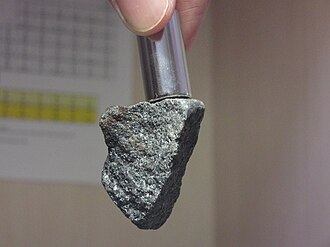
Magnetism was first noticed a long time ago when people found that special stones, called lodestones, could pull iron toward them. These stones are made from a mineral called magnetite. Long ago in Greece, a thinker named Thales talked about magnetism. In India, an old medical book told how to use magnetite to take out arrows from someone's body.
In China, very old books wrote about how lodestones could make iron come close. A Chinese scientist named Shen Kuo wrote about using a special compass with a lodestone spoon to help people find their way by pointing south. Later, people in Europe also began to write about compasses and magnets. One important book about magnets was written by Peter Peregrinus de Maricourt in 1269.
In 1600, a scientist named William Gilbert did many tests with a small model of the Earth and learned that Earth itself acts like a big magnet. This helped explain why compasses point north.
Later, scientists found that electricity and magnetism are connected. In 1819, Hans Christian Ørsted discovered that electric currents can create magnetic fields. This led to more discoveries about how electric currents and magnets work together. These ideas helped create the science of electromagnetism, which brings together electricity, magnetism, and light.
Images
Related articles



This article is a child-friendly adaptation of the Wikipedia article on Magnetism, available under CC BY-SA 4.0.
Images from Wikimedia Commons. Tap any image to view credits and license.