 Safekipedia
Makemake
Adapted from Wikipedia · Discoverer experience
Makemake is a dwarf planet located in a distant area of space called the Kuiper belt. The Kuiper belt is a disk of icy objects that lies beyond the orbit of the planet Neptune. Makemake is one of the largest objects in this area and is the fourth largest known object that orbits the Sun farther out than Neptune. It was discovered in 2005 by astronomers Michael E. ("Mike") Brown, Chad Trujillo, and David Rabinowitz at Palomar Observatory.
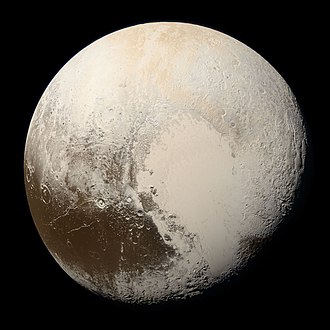
Makemake is similar to the dwarf planet Pluto. Its surface is very reflective and is covered mostly by frozen methane, giving it a reddish-brown color. Scientists think Makemake might have a hidden ocean of liquid water beneath its surface because it shows signs of geological activity. It also has one known moon, though it has not been named yet. Because of its tilt, Makemake experiences extreme seasons.
Because Makemake is very far from Earth, we have not been able to get close-up pictures of its surface. It looks like just a bright dot even through powerful telescopes. Scientists would like to send a space probe to Makemake to learn more about its geology and possible hidden ocean.
History
Discovery
Makemake was discovered in 2005 by a group of American astronomers including Michael E. ("Mike") Brown, Chad Trujillo, and David Rabinowitz. They were searching for big objects that are found beyond the orbit of Neptune. They took pictures of the night sky using a special camera on a telescope at the Palomar Observatory in California, United States. On March 31, 2005, they captured images of Makemake, and a few days later, Mike Brown noticed this very bright object in the pictures.
Before finding Makemake, the team had already discovered other large objects like Haumea and Eris, which were similar in size to Pluto. They planned to announce Makemake later, but had to bring the discovery forward when another team claimed to have found Haumea first. Because of this, they announced Makemake in July 2005 together with Eris, which helped start discussions about what should be called a planet. This led to Pluto being classified as a dwarf planet in 2006.
Name and symbol
This dwarf planet is named Makemake after a creator and god of fertility from the myths of the Rapa Nui people from Easter Island. It was given the number 136472 by the Minor Planet Center on September 7, 2005. Before its official name, it was known by the temporary name 2005 FY9 and had the nickname "Easterbunny" because it was found around Easter time.
Choosing the name was tricky because the astronomers wanted to keep its connection to Easter. They finally chose Makemake, which also followed the rule of naming objects in the Kuiper belt after creator gods. The official name was announced by the International Astronomical Union in July 2008.
A special symbol for Makemake was added to Unicode in January 2022. While scientists usually don’t use these symbols, some astrologers do. The symbol was designed to look like a traditional drawing of Makemake’s face, shaped like the letter “M”.
Orbit and classification
Makemake travels around the Sun at an average distance of 45.5 astronomical units, which is about 6.81 billion kilometers or 4.23 billion miles. It takes about 307 years to complete one full orbit. Its path around the Sun is not a perfect circle, and it comes as close as 38.2 astronomical units to the Sun and goes as far out as 52.8 astronomical units.
Right now, Makemake is near its farthest point from the Sun, called aphelion, and will reach this point in May 2033. It is part of a group of icy objects called the Kuiper belt, which lies beyond the planet Neptune. Makemake is the largest object in the classical Kuiper belt and is classified as a dwarf planet because it is big enough for its own gravity to shape it into a sphere, but not big enough to clear its orbit of other objects.
Size, shape, and mass
Makemake is almost round, with an average width of about 1,430 kilometers, which is about 60% the width of Pluto. It is the fourth-largest known dwarf planet in our solar system. Observations showed that Makemake is slightly flattened at the poles, with a width of around 1,420 kilometers there and 1,434 kilometers around the middle.
Makemake has a mass between about 2.5×10²¹ and 2.9×10²¹ kilograms. This makes it the fourth-most massive known dwarf planet. Compared to Earth's moon, Makemake has about 3.7% of its mass. Its surface gravity is much weaker than Earth's, about 3.6% of Earth's gravity.
Rotation
The time it takes for Makemake to spin once, called its rotation period, is not fully known. Scientists have found it might be about 11.4 hours or possibly 22.8 hours. They figure this out by watching how Makemake’s brightness changes over time.
Makemake’s brightness does not change much, making it tricky to measure its spin. Also, we do not know how much Makemake is tilted on its axis, but it might be quite tilted, which could cause big changes in temperature and surface conditions, much like on Pluto.
Geology
Makemake is a very cold object far from the Sun, with surface temperatures between 30 and 40 K — cold enough for certain substances to stay frozen as ice. Studies show that its surface is mostly covered in frozen methane, mixed with smaller amounts of other frozen compounds.
In visible light, Makemake looks very bright, reflecting about 82% of the sunlight that hits it — even brighter than Pluto. Scientists think the methane on its surface is fresh, and its appearance may change with seasons over many years. The surface seems fairly uniform, without big differences in brightness or color, unlike Pluto.
Atmosphere or outgassing
Analysis of data collected in 2025 showed that Makemake has gaseous methane, which glows in near-infrared light because of sunlight. Makemake is the second object beyond Neptune known to have gas, after Pluto. Scientists are unsure if this methane is held by Makemake's gravity as an atmosphere or if it is temporarily escaping from its surface.
If the methane is held as an atmosphere, its pressure would be extremely low—about 100 billion times less than Earth's atmosphere and 1 million times less than Pluto's. This thin atmosphere was not detected in earlier observations, suggesting Makemake may not have a thick atmosphere. Alternatively, the methane might be escaping from the surface, possibly forming a fuzzy cloud around Makemake. The amount escaping could be similar to water bursts from another small world, Enceladus.
Satellites and potential rings
S/2015 (136472) 1
Main article: S/2015 (136472) 1
Makemake has one known moon, which is unnamed and called S/2015 (136472) 1. It was found in pictures taken by the Hubble Space Telescope on April 27, 2015, and announced in 2016. This moon is much smaller and dimmer than Makemake, about 1,300 times fainter. It orbits Makemake in a circle, taking 18 days to complete one trip around the dwarf planet.
Possibility of other satellites
The Hubble Space Telescope has not found any other moons around Makemake that are brighter than a certain level. Bigger moons might be hidden if they are very close to Makemake.
Possibility of rings
Makemake does not have any known rings. Rings around faraway objects are hard to see directly. They are usually looked for when stars pass behind the object. No rings were seen when this happened for Makemake in 2011. If rings exist, they might be very small and hard to spot, or hidden in the same way as its moon. Some think small rings could exist but they would need special conditions to stay there.
| Name | Diameter (km) | Semi-major axis (km) | Discovery date |
|---|---|---|---|
| Makemake | 1430±14 | March 31, 2005 | |
| S/2015 (136472) 1 | ≈ 175 | 22250±780 | April 27, 2015 |
Origin
Makemake, like other dwarf planets in the Kuiper belt, is thought to have formed early in the Solar System's history, about 4.5 billion years ago. These dwarf planets started as small pieces called planetesimals, growing bigger by pulling in nearby material over a few million years.
One theory suggests that Makemake originally formed closer to the Sun and was moved to its current location due to the movement of the giant planets. This change happened a few tens of millions of years after the Solar System formed.
Observation and exploration
Makemake is very bright because it is large and its surface reflects a lot of sunlight. It can be seen with a strong telescope when it is closest to Earth. Even though it is bright, it was found later than many dimmer objects because its path around the Sun is tilted and hard to see.
Scientists want to send a spacecraft to Makemake to learn more about it. Some ideas suggest a spacecraft could reach Makemake in about 16 years if it uses the gravity of Jupiter to speed up. The New Horizons spacecraft looked at Makemake from far away in 2007 and 2017, giving us useful information about its surface.
Images
Related articles


This article is a child-friendly adaptation of the Wikipedia article on Makemake, available under CC BY-SA 4.0.
Images from Wikimedia Commons. Tap any image to view credits and license.